

Financial institutions are reassessing data platforms as real-time information, APIs, cloud delivery, and AI increasingly shape how financial data is consumed. A 2026 Coalition Greenwich study of 73 global buy-side and sell-side firms found that 56% use real-time data throughout the day, with data quality, performance, stability, and latency remaining key priorities. The study also found that 58% are engaged with or considering Model Context Protocol (MCP) for accessing trusted data in AI-enabled workflows.
The economics of financial data are also significant. A 2026 survey of 101 financial institutions found that 74% spend more than €200,000 annually on financial and market data, while 49% spend more than €500,000. The same research found that 87% consider accuracy and reliability the top purchasing criterion, while 64% plan to rationalize or consolidate vendors over the next three years.
Data architecture is evolving alongside these requirements. The 2026 Infosys Bank Tech Index found that the proportion of banks describing their data architecture as advanced and integrated increased from 57% in 2024 to 66% in 2025.
Against this backdrop, financial data platform supplier benchmarking can help institutions compare providers across data coverage, quality, delivery, APIs, analytics, integration, and overall business relevance.
Financial Data Is Becoming a Strategic Infrastructure Layer
Financial data platforms increasingly support investment analysis, risk management, forecasting, reporting, trading, customer intelligence, and AI applications. As data moves across more workflows, platform selection becomes less about the volume of information available and more about accuracy, timeliness, accessibility, interoperability, and analytical usability. For institutions managing multiple data sources and vendors, benchmarking can provide a structured way to understand where suppliers offer differentiated value and where duplication, quality gaps, or integration challenges may exist.
What Should a Financial Data Platform Benchmark Reveal?
A useful benchmark should examine the characteristics that determine whether data can be reliably consumed and applied across financial workflows:
- Coverage & Quality: Compare asset-class, geographic, entity, historical, and alternative-data coverage alongside accuracy, completeness, consistency, and update frequency.
- Delivery & APIs: Evaluate API capabilities, latency, documentation, connectivity, delivery formats, integration flexibility, and suitability for automated data workflows.
- Analytics Capability: Assess screening, visualization, analytics, enrichment, modelling support, AI readiness, and tools that convert raw data into usable insights.
These dimensions help institutions distinguish platforms based on usable data value rather than dataset breadth alone.
How Nexdigm Translates Benchmark Findings Into Supplier Insights
Nexdigm can use financial data platform supplier benchmarking to develop a clearer view of each provider’s relative strengths, capability gaps, areas of differentiation, and practical fit. By connecting data coverage, quality, delivery, API capabilities, and analytics functionality with the institution’s specific requirements, the assessment can highlight which suppliers warrant deeper evaluation and where existing data arrangements may offer opportunities for consolidation, improvement, or greater analytical value. This enables institutions to move from a broad supplier comparison toward a more focused understanding of which platforms are most relevant to their data strategy.
Nexdigm’s Financial Data Platform Supplier Benchmarking Insights
Nexdigm’s benchmarking can provide institutions with a structured view of where financial data platforms outperform, where gaps exist, and which differences have the greatest business relevance. The insights can help decision-makers:
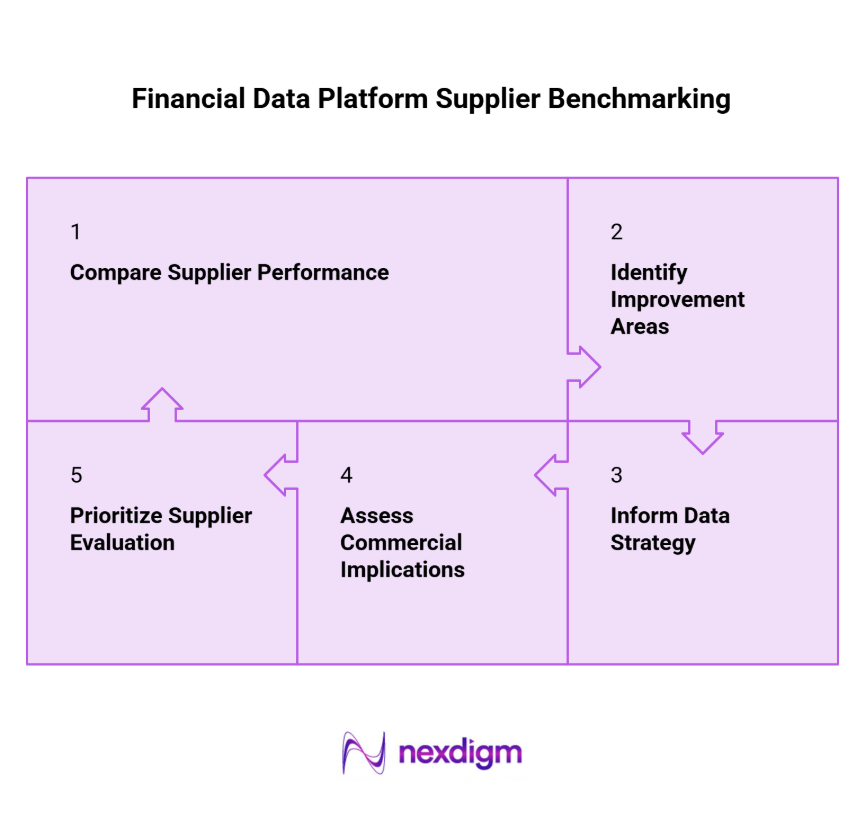
- Compare Supplier Performance: Understand relative strengths across data coverage, quality, delivery, API capabilities, and analytics functionality.
- Identify Improvement Areas: Highlight data gaps, quality concerns, integration challenges, and areas where existing supplier arrangements may limit value.
- Inform Data Strategy: Use benchmark findings to support supplier selection, consolidation, technology investments, and broader data-platform planning.
- Assess Commercial Implications: Examine supplier costs, licensing structures, overlapping data purchases, and potential opportunities to improve the economics of the data ecosystem.
- Prioritize Supplier Evaluation: Identify providers that warrant deeper technical validation, pilot testing, commercial discussions, or consideration for strategic partnerships.
Overall, these insights help institutions move from supplier comparison to actionable data-strategy decisions, with a clearer understanding of which providers can deliver the strongest fit and value.
Nexdigm’s Case
Nexdigm’s benchmarking considered the wider financial-data environment, where 76% of institutions work with more than five data vendors, while 64% plan to rationalize or consolidate vendors over the next three years. Data quality remains a major selection factor, with 87% identifying accuracy and reliability as their top purchasing criterion. The analysis helped the institution evaluate supplier overlap, data-quality priorities, API capabilities, and opportunities for platform consolidation.
To take the next step, simply visit our Request a Consultation page and share your requirements with us.
Harsh Mittal
+91-8422857704