

Financial access has improved significantly, but large gaps remain across income groups, genders, rural communities, and digitally excluded populations. The World Bank’s Global Findex 2025 found that 79% of adults globally owned a financial account in 2024, up from 74% in 2021. Yet 1.3 billion adults still lacked an account, including around 900 million who already owned a mobile phone.
For banks, fintech companies, investors, and development-focused institutions, these gaps can also indicate untapped market potential. A Financial inclusion market opportunity assessment helps identify where demand remains underserved and which models could provide commercially sustainable access.
Nexdigm helps organizations assess these opportunities using demographic data, geographic intelligence, customer behavior, digital connectivity, competitive activity, and market economics. Its analysis helps decision-makers distinguish between markets that need greater access and markets where a scalable financial model can address that need.
Nexdigm in Assessing the Access Gaps
Nexdigm starts with the geography of financial access. Its market assessment combines branch and ATM coverage, agent networks, account ownership, population density, income, and mobile connectivity. Nexdigm uses these indicators to identify:
- Markets with limited banking infrastructure
- Underserved rural and urban communities
- Customer groups with low account ownership
- Locations where digital access is improving faster than financial adoption
This allows Nexdigm to move from a broad inclusion question to specific markets where additional financial services may be needed.
Identifying the Customers Behind these Gaps
Nexdigm examines who remains underserved and why. Demographics, income, employment, location, digital familiarity, and existing financial behavior can influence access and adoption.
For example, the World Bank found that 73% of women in low- and middle-income economies had a financial account in 2024, while significant gender gaps remain across many markets.
Nexdigm segments these populations to understand their financial needs and identify which products could address them.
Its analysis can reveal customers with demand for basic accounts, savings, credit, payments and investment products. This helps financial institutions develop inclusion strategies around identifiable customer opportunities.
How Nexdigm Measures Real Usage
Nexdigm does not treat account opening as the end goal. It examines whether customers actually use financial services after gaining access.
The World Bank reported that 42% of adults in low- and middle-income economies made digital merchant payments in 2024, up from 35% in 2021.
Nexdigm tracks transaction frequency, digital engagement, savings activity and credit usage. These indicators help Nexdigm identify whether a market has basic access, active usage, or potential for deeper financial engagement.
Nexdigm’s Financial Inclusion Framework
Nexdigm structures the Financial inclusion market opportunity assessment around four areas. This framework provides a data-driven approach to identify underserved populations, evaluate access barriers, assess demand, and determine the most effective and scalable delivery models for financial inclusion through:
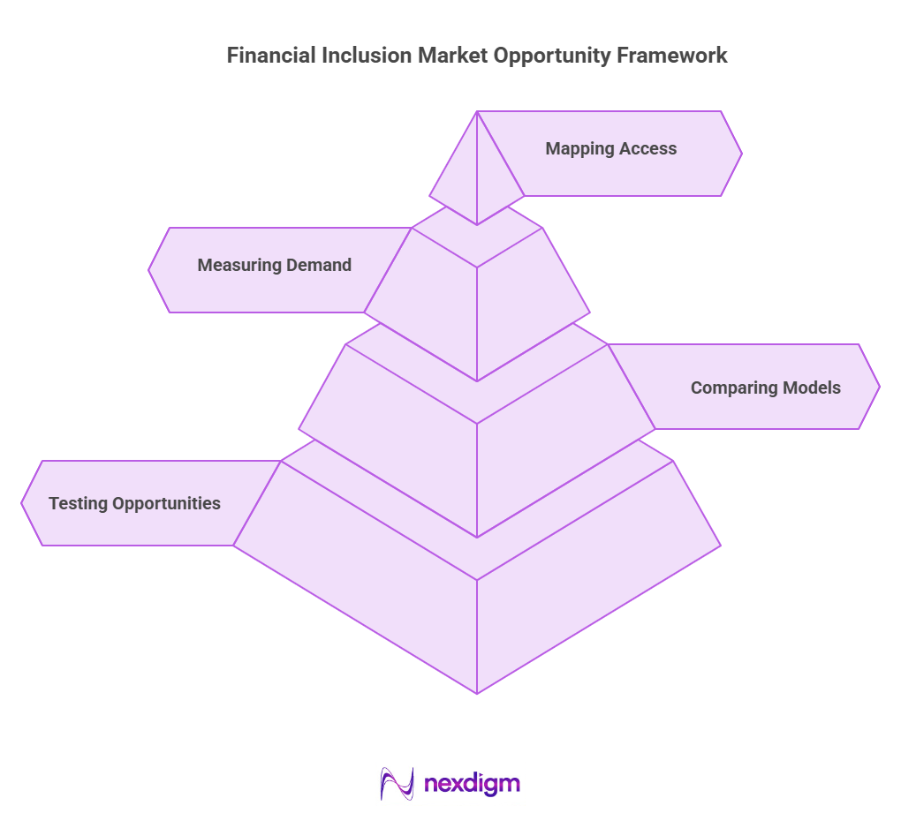
- Mapping Access: Analysis of geography, financial infrastructure, account ownership, demographics, and service coverage to locate underserved markets.
- Measuring Demand: Study of income, transactions, financial behavior, and product needs to estimate demand among underserved customers.
- Comparing Models: Evaluation of digital banking, agents, mobile money, branches, and partnerships against customer needs and market conditions.
- Testing Opportunities: Assessment of revenue potential, operating costs, customer value, competition, and scalability to determine commercial viability.
Together, these four areas provide a comprehensive view of financial inclusion opportunities by identifying underserved segments, understanding their needs, evaluating viable service models, and assessing commercial sustainability.
Nexdigm in Turning Gaps Into Decisions
Nexdigm converts the assessment findings into practical actions for financial institutions and investors. This is done through:
- Prioritizing Markets: Identifying locations with strong unmet demand and attractive market potential.
- Selecting Delivery Models: Recommending models based on infrastructure, customer behavior, and commercial requirements.
- Developing Products: Identifying products that match specific customer needs.
- Allocating Capital: Helping prioritize investments based on market size, demand, and expected economics.
- Measuring Adoption: Tracking movement from access to active usage and broader product adoption.
This creates a direct connection between market research and investment decisions.
Identifying the Untapped Market
The size of an underserved population does not tell investors everything they need to know. Nexdigm connects access gaps with purchasing capacity, digital readiness, product demand, competitive intensity, and potential customer value.
This enables investors to compare markets based on both inclusion needs and commercial opportunity.
For banks and fintech companies, the same analysis can support decisions around market entry, product development, agent expansion, digital investment, and partnership strategies.
Nexdigm’s Case
An anonymized financial institution used Nexdigm’s Financial inclusion market opportunity assessment to identify underserved segments and evaluate delivery models. Over 12 months, new customer acquisition increased 29%, digital account activity rose 35%, financial service usage improved 24%, and distribution costs declined 17%, supporting more targeted market expansion and investment.
To take the next step, simply visit our Request a Consultation page and share your requirements with us.
Harsh Mittal
+91-8422857704