

Financial services are increasingly moving into platforms that combine banking, payments, lending, insurance, commerce, and business services. The opportunity is growing quickly. McKinsey estimates that the global fintech industry generated about $650 billion in revenue in 2025, growing 21% year over year. Payments alone represented around $250 billion of fintech revenue.
This shift is changing how banks, fintech companies, technology providers, and investors evaluate competition. A platform with a large customer base can add financial products, bring in specialist partners, and create multiple revenue streams within one ecosystem.
A Financial platform ecosystem assessment helps decision-makers understand whether a platform has the customer reach, partner network, product depth, and economics needed to scale. Nexdigm supports this assessment through market intelligence, customer analysis, competitive research, and ecosystem mapping.
Nexdigm Maps the Customer Base
Nexdigm begins by examining the customers behind a platform. Customer scale matters, but engagement and relationship depth can be equally important.
Nexdigm analyzes:
- Customer size and growth
- Engagement levels
- Product usage
- Retention
- Digital interactions
- Cross-selling potential
This helps Nexdigm identify platforms that have regular customer interactions and could introduce additional financial services.
Nexdigm Looks at the Partner Network
A financial ecosystem depends on the capabilities it can bring together. Nexdigm maps banks, fintechs, payment providers, technology companies, merchants, and other partners to understand how the ecosystem operates.
The analysis covers:
- Partner Capability: Nexdigm assesses what each partner contributes to the ecosystem.
- Network Reach: Nexdigm evaluates how partnerships can expand customer and market access.
- Platform Dependence: Nexdigm identifies critical external dependencies that could affect scalability.
- Expansion Potential: Nexdigm looks for gaps where new partners could strengthen the ecosystem.
This helps organizations understand whether a platform has the partner base needed for continued growth.
Nexdigm Checks the Product Mix
A platform becomes more valuable when customers can access several relevant services within the same environment. Nexdigm evaluates the existing product portfolio and identifies opportunities for expansion.
The assessment can include:
- Payments
- Deposits
- Lending
- Insurance
- Wealth management
- Business finance
Nexdigm connects product availability with customer needs to identify gaps and potential cross-selling opportunities.
Nexdigm Examines How Platforms Make Money
Customer and product growth need to translate into sustainable economics. Nexdigm evaluates how revenue is generated across the ecosystem and which participants capture the value.
Potential revenue models include:
- Transaction fees
- Subscriptions
- Product commissions
- Interest income
- Revenue sharing
- Platform fees
McKinsey estimates that embedded finance could generate more than €100 billion in annual revenue in Europe by the end of the decade.
Nexdigm uses market data and business-model analysis to assess which monetization approaches have stronger potential.
Nexdigm Finds the Next Growth Path
Many financial ecosystems expand gradually. Nexdigm studies existing customer relationships and product usage to identify realistic paths for adding new services.
Common paths can include:
Payments → Deposits → Lending
Banking → Insurance → Wealth
Business Software → Payments → Credit
Nexdigm evaluates these opportunities against customer demand, partner capabilities, competition, regulation, and market size. This helps organizations distinguish realistic expansion opportunities from product additions that may have limited commercial value.
Nexdigm Framework for Financial Platform Ecosystem Assessment
Nexdigm evaluates financial ecosystems through four areas:
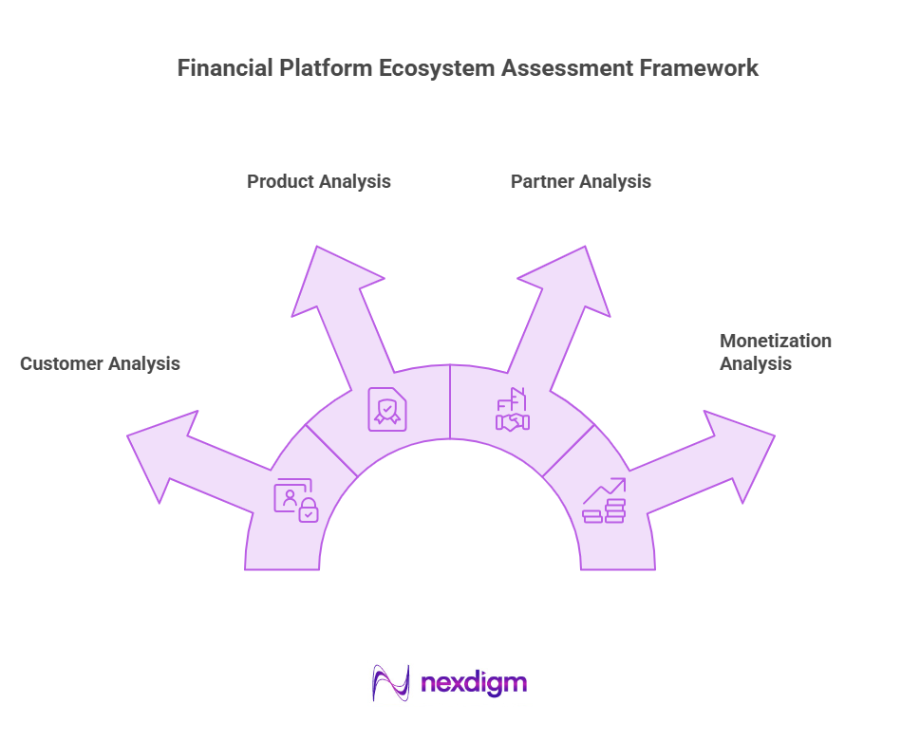
- Customer Analysis
Nexdigm examines customer reach, engagement, retention, product usage, and relationship ownership to identify platforms with stronger customer positions. - Partner Analysis
Nexdigm maps banks, fintechs, technology providers, merchants, and other partners to assess ecosystem depth, capability, and expansion potential. - Product Analysis
Nexdigm evaluates product coverage, customer needs, cross-selling opportunities, and portfolio gaps to identify areas for ecosystem growth. - Monetization Analysis
Nexdigm studies transaction fees, subscriptions, commissions, lending income, and partner economics to assess revenue potential and sustainability.
These analyses help decision-makers understand who the platform serves, who supports it, what it sells, and how it generates value.
How Nexdigm Turns Ecosystem Analysis Into Action
Nexdigm uses the assessment to support practical business and investment decisions.
- Find Growth Opportunities: Nexdigm identifies customer segments and financial products with expansion potential.
- Evaluate Partnerships: Nexdigm helps determine which partners could improve platform capabilities and reach.
- Improve Monetization: Nexdigm assesses revenue models and identifies opportunities to strengthen ecosystem economics.
- Prioritize Investment: Nexdigm ranks opportunities according to market demand, scalability, competitive strength, and commercial potential.
This helps organizations focus resources on ecosystem opportunities with stronger business cases.
Nexdigm’s Case
A financial platform used Nexdigm’s Financial platform ecosystem assessment to evaluate customers, partners, product gaps, and monetization. Over 12 months, the platform increased partner-driven revenue by 28%, improved cross-product adoption by 34%, expanded active customer engagement by 26%, and identified new ecosystem opportunities supporting targeted investment decisions.
To take the next step, simply visit our Request a Consultation page and share your requirements with us.
Harsh Mittal
+91-8422857704