

Financial product demand is changing with customer income, age, digital access, economic conditions, and everyday financial behavior. The World Bank’s Global Findex 2025 found that 79% of adults globally owned a financial account in 2024, while 86% owned a mobile phone. Digital access is creating new opportunities for savings, payments, credit, and investment products.
At the same time, economic conditions can quickly change customer priorities. The IMF projected 3.0% global economic growth for 2026, while noting that inflation and geopolitical risks remain important factors for consumers and businesses.
For banks, fintech companies, and investors, forecasting demand requires more than historical sales data. Financial product demand forecasting helps organizations estimate where demand could increase, which customer groups are likely to respond, and how economic changes could affect future product requirements.
Nexdigm helps financial institutions bring these factors together through demographic analysis, income trends, customer behavior, market intelligence, and macroeconomic assessment.
Nexdigm Starts With Market Signals
Nexdigm begins by examining the external factors that can influence financial product demand. Population changes, income levels, employment, inflation, interest rates, and digital adoption can all influence what customers need.
Nexdigm evaluates:
- Population and demographic trends
- Income and employment patterns
- Economic growth
- Inflation and interest rates
- Digital financial access
- Local market conditions
This gives financial institutions an initial view of where demand may strengthen or weaken.
Nexdigm Connects Demographics With Product Demand
Different customer groups often have different financial priorities. Nexdigm segments markets according to age, income, location, household characteristics, and financial behavior.
For example:
- Younger Customers: Nexdigm may identify stronger demand for digital payments, starter credit, and investment products.
- Working Households: Nexdigm evaluates potential demand for savings, mortgages, insurance, and personal credit.
- Affluent Customers: Nexdigm studies opportunities across investments, wealth management, and premium banking.
- Small Businesses: Nexdigm assesses demand for working-capital finance, payment solutions, and business accounts.
This segmentation helps banks match products with the financial needs of specific customer groups.
Nexdigm Measures What Customers Actually Do
Demographic information alone cannot explain product demand. Nexdigm combines customer profiles with actual financial behavior to understand what customers are already using and where their behavior is changing.
Nexdigm analyzes:
- Account activity
- Deposit balances
- Loan applications
- Payment frequency
- Product switching
- Digital engagement
The World Bank reported that 42% of adults in low- and middle-income economies made digital merchant payments in 2024, up from 35% in 2021.
Nexdigm uses such market signals alongside behavioral data to identify products and channels with stronger adoption potential.
Nexdigm Builds Demand Scenarios
Demand rarely follows a single path. Nexdigm can develop different scenarios based on changes in economic conditions, customer income, interest rates, or market behavior.
For example:
- Base Scenario: Demand follows current market and customer trends.
- Growth Scenario: Improving income and employment increase demand for credit, investments, and higher-value products.
- Pressure Scenario: Higher inflation or weaker economic growth shifts demand toward basic banking and liquidity-focused products.
These scenarios help financial institutions prepare for different market conditions instead of relying on one forecast.
Nexdigm Identifies Product-Level Opportunities
Nexdigm applies demand forecasting across individual financial product categories.
- Savings and Deposits
Nexdigm analyzes income, saving patterns, account activity, and interest-rate conditions to identify markets with potential deposit growth. - Lending
Nexdigm evaluates income, employment, credit behavior, household conditions, and economic trends to estimate future borrowing demand. - Payments
Nexdigm tracks transaction activity, digital adoption, merchant activity, and customer preferences to identify payment growth opportunities. - Investments
Nexdigm studies income levels, wealth segments, risk preferences, and investment adoption to identify potential demand for investment products.
This product-level view helps institutions focus resources where customer demand is more likely to develop.
Nexdigm Framework for Financial Product Demand Forecasting
Nexdigm brings the main demand drivers together through four areas:
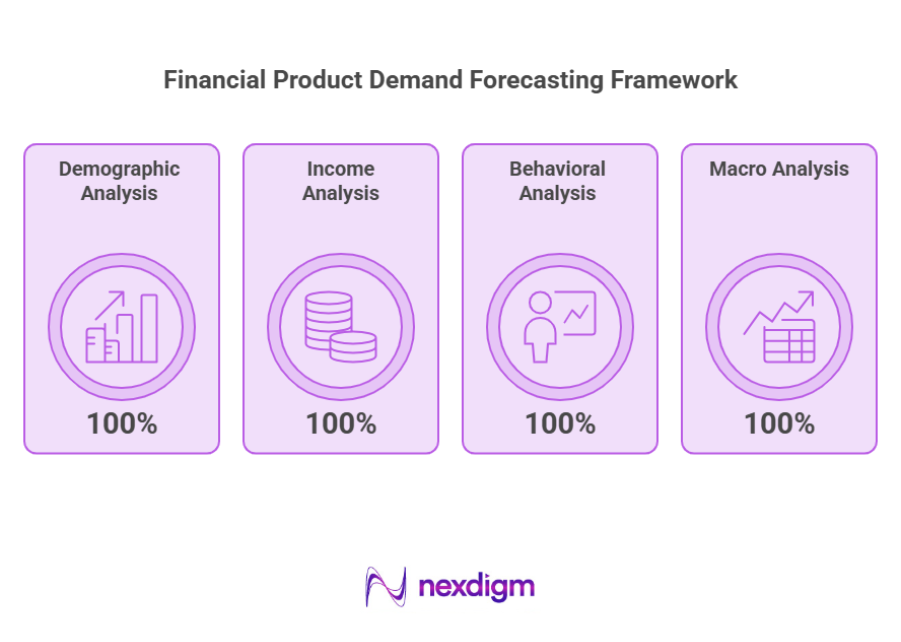
- Demographic Analysis
Nexdigm studies population, age, household structure, location, and customer segments to identify groups with changing financial needs. - Income Analysis
Nexdigm evaluates income, employment, purchasing power, and household finances to understand customers’ ability to save, borrow, and invest. - Behavioral Analysis
Nexdigm examines transactions, product usage, digital engagement, and switching patterns to identify actual changes in customer demand. - Macro Analysis
Nexdigm incorporates inflation, interest rates, economic growth, and market conditions to assess how external factors could influence product demand.
Together, these analyses help institutions connect who customers are, what they can afford, how they behave, and what the economy may do next.
Nexdigm Turns Forecasts Into Decisions
Nexdigm uses demand insights to support practical business decisions.
- Prioritize Products: Identify financial products with stronger future demand.
- Target Customers: Match products with customer segments showing relevant financial needs.
- Plan Capacity: Help institutions anticipate potential changes in lending, deposits, payments, or investment activity.
- Manage Risk: Test how changes in income or economic conditions could affect demand.
- Guide Investment: Direct technology, marketing, and distribution spending toward higher-potential opportunities.
This makes forecasting more useful for product and investment planning.
Nexdigm’s Case
An anonymized financial institution used Nexdigm’s Financial product demand forecasting framework to combine demographic, income, behavioral, and economic data. Over 12 months, forecast accuracy improved by 31%, product targeting efficiency increased by 26%, deposit planning improved by 22%, and high-potential customer segments increased by 19%.
To take the next step, simply visit our Request a Consultation page and share your requirements with us.
Harsh Mittal
+91-8422857704