

A financial product can enter a growing market and still fail commercially. Demand at the market level does not establish demand for a particular product, while customer interest alone says little about whether the product can generate acceptable returns after acquisition, servicing, regulatory, and credit costs.
Before launch, financial institutions need to test four questions together: Do customers need it? Will they pay for it? Can it operate within the regulatory perimeter? And can it reach customers economically?
Start With the Customer Problem
Products gain traction when they address a specific financial constraint rather than simply reproduce features already available in the market.
The underlying friction can take several forms:
- Irregular cash flows that make fixed repayment schedules unsuitable for micro-businesses or gig workers.
- Lengthy documentation that causes customers to abandon applications.
- Bundled financial products that obscure pricing or benefits and weaken customer trust.
- Limited access to products that require specialist advice or underwriting.
The assessment should therefore identify the customer need-state, the alternatives currently being used, and the circumstances under which customers would switch.
A large addressable population is useful only if the product solves a problem sufficiently important to change existing behaviour.
Price Against the Alternatives
Pricing cannot be determined in isolation from competitor alternatives or the capital required to support the product. For credit, effective returns must absorb expected losses, acquisition costs, servicing, and regulatory capital buffers.
The RBI’s increase of consumer credit risk weights to 125% demonstrates how capital rules can alter product viability overnight, even if underlying demand holds steady. Meanwhile, borrowers evaluate total borrowing costs rather than headline interest rates, meaning origination fees, documentation charges, platform levies, and prepayment terms directly shape competitive positioning.
Non-lending products must balance commercial pricing against strict regulatory caps and embedded distribution costs. Investment products must operate within statutory expense boundaries, such as SEBI’s total expense ratio limits on mutual funds, while insurers must fund customer acquisition and capital adequacy directly from the premium pool.
In every segment, true competitive advantage depends on pricing for complete lifecycle economics rather than competing solely on headline rates.
Regulation Can Reshape the Product Before Launch
Compliance must be built into product design from the outset rather than treated as an afterthought. For digital lending, RBI mandates govern borrower disclosures, LSP partnerships, fund flows, and UI design (including dark pattern bans).
Across other financial products, rules around capital buffers, suitability, distribution, data privacy, and fee caps apply. Products that appear commercially viable in isolation often become uneconomic once the full cost of regulatory compliance is factored in.
Distribution Determines Whether Demand Becomes Revenue
A product does not generate revenue simply because customers express interest in it. The acquisition channel must match the complexity, urgency, and trust requirements of the product.
Mass-market products can often benefit from digital onboarding and embedded distribution through existing platforms. Commercial lending, wealth management, and specialist protection products may require relationship managers, brokers, or advisory networks.
Channel assessment should therefore examine:
- Conversion and application drop-off
- Customer acquisition cost
- Partner commissions or fees
- Onboarding and servicing costs
- Customer retention and cross-sell
- Required technology integration
The objective is to identify the channel through which the product can acquire customers at a cost compatible with its lifetime economics.
Product-Market Fit Has to Be Tested Commercially
Customer willingness to buy is only one part of product validation. The product must generate enough contribution to cover acquisition, technology, servicing, regulatory, and risk costs while producing an acceptable risk-adjusted return.
This is particularly important when entering a new market because early volumes may be too small to absorb fixed infrastructure costs. A controlled pilot can reveal whether projected conversion, pricing, delinquency, retention, and servicing assumptions hold before significant capital is committed.
Nexdigm’s Financial Product Market Entry Framework
Nexdigm evaluates financial products through five connected stages:
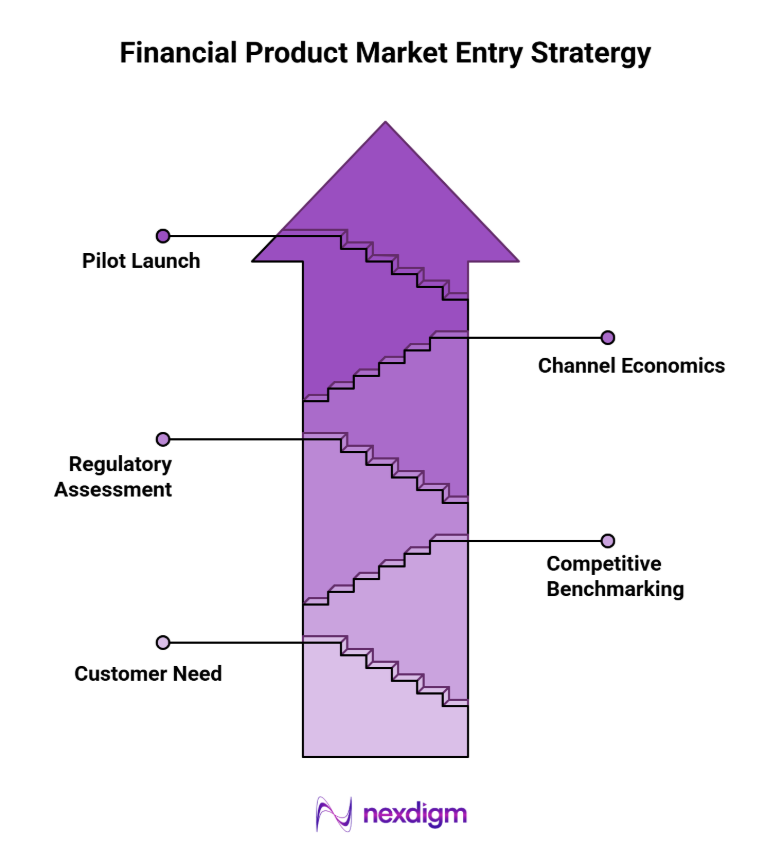
- Customer Need and Friction: Identify target cohorts, unmet needs, current alternatives, willingness to pay, and adoption barriers.
- Competitive and Pricing Benchmarking: Compare direct and indirect alternatives, effective pricing, fees, features, service levels, and price sensitivity.
- Regulatory and Capital Assessment: Determine applicable regulatory requirements, capital consumption, disclosures, risk weights, and operational constraints.
- Channel Economics: Model acquisition cost, conversion, partner economics, onboarding, servicing, and LTV: CAC across potential channels.
- Pilot and Launch Design: Test pricing, adoption, underwriting, retention, and operational scalability before wider deployment.
The resulting financial product market entry strategy identifies the product configuration, target segment, price point, channel, and launch sequence most likely to achieve commercial viability.
How Nexdigm Tests a Financial Product Before Market Launch
A non-banking financial institution evaluated a digital working-capital credit line for light-manufacturing businesses. Nexdigm tested three product configurations across three customer segments and benchmarked them against 12 incumbent offerings. Customers accepted 15.5%–17.5% pricing when four-hour digital drawdown was available. A redesigned cash-flow-backed product achieved 28% application-to-disbursement conversion, reduced CAC by 34%, and supported a projected 2.9% RoA, enabling nationwide expansion.
To take the next step, simply visit our Request a Consultation page and share your requirements with us.
Harsh Mittal
+91-8422857704