

A financial product pricing comparison study enables banks, insurers, and fintech platforms to evaluate how rates, fees, premiums, rewards, commissions, and service benefits differ across competing offerings. Through structured Pricing Analysis, institutions can assess market positioning, customer value, profitability, digital pricing models, and segment-level competitiveness.
The study identifies pricing gaps, excessive premiums, underpriced products, and inconsistent value propositions across traditional and digital channels. These insights support evidence-based repricing and sustainable portfolio growth across an increasingly convergent financial services marketplace with evolving customer expectations globally.
Recent data shows that institutions using comparative Pricing Analysis can improve pricing accuracy by 20–30%, reduce revenue leakage, accelerate product repricing and increase customer conversion by 10–18% through better market benchmarking, value alignment, and competitive product positioning strategies overall.
Financial Product Pricing Analysis Across Banks, Insurers, and Fintech Platforms
The comparative Pricing Analysis evaluates financial products across banks, insurers, and fintech platforms, revealing market gaps, customer value opportunities, and profitable positioning strategies across markets. Core dimensions of the same are:
- Total Customer Cost Analysis: Benchmarks headline prices alongside hidden charges, discounts, waivers, incentives, and benefits, providing a complete view of the customer’s actual financial commitment.
- Commercial Action Planning: Translates findings into repricing priorities, product redesign actions, and governance measures, accelerating implementation while improving pricing consistency, profitability, and customer value delivery.
- Price-to-Benefit Assessment: Measures the relationship between price and product benefits, helping providers identify whether customers receive sufficient value and where propositions require strengthening.
- Proposition Value Comparison: Compares product value through coverage, convenience, flexibility, rewards, service levels, and digital features, helping institutions strengthen differentiation beyond headline price competition.
Nexdigm’s Pricing Analysis Expertise for Market-Aligned Financial Offerings
Nexdigm delivers specialized Pricing Analysis services to help banks, insurers, and fintech platforms strengthen market positioning through data-driven pricing decisions. The team combines financial product pricing comparison study, competitor benchmarking, pricing gap analysis, customer value assessment, profitability modelling, and pricing optimization to benchmark products, identify competitive opportunities, refine pricing strategies, and improve portfolio profitability while maintaining market relevance and long-term commercial sustainability.
Nexdigm’s Comparative Pricing Analysis Architecture for Financial Services
Nexdigm’s architecture structures comparative Pricing Analysis into sequential steps that benchmark financial offerings, expose market misalignment, and convert insights into commercially practical pricing actions. Key strategic steps of the architecture are:
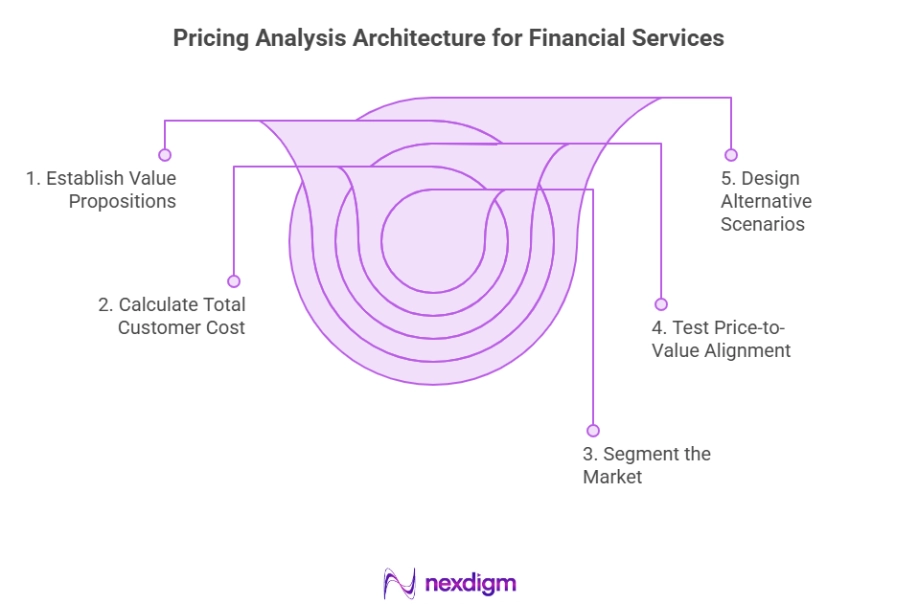
- Establish Value Propositions: Document each product’s core benefits, service features, eligibility conditions, convenience factors, and customer outcomes to create a clear foundation for value-based comparison.
- Calculate Total Customer Cost: Combine headline prices with recurring charges, transaction fees, penalties, waivers, discounts, incentives, and rewards to determine the customer’s complete financial commitment.
- Segment the Market: Compare pricing across retail, affluent, small-business, corporate, digital-first, and risk-based segments, revealing differences in affordability, willingness to pay, and competitive intensity.
- Test Price-to-Value Alignment: Measure whether total customer cost is proportionate to delivered benefits, identifying propositions that appear overpriced, underpriced, insufficiently differentiated, or competitively balanced.
- Design Alternative Scenarios: Develop pricing scenarios involving rate changes, premium adjustments, fee restructuring, rewards, or product bundles, evaluating likely effects on demand and profitability.
Nexdigm’s Case
In a recent financial services engagement, Nexdigm conducted comparative Pricing Analysis across banking, insurance, and fintech products. The study enabled targeted pricing actions that reduced customer acquisition costs by 14%, improved offer acceptance by 19%, increased revenue per product by 11%, and strengthened pricing governance compliance by 26%.
To take the next step, simply visit our Request a Consultation page and share your requirements with us.
Harsh Mittal
+91-8422857704