

Financial institutions are facing a security environment in which identity compromise, fraud, cyberattacks, and transaction abuse increasingly overlap. The RBI’s 2026 Annual Report recorded 10,114 bank fraud cases involving ₹48,021 crore in FY2025-26; while the number of cases fell sharply, the amount involved increased from ₹32,803 crore in FY2024-25. Advances accounted for nearly 85% of the total amount involved.
Cyber risk is also becoming more interconnected. The European Banking Authority reported that banks experiencing 11 or more cyberattacks in the first half of 2026 rose to 11%, compared with 7% in the second half of 2025. DDoS, identity theft, data exfiltration or manipulation, and supply-chain attacks were among the reported threats.
The technology environment is changing at the same time. In such a scenario, financial security technology vendor intelligence can help institutions map providers across identity, fraud, cybersecurity, and transaction protection rather than evaluating these capabilities in isolation.
Financial Security Is Becoming an Integrated Technology Challenge
Identity verification, fraud detection, cybersecurity, and transaction monitoring increasingly depend on shared data, signals, and response mechanisms. A compromised identity can enable account takeover; a cyber intrusion can facilitate fraudulent transactions; and weak API controls can expose payment workflows. This convergence makes it increasingly important to understand how different security technologies work together, where supplier capabilities overlap, and which providers can address multiple risk areas without creating unnecessary technology complexity.
The Growing Importance of Financial Security Vendor Intelligence
A useful market view should go beyond identifying prominent vendors. It should show how providers differ across three connected areas:
- Identity & Access Protection: Assess identity verification, authentication, biometrics, device intelligence, access controls, and account-takeover prevention capabilities.
- Fraud & Transaction Protection: Compare transaction monitoring, behavioral analytics, risk scoring, payment controls, anomaly detection, and fraud-response capabilities.
- Cybersecurity & Resilience: Examine threat detection, endpoint and cloud security, incident response, data protection, vulnerability management, and third-party risk capabilities.
Together, these dimensions provide a broader view of how suppliers contribute to financial security across the customer, transaction, and technology lifecycle.
Nexdigm Connects Vendor Intelligence With Security Priorities
Nexdigms’ experts translate financial security technology vendor intelligence into a practical view of which supplier capabilities matter most to an institution’s specific security environment. The view involves assessing of the following areas:
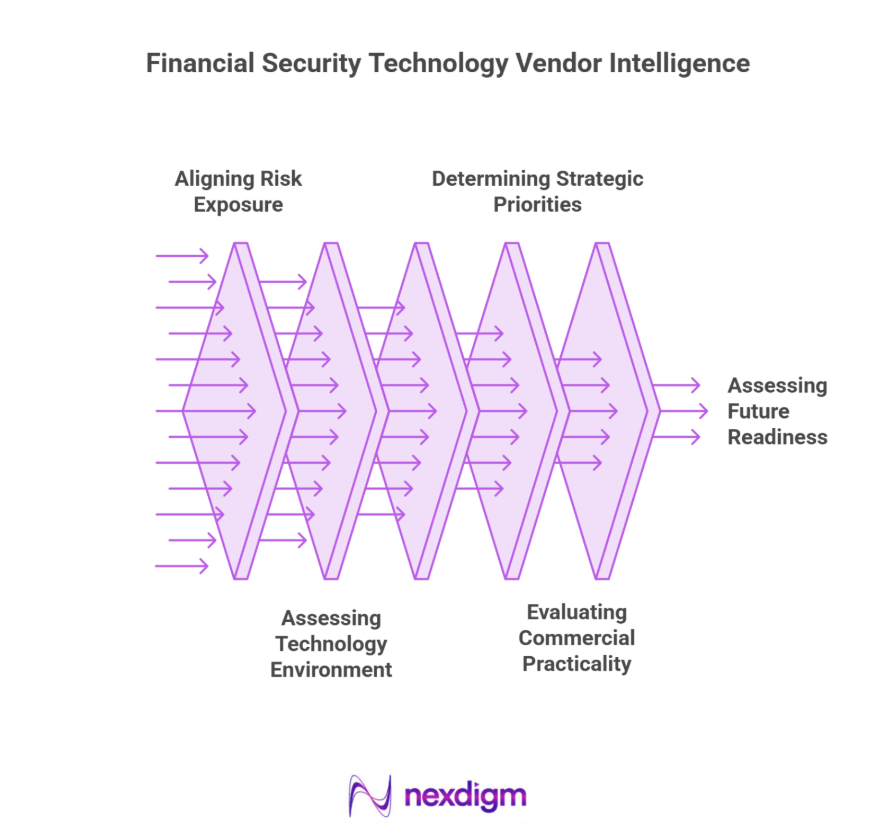
- Aligning Risk Exposure: Mapping supplier capabilities against identity threats, fraud risks, cyber vulnerabilities, transaction exposure, and other institution-specific security priorities.
- Assessing Technology Environment: Evaluating how providers fit existing systems, data architecture, security tools, customer journeys, transaction channels, and integration requirements.
- Determining Strategic Priorities: Identifying suppliers that can support security modernization, resilience objectives, emerging risks, digital growth, and longer-term technology transformation.
- Evaluating Commercial Practicality: Considering implementation requirements, operating costs, service models, scalability, and potential supplier dependencies when assessing overall provider suitability.
- Assessing Future Readiness: Examining whether providers can adapt to emerging threats, evolving regulations, new technologies, expanding digital channels, and changing security requirements.
This approach helps institutions move from broad market intelligence toward focused supplier decisions based on actual security priorities, technology requirements, commercial considerations, and strategic objectives.
Nexdigm Identifies Where Supplier Differentiation Matters
Nexdigm can use the assessment findings to determine which supplier differences have meaningful implications for the institution. Rather than treating every capability equally, the analysis can highlight providers with distinctive strengths in identity protection, fraud prevention, cybersecurity, transaction monitoring, integration, or resilience. This helps institutions understand which capabilities are genuinely differentiated, which are widely available, and which may require specialist providers, creating a clearer basis for supplier prioritization and deeper evaluation.
Nexdigm’s Role in Turning Supplier Insights Into Security Decisions
Nexdigm’s experts translate supplier intelligence into practical decisions across the financial security technology ecosystem:
- Prioritize Suppliers: Identify providers whose capabilities most closely align with the institution’s identity, fraud, cybersecurity, and transaction-protection priorities.
- Identify Capability Gaps: Highlight areas where existing security technologies may have limited coverage, creating a need for new or specialist capabilities.
- Support Platform Decisions: Determine whether providers can complement existing systems, replace overlapping solutions, or support broader security-platform modernization.
- Guide Technology Investment: Connect supplier strengths and market developments with areas where additional technology investment may strengthen security and resilience.
- Enable Deeper Validation: Shortlist providers for technical assessments, proof-of-concept exercises, RFPs, or commercial discussions based on their demonstrated relevance.
This allows Nexdigm to turn financial security technology vendor intelligence into focused supplier and technology decisions, creating a practical bridge between market research and implementation planning.
Nexdigm’s Case
Nexdigm assessed financial security technology providers across identity, fraud, cybersecurity, and transaction protection. The analysis considered ₹48,021 crore in bank fraud amounts reported by RBI for FY2025-26 and the EBA’s finding that 11% of banks faced 11 or more cyberattacks in H1 2026. The findings supported supplier prioritization, capability-gap identification, and technology investment planning.
To take the next step, simply visit our Request a Consultation page and share your requirements with us.
Harsh Mittal
+91-8422857704