

Affordability analysis helps financial institutions understand how income, household expenses, borrowing capacity, interest rates, and service charges influence consumer access to banking products. A financial service affordability pricing study evaluates customer price sensitivity, willingness to pay, repayment ability, and perceived value across loans, cards, deposits, insurance, and investment products. Through Pricing Analysis Services, institutions can apply customer segmentation, price elasticity modeling, competitive benchmarking, demand forecasting, and profitability analysis to develop accessible yet commercially sustainable offers.
These insights support responsible pricing, stronger product adoption, reduced financial exclusion, improved customer retention, and balanced portfolio growth within increasingly cost-conscious consumer markets worldwide.
Pricing Analysis Services supported affordability-focused product redesign, contributing to a 16% increase in applications, 13% improvement in product adoption, 11% revenue growth, and 14% higher retention among cost-conscious customer segments.
Pricing Analysis Strategies for Accessible and Sustainable Financial Products
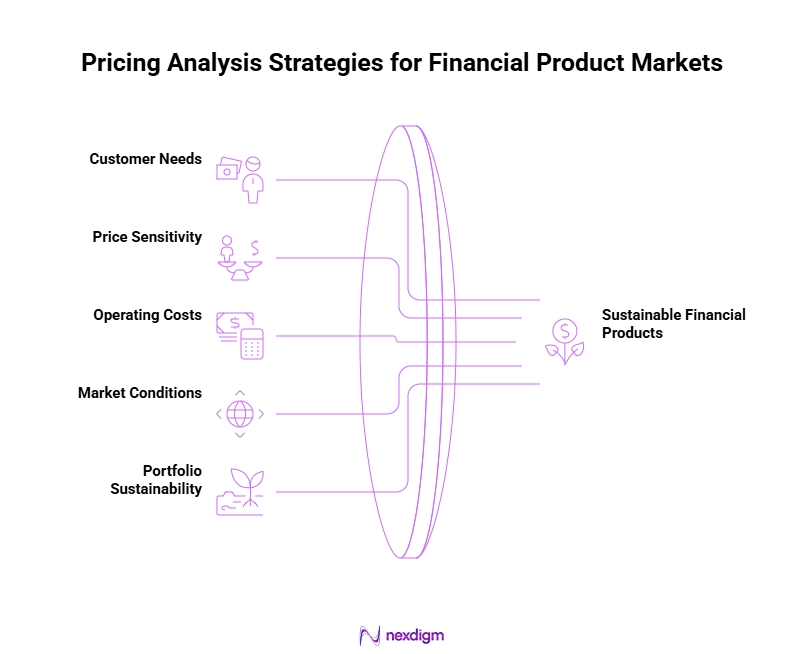
Pricing Analysis Services help financial institutions design affordable, competitive, and profitable financial products by aligning customer needs, price sensitivity, operating costs, market conditions, and long-term portfolio sustainability objectives effectively.
Benefits of Pricing Analysis for Financial Product Accessibility
- Improved Product Affordability: Pricing analysis aligns fees, interest rates, repayment terms, and service charges with customer income levels, improving access to suitable financial products without compromising institutional sustainability.
- Higher Product Adoption: Customer-focused pricing reduces affordability barriers and strengthens perceived value, encouraging cost-conscious consumers to adopt appropriate banking, lending, insurance, payment, and investment solutions.
- Stronger Customer Segmentation: Affordability research identifies differences in income, spending capacity, financial behavior, and price sensitivity, enabling institutions to create targeted pricing for distinct consumer groups.
- Enhanced Financial Inclusion: Accessible pricing structures extend financial services to underserved and lower-income consumers, supporting wider participation in formal banking while reducing exclusion caused by excessive costs.
- Sustainable Revenue Growth: Pricing Analysis Services balance consumer affordability with revenue objectives, helping financial institutions increase product uptake, expand customer relationships, and generate sustainable income across market segments.
Nexdigm’s Role in Developing Accessible and Sustainable Financial Product Pricing
Nexdigm’s Pricing Analysis Services support financial institutions in developing accessible, competitive, and sustainable product pricing. Through financial service affordability pricing studies, customer segmentation, willingness-to-pay analysis, price elasticity modeling, competitive benchmarking, demand forecasting, and profitability assessment, Nexdigm helps align fees, interest rates, and product structures with consumer affordability, financial inclusion, responsible lending, portfolio growth, and long-term commercial objectives across markets.
Nexdigm’s Strategic Blueprint for Affordable and Sustainable Financial Product Pricing
Nexdigm’s strategic pricing blueprint provides structured steps for evaluating affordability, customer demand, competitive positioning, profitability, and long-term sustainability across financial products designed for diverse and cost-conscious consumer segments.
Steps in Nexdigm’s Financial Product Pricing Blueprint
- Define Pricing Objectives: Nexdigm establishes clear affordability, accessibility, revenue, margin, adoption, and financial inclusion objectives to guide pricing decisions across targeted financial product portfolios.
- Assess Market Conditions: Market analysis evaluates economic trends, customer purchasing power, regulatory factors, competitor pricing, and industry dynamics influencing financial product affordability and commercial performance.
- Segment Target Customers: Customer segmentation groups consumers by income, financial behavior, credit profile, product needs, and price sensitivity, enabling differentiated and relevant pricing strategies.
- Evaluate Customer Affordability: Affordability analysis examines disposable income, repayment capacity, financial obligations, and service costs to determine suitable fees, interest rates, and repayment structures.
- Measure Willingness to Pay: Willingness-to-pay research identifies acceptable pricing thresholds and perceived product value, supporting price points that encourage adoption while protecting sustainable revenue opportunities.
Nexdigm’s Case
Nexdigm applied Pricing Analysis Services to redesign financial product fees and repayment structures, contributing to an 18% increase in product adoption, 14% improvement in customer retention, 12% revenue growth, and 10% stronger portfolio profitability.
To take the next step, simply visit our Request a Consultation page and share your requirements with us.
Harsh Mittal
+91-8422857704