

Financial institutions are managing increasingly diverse procurement portfolios as technology, cloud, cybersecurity, data, payments, professional services, and operational support become integral to their operating models. Global enterprise IT spending in banking and investment services is forecast to reach $800 billion in 2026, increasing 9.5% year over year. At the same time, around 40–50% of operating expenses at many banks flows through external vendors and contractors, making third-party spending a significant strategic cost pool.
Technology priorities are also becoming more varied. In 2026, 70% of banking leaders planned to implement instant payments through RTP, while 72% planned to implement FedNow. Cybersecurity budgets are also increasing, with 92% of banking leaders reporting higher spending to address cyber risk.
These shifts make category structure increasingly important. Financial services category sourcing strategy can help institutions determine how different categories should be sourced, benchmarked, managed, and prioritized based on their economics, supplier markets, business criticality, and risk.
Sourcing Strategy Cannot Be Uniform Across Categories
Technology and service categories differ substantially in supplier depth, switching complexity, pricing structures, demand characteristics, and operational impact. A cloud category may require attention to consumption and concentration, while cybersecurity may place greater emphasis on capability, resilience, and regulatory requirements. Professional services may be more suitable for rate and utilization benchmarking, whereas core technology platforms can involve significant migration and dependency considerations. A category-led approach therefore allows financial institutions to apply sourcing strategies according to the characteristics of each spend area, rather than treating the entire supplier portfolio uniformly.
Category Characteristics Can Shape Sourcing Priorities
Before determining the sourcing model, institutions can examine three fundamental characteristics:
- Market Dynamics: Assess supplier depth, competitive intensity, pricing trends, emerging providers, and availability of credible alternatives.
- Business Criticality: Consider operational dependency, regulatory relevance, customer impact, switching complexity, and continuity requirements.
- Spend Economics: Examine expenditure levels, demand patterns, contract structures, pricing mechanisms, and potential value pools within each category.
These factors create a practical basis for determining where competition, negotiation, consolidation, diversification, or longer-term supplier partnerships may be most appropriate.
Nexdigm’s Industry-Led Approach to Category Sourcing
Nexdigm can combine financial-services expertise, procurement intelligence, category research, supplier analysis, and commercial assessment to help institutions develop category-specific sourcing strategies. Through our financial services category sourcing strategy, our experts can assess categories based on their market structure, spend profile, supplier ecosystem, business criticality, commercial dynamics, and sourcing feasibility. This allows sourcing decisions to reflect the realities of each category rather than relying on a single procurement model across technology and services.
How Experts Nexdigm Segment Categories by Strategic Need
Nexdigm can help institutions organize categories by financial services category sourcing strategy, according to the type of sourcing intervention they require:
- Strategic Categories: High-value or business-critical areas where supplier relationships, market intelligence, and long-term sourcing strategy require close management.
- Competitive Categories: Areas with sufficient supplier depth where competitive bidding, benchmarking, or alternative sourcing can create commercial leverage.
- Specialized Categories: Services requiring niche expertise or limited supplier availability, where capability and continuity may outweigh simple price competition.
- Efficiency Categories: More standardized spend areas where consolidation, demand management, process simplification, or contract optimization may create value.
This segmentation can help procurement teams allocate time, analytical resources, and sourcing effort according to category importance and opportunity.
Category Characteristics Shaping Nexdigm’s Sourcing Recommendations
Once categories are segmented, Nexdigm can assess which sourcing approach is most appropriate for each one. The recommendation can consider supplier availability, spend concentration, business criticality, switching complexity, pricing dynamics, and potential value, helping institutions determine whether a category is better suited to competitive sourcing, negotiation, consolidation, diversification, or strategic supplier management. This ensures sourcing decisions reflect the category’s underlying economics and risk profile.
How Nexdigm’s Experts Identify Category-Level Value Opportunities
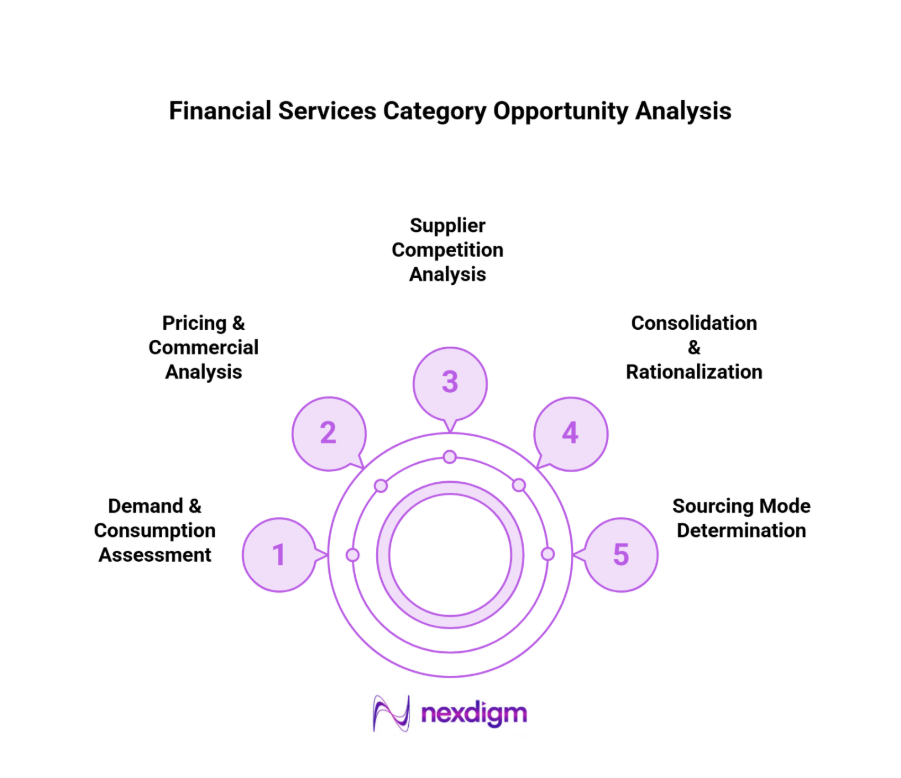
Once the appropriate sourcing model is established, Experts at Nexdigm can examine the underlying cost and supplier dynamics to identify where value can be improved. The analysis can consider:
- Pricing & Commercial Terms: Review rates, discounts, contract structures, payment terms, and volume commitments to identify opportunities for better commercial outcomes.
- Demand & Consumption: Examine usage levels, specifications, purchasing patterns, and demand variation to identify opportunities to control unnecessary or fragmented spending.
- Supplier Competition: Assess the availability and capabilities of alternative suppliers to determine whether greater competition could improve pricing, service, or sourcing flexibility.
- Consolidation & Rationalization: Identify fragmented suppliers, overlapping services, or similar requirements that could potentially be consolidated to improve purchasing leverage and governance.
- Sourcing Model: Determine whether the existing sourcing approach remains appropriate or whether competitive bidding, renegotiation, diversification, or strategic supplier management could create greater value.
This enables Nexdigm to connect category characteristics with specific value levers, helping financial institutions identify where sourcing interventions can deliver the greatest commercial and strategic impact.
Nexdigm’s Case
Nexdigm supported a financial-services organization in assessing 20 technology and service categories to identify category-specific sourcing opportunities. The assessment found 21% of categories suitable for competitive sourcing, 18% with supplier-consolidation potential, and 15% requiring deeper demand and consumption analysis. The findings enabled the organization to prioritize category-level interventions across negotiation, supplier rationalization, demand management, and alternative sourcing.
To take the next step, simply visit our Request a Consultation page and share your requirements with us.
Harsh Mittal
+91-8422857704