

Licensing strategies play a crucial role in shaping market access across regulated financial services sectors, where approvals, eligibility criteria, ownership norms, capital requirements, and compliance obligations determine how firms can operate. For banks, fintechs, brokerages, payment providers, and wealth platforms, licensing decisions directly affect launch timelines, service scope, and expansion costs. A strong market entry strategy helps firms identify the right license type, assess regulatory expectations, prepare documentation, and reduce approval risks.
A well-planned Financial services licensing entry strategy enables companies to enter new markets efficiently while maintaining compliance, operational readiness, and long-term scalability.
Licensing readiness is increasingly important as financial institutions face rising compliance costs and regulatory scrutiny. Global financial crime compliance costs reached USD 206.1 billion in 2023, while institutions are expected to spend USD 34.7 billion on compliance technology and USD 155.3 billion on operations in 2024.
Compliance costs also rose 12% in 2023, with 95% of firms reporting increases, highlighting the need for a strong Financial services licensing entry strategy.
Identifying the Right License Type for Financial Services Operations
Right License Type for Financial Services Operations involves evaluating business activities, product scope, regulatory categories, capital requirements, compliance obligations, and service permissions to ensure lawful market entry:
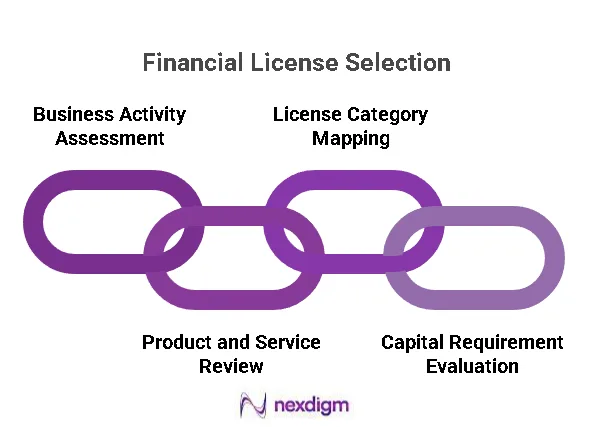
- Business Activity Assessment: Identify whether the firm offers banking, lending, payments, brokerage, advisory, insurance, or wealth management services.
- Product and Service Scope Review: Define products offered, customer segments served, transaction types, distribution channels, and cross-border service coverage.
- License Category Mapping: Match business activities with applicable license types, regulatory classifications, operating permissions, and market access requirements.
- Capital Requirement Evaluation: Assess minimum capital thresholds, liquidity obligations, financial stability requirements, and ongoing prudential conditions linked to each license.
Nexdigm’s Entity Set-Up and Corporate Structuring Support for Licensed Operations
Nexdigm’s Entity Set-Up and Corporate Structuring Support for Licensed Operations helps financial services firms establish compliant legal entities, define ownership structures, meet regulatory conditions, and align tax, governance, and operational requirements. This supports smoother license applications, faster market entry, and scalable operations across regulated financial services sectors.
Nexdigm’s Governance and Internal Controls Review for Regulated Financial Services
Nexdigm’s Governance and Internal Controls Review for Regulated Financial Services helps firms assess board oversight, risk controls, compliance processes, reporting structures, accountability frameworks, and operational safeguards before licensed market entry.
- Board Oversight Assessment: Nexdigm reviews board roles, committee structures, governance policies, decision-making authority, and accountability mechanisms for regulated financial operations.
- Internal Control Evaluation: Nexdigm assesses approval workflows, segregation of duties, transaction controls, documentation standards, and monitoring processes across key business functions.
- Risk Management Framework Review: Nexdigm evaluates credit, operational, compliance, technology, market, and financial crime risk controls before licensed operations begin.
- Compliance Process Assessment: Nexdigm reviews regulatory obligations, policy adherence, reporting responsibilities, escalation mechanisms, and control ownership across compliance functions.
Nexdigm’s case:
Nexdigm helped a regulated financial services firm review its governance and internal controls before applying for a new market license. Nexdigm assessed 50 governance policies, reviewed 35 control processes, mapped 20 regulatory reporting obligations, and identified 14 control gaps across compliance, risk, and operations. The remediation plan helped the company improve license application readiness by 40%, reduce internal review delays by 30%, and strengthen operational safeguards before market entry.
To take the next step, simply visit our Request a Consultation page and share your requirements with us.
Harsh Mittal
+91-8422857704