

Financial services firms are increasingly reconsidering how external providers contribute to operations, technology, and specialized capabilities. EY reports that 61% of organizations are committed to Global Business Services (GBS) models, while 23% say their GBS organizations are already mature and scaling beyond transactional activities. Financial-services firms are increasingly combining captive capabilities with strategic outsourcing to improve efficiency, scalability, resilience, and access to specialized skills.
The outsourcing model itself is also changing. A recent 2026 global research found that 67% of executives reported increased budgets for Operate Services, compared with 57% for Managed Services and 32% for traditional outsourcing. The shift reflects greater interest in outcome-oriented providers that can contribute capabilities, technology, and expertise rather than simply supply labor.
As sourcing models become more complex, financial services outsourcing vendor analysis can help institutions compare providers across service depth, scalability, risk controls, delivery models, and commercial fit.
Outsourcing Is Moving Beyond Traditional Cost Reduction
Outsourcing decisions increasingly involve more than labor arbitrage or short-term cost savings. Financial institutions are using external providers to access specialized expertise, technology capabilities, scalable capacity, and transformation support. At the same time, critical functions require stronger oversight because provider failure can create operational, cybersecurity, regulatory, and reputational consequences. This makes provider selection a balance between value creation and control: the right supplier needs to deliver measurable service benefits without introducing disproportionate operational or third-party risk.
Service Provider Value Can Be Viewed Through These Dimensions
A practical outsourcing assessment can begin with three areas:
- Service Depth: Evaluate functional expertise, process coverage, domain knowledge, technology capabilities, and ability to manage complex financial-services activities.
- Scalability & Delivery: Assess geographic coverage, delivery capacity, talent availability, automation, operating models, and ability to scale services as requirements change.
- Risk & Commercial Fit: Examine security, resilience, compliance, governance, contractual flexibility, pricing structures, and overall value relative to the service delivered.
Together, these dimensions help institutions distinguish between providers that simply offer capacity and those capable of becoming reliable, scalable, and strategically relevant outsourcing partners.
Nexdigm’s Expert-led Role in Evaluating Service Provider Value
Supplier capability alone does not determine whether an outsourcing arrangement will succeed. Nexdigm can assess the institution’s process maturity, internal governance, technology readiness, service criticality, transition requirements, and ability to manage an external provider alongside supplier capabilities.
This provides a broader view of outsourcing readiness and can help identify where process standardization, governance improvements, or technology changes may be needed before transitioning a function externally.
A financial services outsourcing vendor analysis therefore connects supplier suitability with organizational readiness, helping institutions build outsourcing models that are practical to implement, easier to govern, and aligned with long-term operating objectives.
Why Financial Services Outsourcing Vendor Analysis Matters
With outsourcing becoming more specialized, financial institutions need a structured way to assess providers beyond cost and market reputation. Financial services outsourcing vendor analysis can help assess:
- Provider Fitness: Compare suppliers based on service depth, financial-services expertise, delivery capabilities, and alignment with the institution’s specific outsourcing requirements.
- Risk & Scalability: Evaluate operational resilience, governance, security, delivery capacity, and ability to scale services without compromising quality or control.
- Commercial Value: Assess pricing models, transition costs, service levels, contractual flexibility, and expected benefits to understand the broader economics of outsourcing.
Overall, this analysis can help institutions identify best-fit providers, capability gaps, sourcing alternatives, and areas requiring deeper due diligence, supporting more informed and sustainable outsourcing decisions.
Nexdigm’s Approach to Assessing Outsourcing Providers
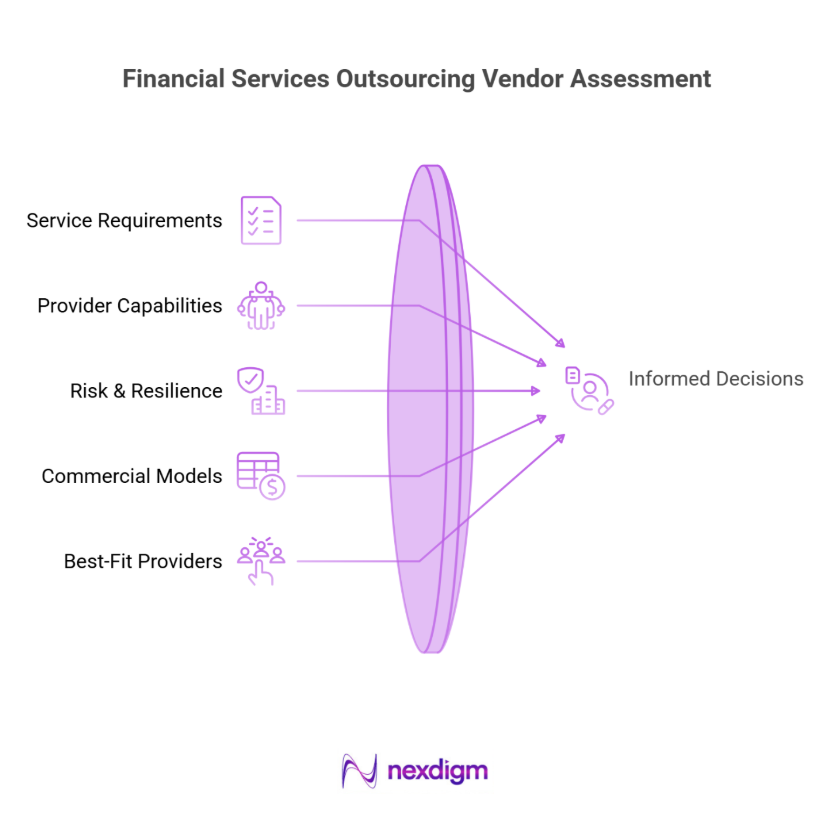
Nexdigm can evaluate outsourcing providers through a structured assessment that connects supplier capabilities with the institution’s service requirements and operating priorities through the following steps:
- Map Service Requirements: Define the processes, service volumes, complexity, locations, technology needs, and expected outcomes.
- Assess Provider Capabilities: Examine domain expertise, service depth, delivery model, technology enablement, scalability, and financial-services experience.
- Evaluate Risk & Resilience: Review security, regulatory compliance, business continuity, governance, subcontracting, and operational resilience.
- Compare Commercial Models: Assess pricing structures, transition costs, service levels, contractual flexibility, and potential value.
- Prioritize Best-Fit Providers: Bring the findings together to identify suppliers suited for deeper due diligence, RFPs, negotiations, or strategic partnerships.
This approach helps Nexdigm move from broad market intelligence to a focused assessment of provider suitability, risk, scalability, and commercial value, supporting more informed outsourcing decisions.
Nexdigm’s Approach Supporting Outsourcing Decisions
Nexdigm’s structured assessment brings supplier capability, risk, scalability, and commercial considerations into one comparative view. By linking these findings with the institution’s outsourcing requirements, the approach helps decision-makers identify best-fit providers, potential gaps, sourcing alternatives, and areas requiring deeper diligence. This creates a clearer evidence base for shortlisting, RFPs, negotiations, and long-term outsourcing strategy.
Nexdigm’s Case
Nexdigm assessed 38 financial-services outsourcing providers across service depth, delivery coverage, risk controls, technology enablement, and commercial models. 32% demonstrated strong service-model alignment, 23% showed broad delivery scalability, and 18% offered differentiated commercial structures. The assessment enabled the institution to prioritize providers for detailed risk due diligence, transition planning, and commercial negotiations.
To take the next step, simply visit our Request a Consultation page and share your requirements with us.
Harsh Mittal
+91-8422857704