

Financial services growth is increasingly shaped by ecosystems rather than standalone distribution. Banks, insurers, and NBFCs bring regulated balance sheets, capital, underwriting capabilities, and established financial infrastructure. Fintechs and digital platforms contribute technology, customer access, transaction data, and faster product development.
The commercial opportunity lies in combining these capabilities without creating an operating model where integration costs, unclear incentives, or regulatory constraints outweigh the value of the partnership.
The Right Partner Solves a Commercial Constraint
Partnerships create value when they address a specific weakness in the institution’s existing model. The starting point is therefore the commercial problem rather than the partner category.
Common constraints include:
- Distribution gaps: Reaching customers outside conventional branch, broker, or advisory networks.
- Data limitations: Accessing transaction, invoice, payroll, or supply-chain data that can strengthen underwriting.
- Technology constraints: Adding modern lending, payments, policy, or servicing capabilities without replacing legacy systems.
- Cost pressures: Reducing acquisition, underwriting, servicing, or distribution costs through shared infrastructure.
A technology partnership that does not improve one of these economics may add complexity without creating meaningful growth.
Banks, Fintechs, Platforms, and Distributors Play Different Roles
Partner selection becomes more effective when the ecosystem is mapped according to the capability and risk each participant contributes.
- Regulated balance-sheet institutions such as banks, NBFCs, and insurers provide capital, assume financial risk, and remain accountable for regulatory obligations.
- Technology infrastructure providers contribute APIs, automated KYC, fraud detection, loan management, and other modular capabilities.
- Contextual platforms such as marketplaces, SaaS providers, logistics networks, and enterprise software platforms provide frequent customer interactions and proprietary transaction data.
- Institutional distributors including brokers, bancassurance networks, and IFAs provide trusted, high-touch access for products requiring advice or more complex decision-making.
The most valuable ecosystems are usually complementary. They combine assets that would be expensive or difficult for one participant to build independently.
Distribution Access Can Be Harder to Replicate Than Technology
Financial technology capabilities are becoming increasingly modular. Distribution relationships, however, can take years to establish.
A financial institution embedded within an accounting platform, logistics network, or retail distribution ecosystem can reach customers at the point where a financial need arises. This can reduce dependence on open-market acquisition and improve conversion by using existing customer relationships and transaction flows.
Instead of assessing prospective partners solely on their technology, institutions should focus on strategic assets: do they supply the market reach, proprietary data, and customer touchpoints that are difficult or expensive to develop in-house?
Partnership Economics Determine Whether Growth Is Sustainable
A partnership can generate strong initial volumes and still fail commercially if the economics are poorly structured.
Four areas require particular attention:
- Revenue sharing: Fees, commissions, and performance-linked compensation must provide sufficient incentive for both parties.
- Integration costs: Legacy technology can turn an apparently simple API deployment into a much larger transformation programme.
- Customer ownership: Contracts need to establish who controls the customer relationship, data, servicing, and future cross-sell opportunities.
- Risk allocation: Credit, insurance, fraud, operational, and compliance responsibilities need to correspond with each participant’s role.
For example, an embedded credit partnership may combine an upfront origination fee with performance-linked compensation, while a co-lending arrangement may allocate economics according to each participant’s capital contribution and risk exposure.
The structure should be designed around the economics of the entire customer lifecycle rather than the initial transaction.
Nexdigm’s Financial Services Partnership Ecosystem Framework
A Financial services partnership ecosystem analysis by Nexdigm assesses partnership opportunities through five stages:
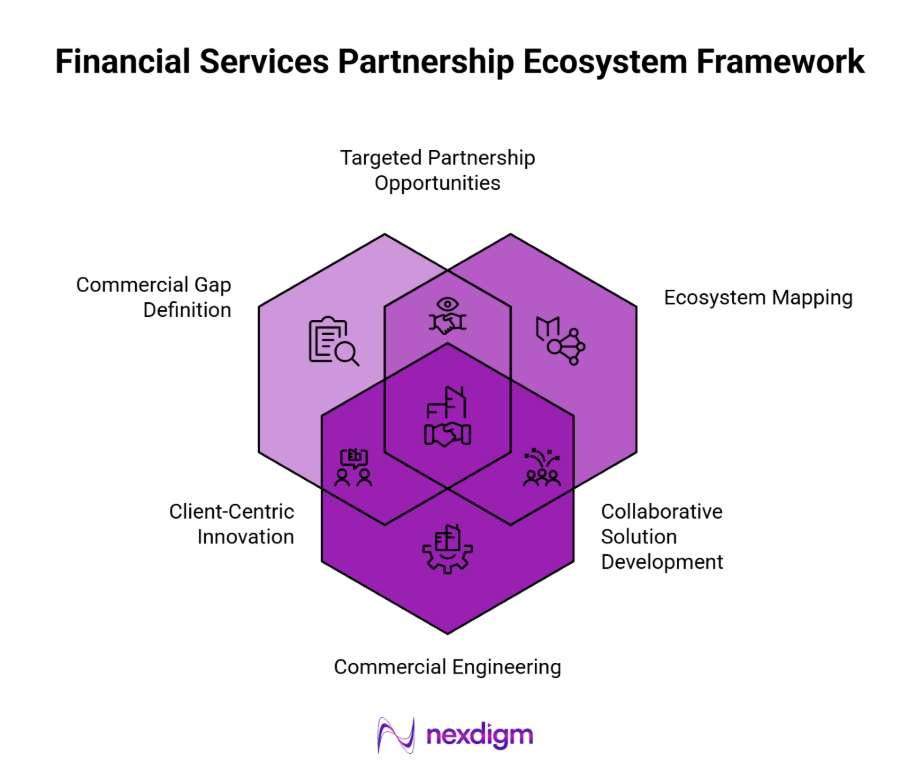
- Commercial Gap Definition: Establish whether the objective is customer acquisition, distribution expansion, better underwriting, technology modernization, or access to a regulated capability.
- Ecosystem Mapping: Build a universe of potential partners and tier them by customer reach, transaction volumes, technical maturity, compliance record, and strategic fit.
- Commercial Engineering: Model revenue shares, commissions, performance incentives, implementation costs, and risk allocation to determine whether the relationship creates sustainable economics.
- Integration Feasibility: Assess APIs, data flows, privacy requirements, SLAs, servicing processes, and the effort required to connect the partner with existing infrastructure.
- Governance and Scalability: Establish compliance controls, ownership rights, operating responsibilities, and performance metrics before scaling the partnership.
The outcome is a prioritized partner portfolio, with each relationship assessed for commercial value, implementation feasibility, regulatory exposure, and expected return.
How Nexdigm Converts Partner Networks Into Growth
A tier-1 private general insurer evaluated 120 potential distribution partners across commercial transportation and digital enterprise software. Nexdigm narrowed the universe to 26 candidates and developed integration and commercial models for nine priority partners. The resulting ecosystem reached 3.8 million users, reduced customer acquisition costs by 32%, and generated ₹280 crore in new GWP within 18 months.
To take the next step, simply visit our Request a Consultation page and share your requirements with us.
Harsh Mittal
+91-8422857704