

Financial services procurement planning should begin with the institution’s operating priorities, not with a list of contracts approaching renewal. Banks, insurers, payment companies and other financial institutions purchase a wide range of technology, infrastructure, professional services and operational support. Treating these categories as one procurement pipeline can obscure differences in business criticality, supplier concentration, market availability and sourcing lead times.
A structured plan connects expected demand with category-level market conditions. It helps procurement teams determine which requirements need early attention, where supplier options are limited and which purchases can be consolidated or sourced through more competitive processes.
Start With Category Prioritisation
The first planning decision is to determine which procurement categories have the greatest effect on business continuity, regulatory obligations and service delivery.
Technology infrastructure, core banking systems, cybersecurity, data centres and payment processing may have high operational importance because disruptions can affect multiple business functions. Other categories, such as office supplies or routine facilities services, may have more standardised specifications and a wider supplier market.
This distinction should influence sourcing timelines and the level of market research required. A critical technology category may need extensive supplier mapping, architecture discussions and risk assessment months before a contract expires. A standardised service may be suitable for a shorter competitive process.
Financial services organisations should typically organise procurement demand across several broad groups:
- Technology and digital services: Core systems, software licences, cloud services, cybersecurity and application development.
- Infrastructure: Data centres, connectivity, hardware, network equipment and disaster recovery facilities.
- Operational services: Customer support, document processing, facilities management and business process outsourcing.
- Professional and specialist services: Legal, audit, consulting, actuarial and regulatory support.
- Physical banking infrastructure: ATMs, POS terminals, branch equipment and associated maintenance.
The category structure should reflect actual spending patterns and operational dependencies rather than relying on generic procurement classifications.
Build a Reliable View of Spend and Demand
Procurement planning becomes unreliable when spending information is fragmented across departments, subsidiaries and technology teams. Contract values may be recorded separately from usage-based charges, while recurring subscriptions and infrastructure commitments can be overlooked during annual budgeting.
A useful spend baseline should distinguish committed expenditure from variable demand. It should capture contract duration, renewal dates, usage volumes, business ownership, supplier concentration and any minimum purchase commitments.
For technology categories, this may require examining the number of active licences, cloud consumption, storage requirements and application usage. For physical infrastructure, the relevant variables could include installed equipment, maintenance frequency, replacement cycles and geographic coverage.
Forecasting should also account for changes in the business. A bank expanding its digital channels may need additional cloud capacity and cybersecurity services. An insurer entering new product segments may require policy administration software, claims technology and external data services.
Supplier Availability Should Shape the Sourcing Calendar
The number of suppliers in a category does not necessarily indicate the level of competition available to a buyer. Several vendors may offer similar products, but only a smaller group may meet the institution’s security, integration, geographic or regulatory requirements.
Procurement teams should therefore distinguish between the overall supplier market and the genuinely addressable supplier pool.
Categories involving proprietary platforms, specialised infrastructure or complex integrations may require longer market-sounding and evaluation periods. Standardised products can often be sourced more quickly, particularly where specifications are clear and switching costs are low.
Supplier research should examine market concentration, alternative providers, geographic presence, delivery capacity, product specialisation and the commercial models available. This information helps identify categories where early engagement is necessary to preserve sourcing options.
Align Sourcing Timelines With Contract and Implementation Risk
Contract renewal dates are important, but they should not be treated as the only planning milestones. A complex technology replacement may require architecture assessment, data migration planning, testing and regulatory review before a new provider can become operational.
A practical sourcing calendar should work backwards from the required service commencement date. It should include time for requirements definition, market mapping, supplier engagement, commercial comparison, internal approvals, contracting and implementation.
The amount of lead time should vary by category. A data centre arrangement or core technology replacement may require substantially more preparation than a routine software subscription. Planning should also account for contract notice periods, transition support and exit obligations.
Use Market Intelligence to Challenge the Existing Supplier Base
Procurement teams often have detailed knowledge of their current suppliers but limited visibility into alternative providers. This can create an incumbent bias, particularly where technology has been embedded in internal systems over several years.
Financial Services Procurement Planning becomes more effective when internal spend information is combined with external supplier intelligence. Nexdigm’s procurement research can help map category markets, identify alternative suppliers, compare capabilities and examine commercial positioning. This provides a market-based view of sourcing options without assuming that every incumbent should be replaced.
India’s financial sector also operates within an increasingly complex technology and outsourcing environment. The RBI’s 2025 outsourcing directions reinforce the need for regulated entities to maintain oversight of outsourced activities and assess associated risks. Procurement calendars should therefore allow time for relevant governance reviews, not simply commercial negotiations.
Financial Services Procurement Planning Framework
A useful plan can be developed through the following sequence:
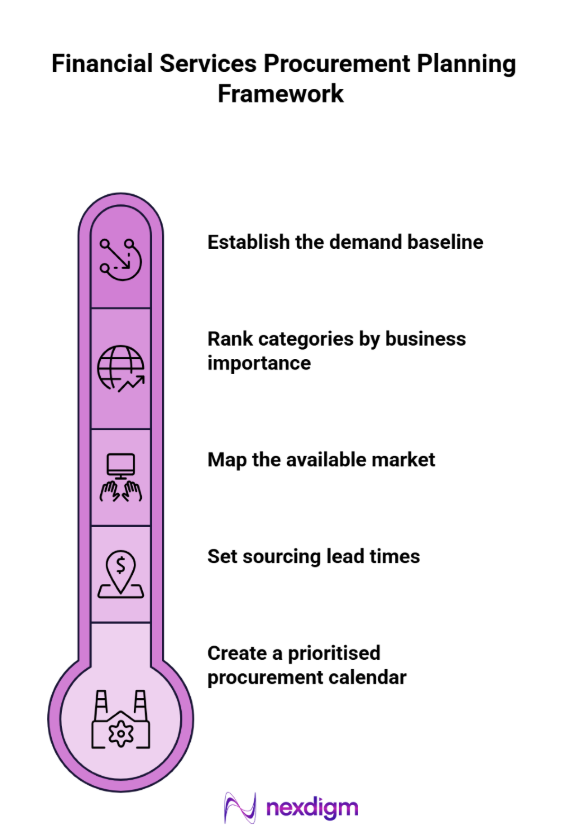
- Establish the demand baseline: Consolidate historical spend, committed contracts, usage patterns and expected business requirements.
- Rank categories by business importance: Consider operational criticality, regulatory relevance, supplier concentration and the consequences of service interruption.
- Map the available market: Identify suppliers, alternatives, market capacity, specialisation and barriers to switching.
- Set sourcing lead times: Work backwards from contract expiry or required deployment, accounting for evaluation, approval, transition and implementation.
- Create a prioritised procurement calendar: Assign category owners, sourcing milestones and decision deadlines, with earlier attention given to high-dependency categories.
Case Study: Financial Services Procurement Planning
An Indian financial services group consolidated procurement requirements across 34 categories and 112 active supplier relationships. Market mapping identified nine categories with limited alternative coverage. The revised sourcing calendar brought forward six major technology reviews and prioritised competitive assessment in three concentrated supplier markets.
To take the next step, simply visit our Request a Consultation page and share your requirements with us.
Harsh Mittal
+91-8422857704