

The growing dependence on cloud computing, data centres, and digital platforms is bringing infrastructure sustainability into sharper focus for financial institutions. According to CEEW, data centres accounted for approximately 0.5% of India’s electricity consumption and around 150 billion litres of water use in 2024, with both figures projected to more than double by 2030.
Uptime Institute’s 2026 survey reports an average data centre Power Usage Effectiveness (PUE) of 1.52, highlighting the importance of energy efficiency. Its 2025 survey also found that 45% of IT workloads remain in corporate data centres. These developments make financial technology procurement sustainability analysis important for evaluating infrastructure efficiency, vendor ESG performance, and long-term sourcing implications.
Why Is Sustainability Becoming a Procurement Priority?
Sustainability is becoming an important consideration in financial technology procurement for several reasons:
- Growing Infrastructure Demand: Increasing reliance on cloud platforms, data centres, and digital services is raising energy and resource requirements.
- Environmental Accountability: Financial institutions face growing expectations to understand the environmental impact of their technology supply chains.
- Operational Efficiency: Energy-efficient infrastructure and resource optimisation can support more sustainable and cost-conscious technology operations.
- Supplier Transparency: Greater visibility into vendor emissions, environmental policies, and sustainability commitments helps strengthen procurement oversight.
Factors Shaping Sustainable Technology Vendor Selection
Financial institutions should evaluate technology vendors across energy and resource efficiency, ESG transparency, and infrastructure resilience. This involves examining data centre energy consumption, cooling practices, renewable energy usage, emissions disclosures, sustainability targets, infrastructure scalability, and service reliability. Assessing these factors together helps procurement teams balance environmental objectives with commercial competitiveness, technology requirements, and long-term supplier suitability.
Identifying Sustainability Gaps Across Financial Technology Vendors
Understanding the sustainability position of technology providers requires more than reviewing their environmental commitments. Nexdigm supports financial institutions through company-level research and comparative assessments that help with:
- Evaluating Environmental Commitments: Examine vendors’ emissions targets, renewable energy initiatives, environmental policies, and resource-management practices.
- Reviewing Disclosure Maturity: Assess the availability of sustainability reports, emissions information, environmental certifications, and supporting performance indicators.
- Identifying ESG Performance Gaps: Highlight differences between stated sustainability objectives and documented initiatives, identifying areas requiring further validation.
- Comparing Vendor Readiness: Evaluate how providers demonstrate accountability, integrate sustainability into business operations, and respond to evolving environmental expectations.
This research helps financial institutions distinguish vendors with established sustainability practices from those requiring greater transparency or further assessment.
Nexdigm’s Framework for Financial Technology Sustainability Assessment
Nexdigm follows a structured research approach to help financial institutions evaluate technology providers across infrastructure efficiency, environmental performance, and supplier capabilities. The assessment can be organised into the following stages:
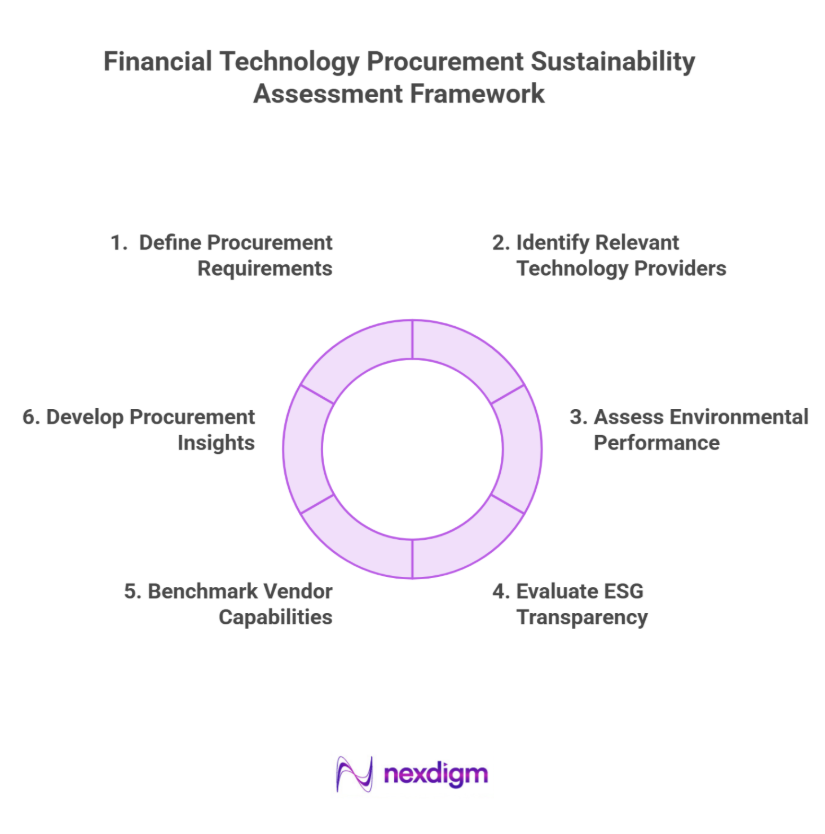
- Define Procurement and Sustainability Requirements: Understand the institution’s technology requirements, sustainability objectives, procurement priorities, and key evaluation parameters.
- Identify Relevant Technology Providers: Map vendors across relevant categories, including cloud services, data centre infrastructure, payment technology, software platforms, and IT services.
- Assess Infrastructure and Environmental Performance: Examine energy consumption disclosures, renewable energy initiatives, emissions data, resource efficiency, and infrastructure sustainability practices.
- Evaluate ESG Transparency and Governance: Review sustainability reports, environmental policies, certifications, governance frameworks, reporting consistency, and accountability mechanisms.
- Benchmark Vendor Capabilities: Compare providers across sustainability indicators, technology offerings, infrastructure capabilities, market presence, and commercial positioning.
- Develop Procurement Insights: Consolidate assessment findings to identify suitable vendors, highlight information gaps, and support supplier prioritisation based on institutional requirements.
Through this structured approach, Nexdigm connects financial technology procurement sustainability analysis with practical vendor evaluation, helping financial institutions incorporate sustainability into technology sourcing decisions.
Business Impact of Nexdigm’s Financial Technology Sustainability Assessment
Nexdigm’s research-led assessment framework helps financial institutions connect sustainability evaluation with broader procurement and business priorities. By providing visibility into supplier practices, infrastructure efficiency, ESG disclosures, and technology capabilities, Nexdigm supports better-informed vendor selection, improved understanding of resource-related cost implications, stronger supplier risk awareness, and more sustainable sourcing strategies. This enables institutions to balance environmental objectives with commercial competitiveness and long-term technology requirements.
Nexdigm’s Case
A financial institution engaged Nexdigm to assess sustainability across 40 technology providers. The research found that 28% demonstrated strong ESG alignment, 25% showed moderate sustainability maturity, 22% had notable infrastructure efficiency initiatives, and 25% required further disclosure validation. These findings supported a more structured vendor comparison and informed sustainable technology sourcing priorities.
To take the next step, simply visit our Request a Consultation page and share your requirements with us.
Harsh Mittal
+91-8422857704