

Financial institutions are increasing technology investment while facing pressure to control costs, modernize legacy environments, and strengthen resilience. Global enterprise IT spending in banking and investment services is forecast to reach $857.5 billion in 2026, growing 9.5% year over year. Worldwide IT spending is expected to reach $6.37 trillion, up 14.2%, with software spending growing 15.5% and infrastructure-as-a-service spending 29.3%.
The cost challenge is particularly significant for banks because technology has become an increasingly important component of overall expenditure. Research from the Federal Reserve Bank of Kansas City found that the share of bank spending allocated to IT and marketing increased from 4% of total spending in 2004 to 19% in 2025. The same research found that higher IT spending was associated with higher bank profits, making indiscriminate cost reduction potentially counterproductive.
At the same time, cloud and security spending continue to expand. Public-cloud spending in India is forecast to grow 28.1% in 2026, while information-security spending is projected to increase 11.7%. This makes financial technology sourcing cost optimization less about cutting technology expenditure broadly and more about identifying inefficient sourcing, pricing, utilization, and supplier arrangements without compromising critical capabilities.
Technology Cost Optimization Requires a Risk-Aware Approach
Technology sourcing costs can often be reduced without weakening the underlying technology environment, but the opportunity depends on understanding what drives expenditure. Unused licenses, fragmented suppliers, overlapping solutions, unfavorable renewal terms, excess capacity, and poorly structured contracts can create avoidable costs. However, reducing spend on cybersecurity, resilience, critical infrastructure, or essential functionality without assessing the associated risk can create larger downstream costs. A sustainable approach therefore distinguishes between cost that creates measurable business value and cost that results from commercial or operational inefficiency.
Where Can Institutions Look for Safer Cost Optimization?
Financial institutions can identify savings through supplier consolidation, contract benchmarking, license optimization, cloud-cost assessments, and strategic sourcing reviews. Nexdigm supports this process through procurement advisory, cost benchmarking, and vendor evaluation, helping institutions identify sourcing inefficiencies, assess supplier competitiveness, and improve commercial arrangements. This enables banks to optimize technology expenditure while maintaining operational resilience, regulatory compliance, and service quality.
How Nexdigm Supports Smarter Technology Sourcing Decisions
Nexdigm helps financial institutions improve technology sourcing efficiency by examining procurement practices, supplier arrangements, and expenditure patterns. Our approach focuses on:
- Spend Analysis and Benchmarking: Identifying expenditure patterns, pricing gaps, and sourcing inefficiencies to uncover potential cost-saving opportunities.
- Strategic Supplier Evaluation: Assessing vendor capabilities, commercial terms, and service performance to support informed supplier selection and negotiations.
- Procurement Transformation: Improving sourcing processes, contract management, and supplier governance to strengthen cost control and long-term procurement effectiveness.
- Sustainable Cost Optimization: Aligning technology sourcing decisions with business priorities, regulatory expectations, and operational resilience.
Financial institutions can achieve sustainable technology cost savings through smarter sourcing, effective vendor management, and data-driven decisions. With Nexdigm’s support, banks can optimize procurement expenditure while maintaining long-term business value.
Nexdigm in Building a Cost-Efficient Technology Ecosystem
Nexdigm helps financial institutions improve procurement efficiency through structured sourcing strategies and data-driven assessments. Our approach to financial technology sourcing cost optimization focuses on identifying savings opportunities through the following steps:
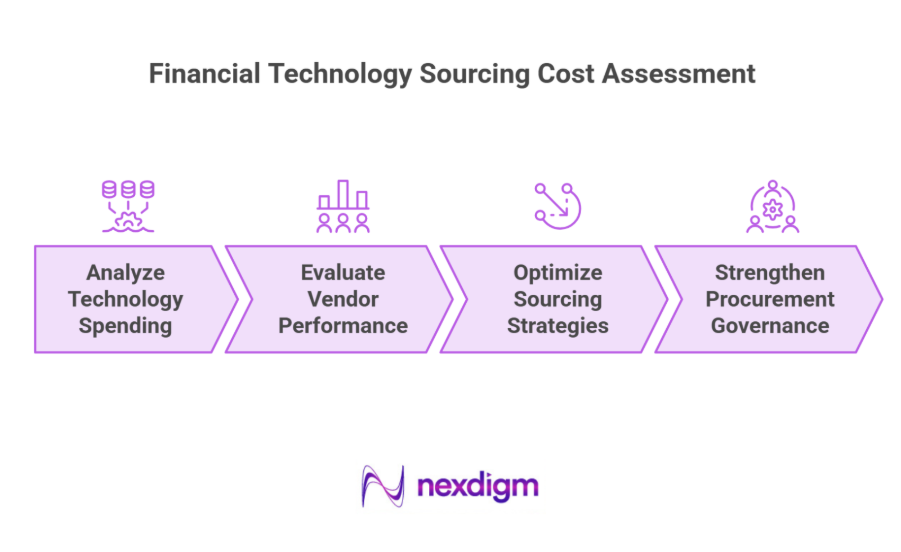
- Analyze Technology Spending: Review existing expenditure to identify cost leakages, overlapping services, and opportunities for improved resource utilization.
- Evaluate Vendor Performance: Assess supplier pricing, service quality, contractual terms, and delivery capabilities to identify better sourcing opportunities.
- Optimize Sourcing Strategies: Recommend procurement improvements, supplier consolidation, and commercial negotiations to achieve sustainable cost efficiencies.
- Strengthen Procurement Governance: Improve supplier oversight, contract management, and performance monitoring to support long-term cost control and operational stability.
With Nexdigm’s strategic sourcing support, financial institutions can optimize technology expenditure, improve vendor performance, and achieve sustainable cost efficiencies without compromising operational resilience.
Why Financial Institutions Should Consider Nexdigm
Choosing the right procurement partner can help financial institutions turn sourcing challenges into measurable business improvements. Nexdigm’s expertise in procurement advisory, supplier evaluation, and cost optimization helps banks identify commercial opportunities, improve sourcing efficiency, and make informed technology investment decisions. This approach supports long-term value creation while maintaining operational resilience and cost discipline.
Nexdigm’s Case
A financial institution partnered with Nexdigm to streamline technology procurement through spend analysis, supplier benchmarking, and contract optimization. The initiative delivered 15% procurement cost savings, 20% improved sourcing efficiency, and 25% better vendor performance visibility, demonstrating the value of structured sourcing and supplier management.
To take the next step, simply visit our Request a Consultation page and share your requirements with us.
Harsh Mittal
+91-8422857704