

Banks increasingly depend on external technology providers for cloud infrastructure, cybersecurity, payments, data analytics, core banking systems, and digital services. However, greater supplier dependence also expands operational, regulatory, and cybersecurity exposure. A 2026 financial-services survey reported that 53% of institutions manage at least 300 vendors, while 63% have only one or two dedicated employees overseeing third-party risk.
Additionally, 72% were only partially aware of which vendors use AI. These findings highlight the growing complexity of supplier oversight. The Bank for International Settlements’ March 2026 guidance also emphasizes risk assessment, due diligence, contractual safeguards, onboarding, and ongoing monitoring throughout the supplier lifecycle. To address such situation, financial technology supplier due diligence is essential to evaluate a provider’s suitability before granting access to banking systems, data, or critical operations.
Why Supplier Selection Requires More Than Technical Evaluation
A supplier may offer advanced technology and competitive pricing but still present risks through weak security controls, limited financial stability, inadequate service continuity, or reliance on subcontractors. Banks should assess the provider against the importance of the service, sensitivity of information handled, regulatory obligations, and potential customer impact. Due diligence should be proportionate to the supplier’s risk and the criticality of the arrangement.
Major Areas Banks Should Examine Before Onboarding
Before approving a technology supplier, banks should establish whether the provider can meet operational expectations, protect sensitive information, and support long-term business requirements.
- Technology and Security Readiness: Evaluate architecture, cybersecurity controls, data protection, access management, vulnerability handling, and integration capabilities against the bank’s security requirements.
- Operational and Financial Stability: Examine service delivery history, financial health, business continuity arrangements, disaster recovery capabilities, support infrastructure, and capacity to meet agreed service levels.
- Regulatory and Supply Chain Exposure: Review regulatory compliance, subcontractor dependencies, data location, audit rights, concentration risks, and contractual responsibilities for managing third-party incidents.
These checks help banks distinguish between suppliers that demonstrate technical capability and those equipped to operate reliably within a regulated financial-services environment.
Nexdigm’s Approach to Financial Technology Supplier Due Diligence
Nexdigm can support banks in evaluating technology suppliers through financial technology supplier due diligence. Rather than relying solely on vendor presentations or self-reported credentials, the assessment can examine a provider’s market position, service capabilities, technology expertise, industry experience, and alignment with the bank’s requirements. This enables procurement, technology, risk, and compliance teams to develop a more evidence-based view of supplier suitability before progressing with onboarding.
How Nexdigm Evaluates Financial Technology Suppliers Before Onboarding
Nexdigm can support banks through a structured financial technology supplier due diligence process, converting the key onboarding requirements into practical assessment steps:
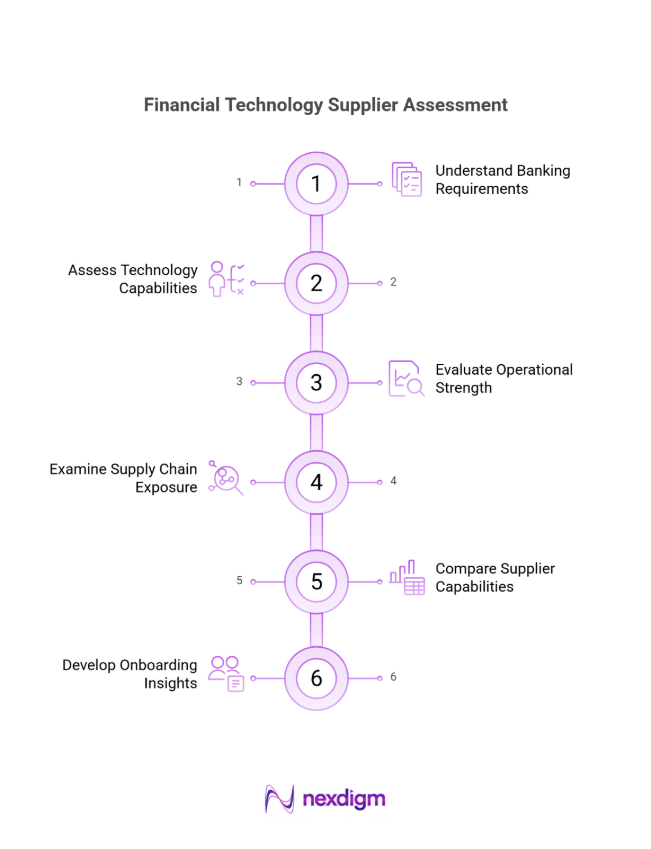
- Understand Banking Requirements: Identify the bank’s technology needs, service expectations, operational dependencies, security requirements, and regulatory considerations.
- Assess Technology Capabilities: Examine supplier expertise, technology offerings, cybersecurity capabilities, integration readiness, and service maturity against institutional requirements.
- Evaluate Operational and Financial Strength: Review delivery models, industry experience, financial position, scalability, business continuity arrangements, and support capabilities.
- Examine Regulatory and Supply Chain Exposure: Assess compliance practices, data management, subcontractor relationships, third-party dependencies, and potential concentration risks.
- Identify Gaps and Compare Suppliers: Benchmark supplier capabilities, highlight areas requiring further validation, and compare providers against the bank’s priorities.
- Develop Onboarding Insights: Consolidate findings into supplier profiles and comparative assessments to help banks prioritize suitable providers for further technical, legal, security, and compliance checks.
Through these steps, Nexdigm helps banks build a more evidence-based understanding of supplier suitability, identify potential concerns before onboarding, and make informed technology partnership decisions.
Nexdigm’s Supplier Assessment Helping With Informed Onboarding Decisions
The findings from Nexdigm’s financial technology supplier due diligence process can help banks move from supplier evaluation to practical procurement decisions. The assessment supports:
- Supplier Shortlisting: Prioritize providers whose technology capabilities, industry experience, and delivery models align with the bank’s requirements.
- Capability Gap Visibility: Identify weaknesses or areas requiring additional technical, security, operational, or regulatory validation before onboarding.
- Comparative Decision-Making: Provide a consistent basis for comparing supplier strengths, service offerings, market positioning, and potential dependencies.
- Onboarding Prioritization: Help stakeholders determine which suppliers are suitable for further evaluation and which require additional evidence or clarification.
This enables banks to approach supplier onboarding with clearer evaluation criteria, stronger procurement insights, and a better understanding of potential risks before entering into technology partnerships.
Nexdigm’s Case
Nexdigm assessed technology suppliers for a banking institution seeking to strengthen its partner ecosystem. The evaluation covered supplier capabilities, operational readiness, technology expertise, and risk-related considerations. The assessment identified 30% of reviewed suppliers as closely aligned with the bank’s requirements, while 22% demonstrated differentiated technology capabilities and 18% required further validation around operational or compliance considerations. These insights supported a more focused supplier shortlist and informed onboarding decisions.
To take the next step, simply visit our Request a Consultation page and share your requirements with us.
Harsh Mittal
+91-8422857704