

Fintech capital is becoming more selective. The period when investors could justify high valuations through user growth, transaction volumes, or gross merchandise value alone has given way to greater scrutiny of cash generation, retention, regulatory resilience, and capital efficiency.
The shift is visible in global funding. In the first half of 2026, fintech investment reached $103.1 billion across 2,100 transactions, with $67.9 billion coming through M&A. The concentration of capital in established platforms and strategic transactions points to a market increasingly rewarding proven economics and defensible infrastructure.
Scale Alone Is No Longer an Investment Thesis
Rapid customer acquisition can conceal weak economics when growth depends on subsidies, low transaction pricing, or expensive marketing. Investors are therefore looking beyond headline user numbers to understand what each customer contributes after acquisition and servicing costs.
Key indicators increasingly include:
- LTV:CAC ratios of 4:1 or higher
- Customer payback periods below 12 months
- Low churn among high-value enterprise or merchant accounts
- Positive contribution margins after technology, processing, support, and compliance costs
- Evidence that existing customers can generate additional revenue over time
For investors, the question is whether growth improves the economics of the business or simply increases the amount of capital required to sustain it.
Fintech Verticals Have Fundamentally Different Economics
Payments, lending, WealthTech, and B2B infrastructure should not be evaluated using the same investment criteria.
Digital payments can generate substantial transaction volumes while operating on thin take rates. Consumer payment aggregation may produce only 12–25 basis points on transaction value, making cross-selling software, credit, payroll, or other services important to the overall economics.
Digital lending can produce stronger yields, but returns are exposed directly to credit losses, regulatory restrictions, and balance-sheet capital requirements. The economics of prime retail lending are materially different from unsecured consumer or micro-lending portfolios, where loss rates can be substantially higher.
WealthTech platforms face another challenge. Brokerage revenues can fluctuate with market activity, while retail customers can be difficult to retain during weak equity cycles. Recurring advisory, portfolio-management, and distribution revenues can therefore provide greater durability than transaction-led income alone.
B2B financial infrastructure offers a different risk profile. API middleware, SaaS platforms, and regulatory technology can generate recurring revenues with high gross margins without taking direct balance-sheet credit exposure.
Fragmented Infrastructure Is Creating More Attractive Opportunities
Some of the strongest risk-adjusted opportunities are emerging beneath the consumer-facing fintech layer. Financial institutions continue to require technology that connects legacy infrastructure with modern applications while meeting increasingly complex compliance requirements.
Areas attracting attention include:
- Core banking modernization: Microservices and middleware connecting legacy banking systems with cloud applications.
- Embedded credit infrastructure: Platforms connecting enterprise ERP and transaction ecosystems with lending institutions.
- RegTech: Automated identity verification, AML monitoring, reporting, and compliance workflows.
- B2B financial infrastructure: API-led systems that allow financial institutions and enterprises to integrate payments, lending, reconciliation, and data services.
These businesses can offer a different combination of recurring revenue, enterprise retention, and lower capital intensity than consumer fintech models dependent on continuous customer acquisition.
Capital Is Following Businesses That Can Compound
Institutional investors are increasingly assessing whether a fintech can grow without proportionally increasing its capital requirements. Revenue quality matters as much as revenue growth.
A business generating contracted ARR from a concentrated customer base may be more attractive than one reporting significantly higher transaction volumes but relying on volatile take rates. Similarly, strong Net Revenue Retention can indicate that growth is occurring within existing accounts rather than being purchased through continued acquisition spending.
The investment case therefore increasingly rests on three questions: how durable is the revenue, how efficiently can the business scale, and how much regulatory or balance-sheet risk sits behind that growth?
Nexdigm’s Fintech Investment Opportunity Framework
A Fintech investment market study by Nexdigm evaluates opportunities through four connected lenses:
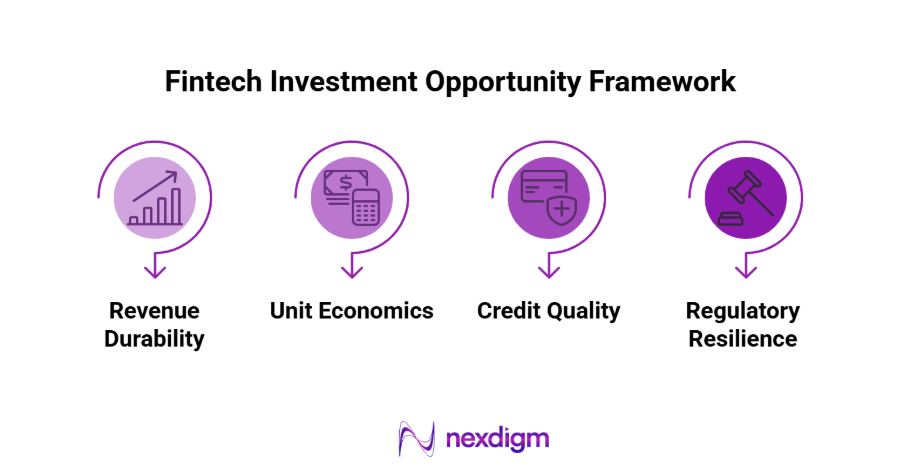
- Revenue Durability and Take-Rate Quality: Separate recurring ARR from transaction-led income, assess pricing stability, and identify dependence on volume growth or subsidies.
- Unit Economics and Capital Efficiency: Calculate fully loaded CAC, payback periods, processing costs, cloud expenditure, servicing costs, and equity capital requirements.
- Credit Quality and Underwriting Performance: For lending businesses, assess vintage-level delinquency, defaults, recoveries, portfolio seasoning, and credit-enhancement structures.
- Regulatory Resilience: Review licensing requirements, compliance exposure, data-localization obligations, and the potential impact of regulatory changes on the operating model.
The resulting assessment distinguishes businesses that can scale efficiently from those where growth remains dependent on external capital.
How Nexdigm Identifies Fintech Businesses Worth Backing
A private equity growth fund evaluating a ₹1,000 crore fintech allocation screened 86 enterprises across five verticals. Nexdigm eliminated six lending platforms because of off-balance-sheet credit exposure and payback periods exceeding 20 months, then shortlisted 12 priority targets. Two core opportunities were identified in enterprise API middleware and embedded invoice financing. Five-year modelling projected a 25.8% IRR, guiding the client’s capital deployment.
To take the next step, simply visit our Request a Consultation page and share your requirements with us.
Harsh Mittal
+91-8422857704