

Fintech Market Entry Strategies Navigate Competition in a Market Attracting Billions in Annual Investment highlights the need for structured expansion planning in a fast-evolving financial technology landscape. As fintech segments such as digital payments, lending, wealthtech, insurtech, and embedded finance attract significant funding, competition for customers, partners, and regulatory approval continues to intensify.
A strong Fintech market entry strategy helps firms assess market demand, licensing requirements, customer behavior, competitive gaps, partnership models, and risk factors before launch. This market entry strategy enables fintech companies to enter new regions efficiently, differentiate offerings, and scale sustainably.
Fintech market entry strategy is critical in a highly funded and competitive sector. Global fintech investment rebounded to USD 116 billion across 4,719 deals in 2025, up from USD 95.5 billion in 2024. The fintech market is also expected to reach USD 320.81 billion in 2025 and grow to USD 652.80 billion by 2030, reflecting a 15.27% CAGR.
Identifying High-Growth Fintech Markets for Expansion
Identifying High-Growth Fintech Markets for Expansion involves assessing digital adoption, funding activity, regulatory openness, customer demand, competitive gaps, infrastructure maturity, and partnership opportunities to prioritize scalable fintech market entry.
- Digital Adoption Levels: Assess smartphone usage, internet access, digital payments, and app-based financial behavior to identify fintech-ready markets.
- Fintech Investment Activity: Review funding trends, deal volumes, and investor interest to understand market maturity and growth potential.
- Regulatory Openness: Evaluate fintech licenses, sandbox programs, digital KYC rules, and regulator support for innovation-led market entry.
- Customer Demand Gaps: Identify underserved needs in payments, lending, insurance, wealth, remittances, and SME finance.
Nexdigm’s Tax and Compliance Structuring for Fintech Market Entry
Nexdigm’s Tax and Compliance Structuring for Fintech Market Entry helps fintech firms design efficient tax models, assess regulatory obligations, manage cross-border transactions, and meet reporting requirements. This support enables compliant market entry, reduces operational risks, improves governance, and helps fintech companies scale sustainably in competitive digital finance markets.
How Does Nexdigm Support Market Research for Fintech Market Entry?
Nexdigm Support Market Research for Fintech Market Entry, Nexdigm helps fintechs assess market size, customer demand, competition, regulations, investment trends, partnership opportunities, and growth potential before expansion:
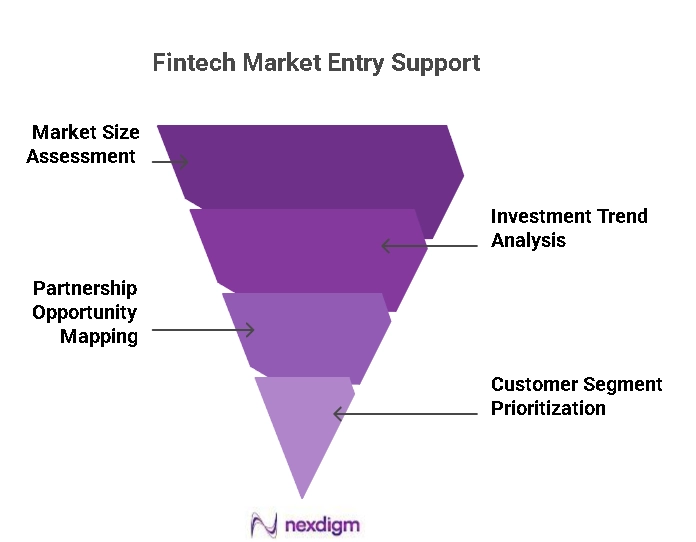
- Market Size Assessment: Nexdigm evaluates fintech market value, growth rates, customer base, transaction volumes, and revenue potential across target geographies.
- Investment Trend Analysis: Nexdigm reviews funding activity, deal flows, investor interest, and segment-level momentum to measure market attractiveness.
- Partnership Opportunity Mapping: Nexdigm identifies banks, payment networks, technology vendors, telecoms, and platforms that can support faster market entry.
- Customer Segment Prioritization: Nexdigm ranks target users by adoption readiness, profitability, digital behavior, unmet needs, and long-term growth potential.
Nexdigm’s case:
Nexdigm helped a fintech company conduct market research before entering two high-growth digital finance markets. Nexdigm assessed 5 fintech segments, benchmarked 12 competitors, analyzed 6 customer groups, and mapped 4 partnership opportunities. This helped the company identify 3 priority markets, reduce research timelines by 30%, and build a more focused fintech market entry strategy.
To take the next step, simply visit our Request a Consultation page and share your requirements with us.
Harsh Mittal
+91-8422857704