

Fintech vendors can help financial institutions launch digital products, automate processes and improve customer access without building every capability internally. However, onboarding a vendor also introduces dependencies involving customer data, transaction processing, technology infrastructure and regulatory compliance. A solution that performs well in a demonstration may still create operational or compliance problems once it is connected to core banking systems.
Vendor assessment should therefore begin before commercial selection. Procurement, technology, information security, compliance and business teams need a shared view of what the vendor will do, what information it will access and what could happen if the service fails.
Start With The Service, Not The Sales Pitch
The first step is to define the proposed service and its role in the institution’s operating model. A vendor providing customer analytics has a different risk profile from one handling payment instructions, identity verification or loan origination.
The assessment should establish:
- Business criticality: Would disruption affect customer transactions, financial reporting or access to essential services?
- Data exposure: Will the vendor access personal information, financial records, credentials or confidential business data?
- System connectivity: Does the solution connect to core banking, payment, customer relationship or identity-management systems?
- Operational dependence: Can the institution continue operating if the vendor becomes unavailable?
This classification determines the depth of due diligence. A low-impact software subscription should not automatically face the same assessment as a platform that processes sensitive customer information or supports a critical service.
What Should Procurement Examine?
A fintech assessment needs to look beyond product functionality and quoted cost. Several areas require evidence from the vendor.
- Regulatory and legal alignment
Review the vendor’s legal status, contractual responsibilities, applicable licences and ability to support the institution’s regulatory obligations. In India, the RBI’s outsourcing directions distinguish between IT services and financial services, so the nature of the activity matters when determining which requirements apply. - Technology and integration readiness
Examine system architecture, API security, access controls, encryption, change management, vulnerability management and compatibility with existing infrastructure. Integration plans should identify data flows, system owners, testing responsibilities and rollback arrangements. - Information security and privacy
Request security policies, independent audit reports, incident-response procedures, data-retention practices and details of subcontractors. Certifications can provide useful evidence, but they do not replace a review of the actual controls relevant to the proposed service. - Financial and operational stability
Assess the vendor’s financial position, ownership structure, key customers, staffing model and dependence on other technology providers. A small specialist provider may offer a strong product while carrying concentration or continuity risks that need contractual safeguards. - Commercial and exit conditions
Review service levels, liability provisions, audit rights, incident notification timelines, data return and deletion, termination assistance and transition support. The institution should understand how it can move away from the vendor without losing access to records or interrupting customer services.
Evidence That Should Be Collected Before Approval
A practical due-diligence file should contain more than a completed questionnaire. It should include supporting documents and a record of unresolved issues.
Useful evidence includes:
- Corporate and financial information, ownership details and relevant licences.
- Security certifications, penetration-test summaries and independent assurance reports.
- Data-flow diagrams, hosting locations and subcontractor information.
- Business continuity and disaster recovery test results.
- Sample service-level reports and incident-management records.
- Contractual commitments covering audit, access, data handling and exit.
The institution should also validate key claims through demonstrations, technical workshops, reference checks or targeted control testing.
Nexdigm Fintech Vendor Assessment Framework
A fintech vendor compliance assessment consulting exercise can help procurement teams connect regulatory requirements with operational suitability. The assessment should follow a decision sequence:
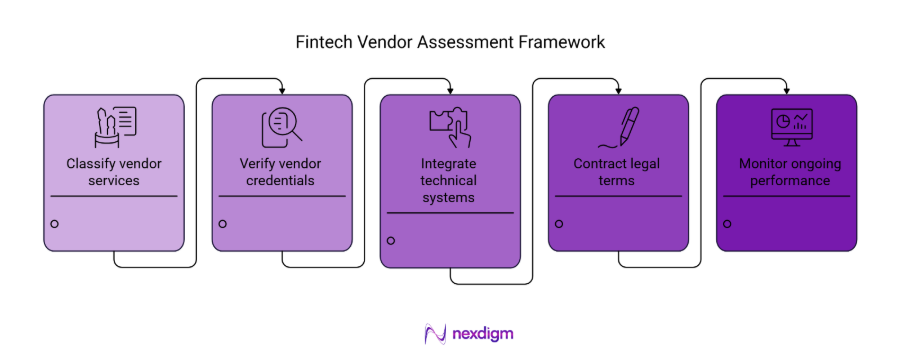
- Classify: Define the service, data access, criticality and regulatory scope.
- Verify: Test the vendor’s legal standing, financial stability, control environment and technical capability.
- Integrate: Examine architecture, access permissions, data flows and implementation dependencies.
- Contract: Translate identified risks into enforceable service levels, audit rights, security obligations and exit provisions.
- Monitor: Establish review frequency, performance indicators, incident escalation and reassessment triggers.
Nexdigm can support this process through vendor due diligence, compliance gap assessment, control benchmarking and procurement research, helping institutions compare providers on evidence rather than product claims alone.
Nexdigm’s Case Study
A financial institution evaluated 8 fintech vendors for a digital onboarding programme. Initial screening retained 5, but security reviews identified unresolved subcontractor and data-access issues at 2 providers. Technical and commercial assessment narrowed the shortlist to 2 vendors, with final selection conditional on revised access controls and contractual audit rights.
To take the next step, simply visit our Request a Consultation page and share your requirements with us.
Harsh Mittal
+91-8422857704