

Financial institutions should evaluate fintech vendors on their ability to support business outcomes, integrate with existing systems and operate within the institution’s risk environment. A platform may offer advanced automation or an extensive feature set, yet prove commercially unsuitable because of high implementation costs, limited interoperability, weak support arrangements or dependence on a narrow group of infrastructure providers.
The strongest vendor assessments therefore combine product evaluation with market intelligence, technical due diligence, commercial analysis and an understanding of the provider’s wider business position. This gives decision-makers a clearer view of what they are purchasing, what dependencies they are accepting and whether the provider can support the institution’s longer-term plans.
Product Capability Is Only the Starting Point
A fintech product should first be assessed against the specific operational requirement. A lending platform, for example, may offer automated underwriting, customer onboarding and loan servicing. However, an institution evaluating it must establish whether these functions work with its existing credit systems, customer databases, payment infrastructure and reporting requirements.
The same distinction applies across banking, payments, wealth management and regulatory technology. Product demonstrations often highlight the most attractive functions, while implementation complexity and operational limitations receive less attention.
A more useful assessment examines how the software performs within the buyer’s actual operating environment. This includes the quality of its APIs, data exchange capabilities, configuration flexibility, system compatibility and ability to handle expected transaction volumes. It should also establish which functions require custom development and which are available as standard capabilities.
Examine the Provider Behind the Product
The vendor’s business position can reveal risks that are not immediately visible in a product demonstration. A specialist fintech may offer strong technology in a narrow category but have limited financial resources, a concentrated customer base or substantial dependence on another infrastructure provider.
Larger technology companies may offer greater financial stability and broader support networks, but their platforms can involve longer implementation cycles, more complex licensing and less flexibility for smaller institutions.
Vendor research should establish:
- Business stability: Operating history, ownership, financial position, funding structure and customer concentration.
- Market position: Target customer segments, geographic presence, product specialisation and competitive standing.
- Technology ownership: Proprietary capabilities, third-party dependencies and reliance on external infrastructure.
- Delivery capability: Implementation footprint, support arrangements, product development and service coverage.
These factors help distinguish a provider with a credible long-term position from one whose product appears attractive but whose operating model may introduce additional risk.
Integration and Operating Dependencies Determine Long-Term Fit
A fintech platform rarely operates independently. It may connect with core banking systems, payment networks, identity verification services, cloud infrastructure, data providers and customer-facing applications. Each connection creates a technical and operational dependency.
Institutions should understand how these relationships affect service continuity, data access and future system changes. A platform that depends on proprietary interfaces or a limited number of integration partners may create switching costs. Similarly, a vendor offering a cloud-based service should be assessed on its hosting arrangements, subcontractors, data locations and recovery capabilities.
The assessment should also distinguish between technical compatibility and actual implementation readiness. Standard APIs do not guarantee a straightforward deployment if the institution’s legacy systems require extensive modifications or data migration.
Commercial Evaluation Must Include the Cost of Ownership
Licensing fees rarely represent the full financial commitment. Implementation, configuration, data migration, training, infrastructure, maintenance and ongoing support can materially change the economics of a fintech investment.
Pricing structures also differ. Vendors may charge per user, transaction, account, application, module or annual subscription. Some combine fixed platform fees with usage-based charges. These models should be tested against projected business volumes to identify how costs behave as the institution expands.
This is where fintech vendor evaluation and research consulting can help institutions move beyond feature-led comparisons. Nexdigm’s market and supplier research can map provider capabilities, commercial positioning, customer segments and technology dependencies to support a more informed shortlist.
Regulatory Expectations Make Third-Party Assessment Essential
Financial institutions remain accountable for their regulated activities even when technology functions are outsourced. Vendor assessment must therefore consider information security, business continuity, audit access, subcontracting, data confidentiality and exit arrangements.
The RBI’s 2025 Directions on Managing Risks in Outsourcing require applicable regulated entities to establish governance and oversight arrangements for outsourced activities. These requirements make the provider’s operational structure and third-party relationships relevant to commercial selection, not simply post-contract compliance.
The wider technology market is also becoming more demanding. India’s digital financial services ecosystem continues to expand, increasing the importance of vendors that can support higher transaction volumes without creating disproportionate operational complexity.
Fintech Vendor Evaluation and Strategic Fit Framework
A defensible shortlist can be built through four connected stages:
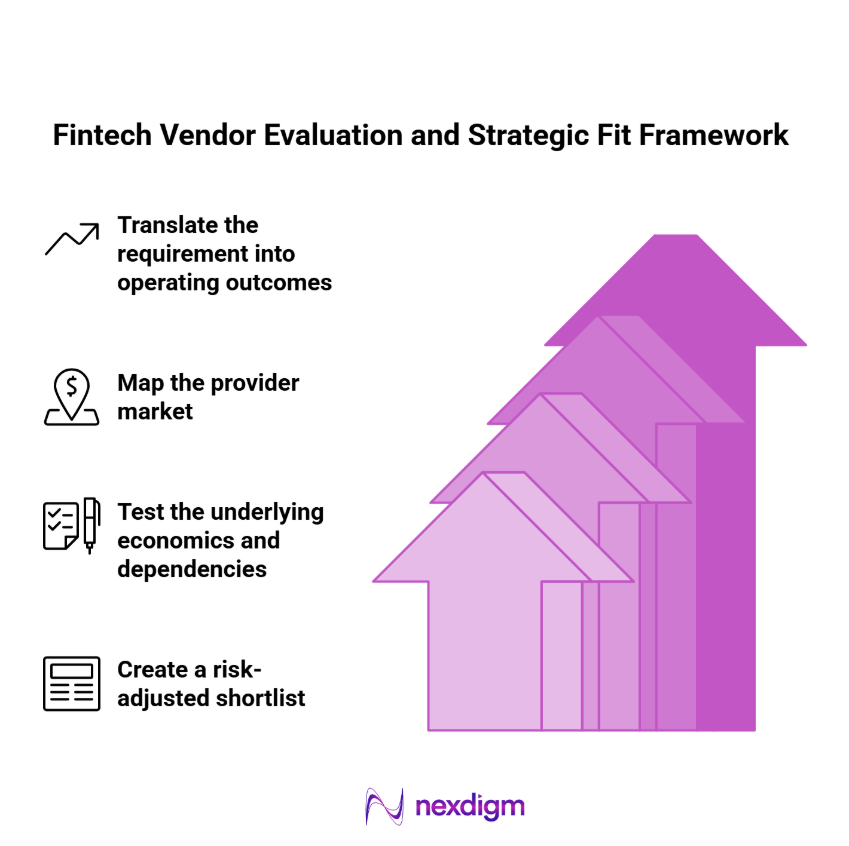
- Translate the requirement into operating outcomes. Define the business process, expected volumes, user groups, integration requirements and measurable improvement sought.
- Map the provider market. Identify relevant fintech categories, specialist providers, established technology companies and emerging suppliers. Compare their customer segments and commercial positioning.
- Test the underlying economics and dependencies. Examine total ownership costs, infrastructure relationships, implementation requirements, financial stability and potential switching barriers.
- Create a risk-adjusted shortlist. Rank vendors against business priorities, technical compatibility and regulatory considerations. Identify which claims require further validation before selection.
Nexdigm’s Case: Fintech Vendor Shortlisting
A mid-sized Indian bank reviewed 26 fintech providers across lending, onboarding and payment operations. The assessment compared product coverage, integration dependencies, financial positioning and indicative ownership costs. Eight providers met the initial requirements, while three were prioritised for detailed technical and commercial evaluation.
To take the next step, simply visit our Request a Consultation page and share your requirements with us.
Harsh Mittal
+91-8422857704