

In the logistics industry, fleet management benchmarking has become a critical tool for gaining a competitive edge. By systematically comparing fleet performance metrics such as vehicle utilization, fuel efficiency, and maintenance costs across different routes and networks, organizations can identify best practices and areas for improvement.
Integrating it with competitive intelligence allows companies to monitor industry standards, track competitor efficiency, and make data-driven decisions that enhance operational performance. Effectively leveraging benchmarking in fleet management not only optimizes resource utilization but also strengthens a company’s strategic position in an increasingly competitive logistics market.
Industry data underscores the value of fleet management benchmarking for improving utilization and reducing waste. High‑performing logistics fleets typically achieve vehicle utilization rates of 80–90%, whereas many operators linger below 70 %, indicating excess capacity and inefficiency. Around 15–20 % of vehicles in a typical fleet may be underutilized at any time, incurring unnecessary costs.
Benchmarking also reveals gaps in maintenance and downtime like top quartile fleets show significantly lower unplanned downtime and higher preventive maintenance compliance, which correlates with lower operating costs and better asset use.
High Vehicle Utilization Strategies Using Competitive Intelligence
High vehicle utilization strategies using competitive intelligence involve analyzing competitor data, optimizing routes, scheduling efficiently, and maximizing load capacity to reduce idle time, lower costs, and improve overall fleet performance:
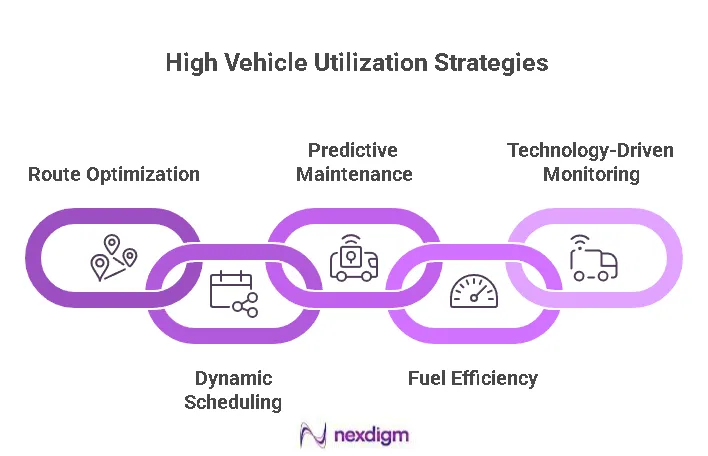
- Route Optimization Using Competitive Intelligence – Analyze competitor routes to identify efficient paths, reduce travel time, fuel usage, and improve on-time delivery rates.
- Dynamic Scheduling and Load Planning – Use competitor insights to adjust schedules, maximize cargo capacity, and minimize idle vehicle time across the fleet.
- Predictive Maintenance and Downtime Reduction – Benchmark competitor maintenance practices to schedule preventive checks, reducing unplanned downtime and maintaining high vehicle availability.
- Fuel Efficiency and Cost Management – Monitor industry fuel consumption trends to adopt best practices, lowering operating costs while sustaining high utilization.
- Technology-Driven Monitoring – Implement telematics and AI-driven tools informed by competitive intelligence to track performance, optimize fleet deployment, and enhance operational efficiency.
Nexdigm’s Fleet Efficiency Assessment Framework for Benchmarking
Nexdigm’s Fleet Efficiency Assessment Framework provides a structured approach to benchmarking by evaluating vehicle utilization, delivery performance, fuel consumption, and maintenance costs. It combines data collection, KPI analysis, and industry comparisons to identify efficiency gaps. By integrating competitive intelligence, the framework enables logistics operators to optimize fleet operations, improve resource allocation, and enhance overall network performance while maintaining high utilization.
Nexdigm Strategic Advisory for Fleet Network Optimization in Managing High Utilization Logistics
Nexdigm’s Strategic Advisory for Fleet Network Optimization guides logistics operators in managing high utilization by aligning fleet deployment, benchmarking performance, and implementing data-driven strategies for cost efficiency and operational excellence.
- Fleet Deployment Planning – Optimizing vehicle allocation across routes to maximize utilization, reduce idle time, and improve delivery efficiency.
- Performance Benchmarking and KPI Analysis – Comparing fleet metrics against industry standards to identify gaps and prioritize operational improvements.
- Data-Driven Route Optimization – Using analytics to design efficient routes, minimize travel time, and enhance vehicle productivity.
- Cost Efficiency and Resource Management – Analyzing operating costs to implement strategies that lower expenses while sustaining high utilization.
- Predictive Maintenance Advisory – Planning preventive maintenance schedules to reduce unplanned downtime and maintain fleet availability.
Nexdigm’s case:
In a recent Nexdigm engagement with a pan‑India logistics provider, fleet utilization improved from 68 % to 84 % within six months through structured benchmarking and competitive intelligence‑driven route optimization. Fuel cost per kilometer decreased by 12 %, and unplanned maintenance dropped by 18 % due to predictive analytics and utilization monitoring. These improvements collectively reduced operating costs and enhanced on‑time delivery performance.
To take the next step, simply visit our Request a Consultation page and share your requirements with us.
Harsh Mittal
+91-8422857704