

Managing a commercial fleet involves monitoring vehicle locations, transportation schedules, driver behaviour, fuel consumption and vehicle condition. When these activities are managed through separate systems or manual reporting, fleet operators may struggle to identify delays, control operating expenses and maintain consistent service performance.
Fleet tracking technology combines GPS, telematics and analytics to provide businesses with information about vehicle movements and operational performance. However, vendors differ in their device capabilities, data accuracy, software functionality and integration options.
Selecting a provider requires an assessment of how its technology supports the organisation’s fleet management requirements.
Understanding the Fleet Tracking Technology Landscape
Fleet tracking solutions generally combine vehicle-mounted devices, communication networks and software platforms. GPS provides location information, while telematics systems collect and transmit operational data from vehicles.
Depending on the provider, the platform may also support route monitoring, driver behaviour analysis, fuel tracking, vehicle diagnostics and maintenance alerts.
The technology landscape includes several categories:
- GPS tracking providers: These vendors offer location monitoring, route history, geofencing and vehicle movement alerts.
- Telematics providers: Their systems collect vehicle data relating to engine performance, fuel consumption, mileage and operating conditions.
- Driver analytics platforms: These solutions evaluate driving behaviour using information such as speeding, harsh braking, acceleration and idling.
- Integrated fleet management platforms: These combine tracking, maintenance, driver management, route planning and operational reporting.
India’s AIS-140 framework provides an additional consideration for certain vehicle categories. The framework establishes requirements for vehicle location tracking devices and emergency buttons in applicable public service vehicles. Procurement teams operating in regulated segments should assess device compliance and approved equipment requirements.
Comparing GPS Accuracy and Telematics Capabilities
GPS accuracy and data availability are important when evaluating fleet tracking vendors. A platform should provide reliable location updates, route history and vehicle movement information across the geographical areas where the fleet operates.
However, location tracking alone provides limited information about fleet performance.
Telematics can offer a broader view by collecting data from vehicle systems and connected devices. Depending on hardware compatibility, this may include engine diagnostics, fuel usage, battery status, mileage and maintenance indicators.
The assessment should examine whether the vendor supports different vehicle manufacturers and models, whether additional hardware is required and how frequently operational data is transmitted.
Device installation, network coverage and connectivity interruptions should also be considered. A system that performs well in urban environments may offer less consistent updates in remote operating regions.
Driver Analytics and Route Visibility
Driver analytics can help fleet operators identify behaviour associated with fuel consumption, vehicle wear and road safety.
The platform may monitor speeding, harsh braking, rapid acceleration, excessive idling and other driving patterns. However, procurement teams should evaluate how these indicators are calculated and whether they can be customised according to vehicle type and operating conditions.
Route visibility is another important capability. Fleet managers should be able to compare planned routes with actual vehicle movements, identify deviations and monitor delivery progress.
A strong platform should also support geofencing, stop-duration monitoring, estimated arrival times and alerts for unexpected route changes.
The Australian National Heavy Vehicle Regulator identifies GPS tracking, route planning, driver fatigue monitoring and vehicle behaviour data as important telematics applications for improving transport safety and operational oversight.
Integration, Reporting and Vendor Support
Fleet tracking platforms often need to exchange information with transportation management systems, ERP applications, dispatch platforms and maintenance software.
Procurement teams should examine API availability, reporting flexibility, data export options and integration costs.
Other considerations include device warranty, installation support, replacement procedures, software updates and technical assistance. The vendor should also clarify ownership of vehicle-generated data and the organisation’s ability to retrieve historical records if the contract ends.
Fleet Tracking Technology Evaluation Framework
A structured fleet tracking technology vendor intelligence exercise should compare providers through six stages:
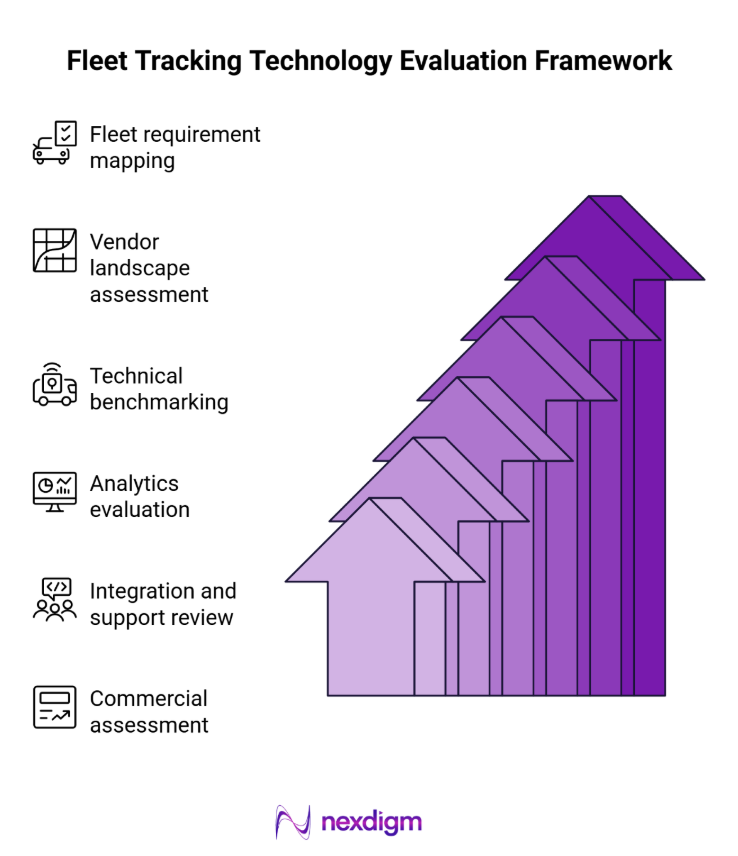
- Fleet requirement mapping: Identify vehicle categories, fleet size, operating regions and monitoring requirements.
- Vendor landscape assessment: Map GPS, telematics and integrated fleet management providers.
- Technical benchmarking: Compare device accuracy, update frequency, sensor compatibility and network coverage.
- Analytics evaluation: Assess driver behaviour monitoring, route visibility, fuel reporting and maintenance alerts.
- Integration and support review: Examine APIs, system compatibility, installation, maintenance and data ownership.
- Commercial assessment: Compare device costs, subscription charges, installation expenses and ongoing support fees.
Nexdigm can support fleet operators through vendor intelligence, technology benchmarking, supplier comparisons and commercial assessments. These exercises help organisations identify suitable tracking solutions and evaluate the operational capabilities of competing providers.
Nexdigm’s Case Study: Improving Fleet Monitoring and Driver Visibility
Nexdigm compared 10 fleet tracking vendors across 3 vehicle categories, assessing GPS accuracy, telematics coverage, driver analytics and integration. The research shortlisted 4 providers, identified a 16% variation in annual subscription costs and established 8 fleet performance indicators for vendor selection.
To take the next step, simply visit our Request a Consultation page and share your requirements with us.
Harsh Mittal
+91-8422857704