

Competitive intelligence evaluates how policy initiatives promoting ethanol blending and reshaping fuel markets and automotive competitiveness. It assesses regulatory momentum, supply chain readiness, and OEM responses, particularly the rise of flex fuel vehicle study as a key enabler of adoption. The analysis compares market readiness across regions, cost implications for refiners and automakers, and the impact on traditional fossil fuel demand.
India achieved E20 petrol rollout in 2025 ahead of schedule, with ethanol blending reaching around 18–19%. The government targets 20%+ blending by 2025–26, potentially saving $4–5 billion in crude oil imports annually.
It also identifies strategic opportunities for fuel producers and vehicle manufacturers to gain advantage in a transitioning energy ecosystem driven by sustainability mandates and evolving consumer mobility preferences.
Competitive Intelligence on Pricing Models for Ethanol Blended Fuels
Competitive intelligence’s pricing models for ethanol blended fuels are evaluated based on government regulation, feedstock costs, and crude oil benchmarks. It analyses how pricing structures influence OMC margins, consumer adoption, and market competitiveness while shaping the economic viability of E20+ ethanol blending expansion:
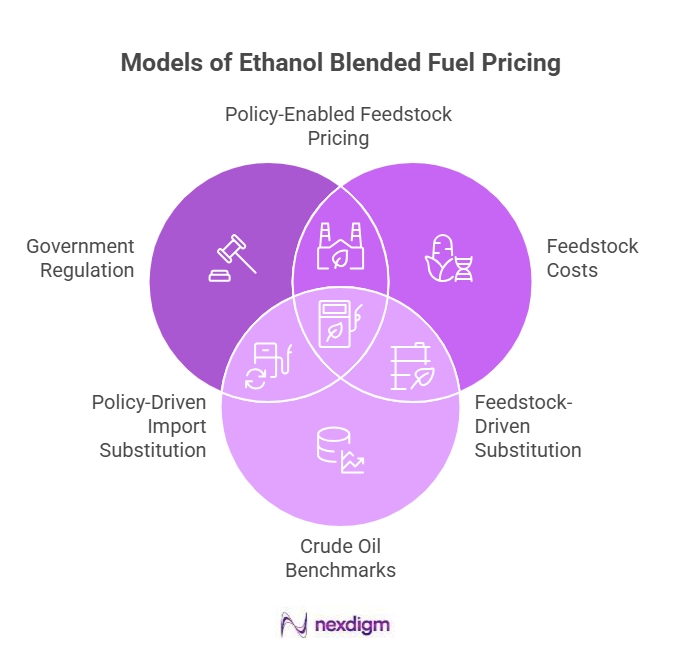
- Government-Controlled Price Regulation: ethanol pricing is largely policy-driven, limiting volatility and ensuring predictable blending economics for oil companies.
- Crude Oil Substitution Benchmarking: Pricing models are assessed against global crude benchmarks to evaluate import substitution benefits and foreign exchange savings.
- Feedstock-Based Pricing Variability: Competitive intelligence highlights sugarcane and maize costs directly influencing ethanol pricing competitiveness across production cycles.
- Oil Marketing Company Margin Analysis: Pricing structures impact OMC profitability, with blending mandates shaping margin protection strategies.
- Regional Price Differentiation Trends: localized ethanol pricing differences based on logistics, availability, and state-level policy incentives.
Nexdigm’s policy of fuel blending
Nexdigm’s policy advisory on fuel blending focuses on evaluating ethanol and biofuel blending mandates through regulatory analysis, market readiness assessment, and cost-impact studies. Its services include competitive intelligence, policy benchmarking, supply chain evaluation, and OEM transition strategies, enabling stakeholders to align with E20+ adoption goals and evolving sustainable fuel frameworks.
Nexdigm’s market rediness in blending expansion
Nexdigm’s, market readiness for ethanol blending expansion is assessed through supply chain capability, infrastructure preparedness, policy enforcement, and OEM alignment. The evaluation focuses on identifying gaps in ethanol availability, distribution efficiency, and flex fuel vehicle adoption to determine scalability of E20+ implementation across diverse regional markets.
Market Demand-Supply Alignment
Competitive intelligence assesses ethanol supply versus blending targets Nexdigm identifies regional gaps limiting consistent E20+ fuel availability and scalability
Policy Enforcement Strength Across Regions
Comparative policy analysis shows uneven enforcement levels Nexdigm highlights this variability as a key driver of adoption speed differences
Fuel Infrastructure Readiness Assessment
Infrastructure evaluation includes storage blending and retail networks Nexdigm notes infrastructure limitations as a major barrier to scaling ethanol blending
Flex Fuel Vehicle Readiness
Analysis of automaker preparedness and flex fuel adoption levels Nexdigm considers OEM alignment essential for successful ethanol blending transition
Cost Competitiveness of Blended Fuels
Pricing comparison between ethanol blends and petrol Nexdigm emphasizes cost parity as critical for widespread consumer acceptance
Nexdigm’s case:
Nexdigm highlights India’s ethanol blending progress where E20 rollout was achieved ahead of target with blending reaching nearly 18–19% Industry estimates indicate potential annual crude oil import savings of around 4–5 billion USD Nexdigm notes this shift strengthens energy security while accelerating OEM focus on flex fuel vehicle development and supply chain expansion.
To take the next step, simply visit our Request a Consultation page and share your requirements with us.
Harsh Mittal
+91-8422857704