

FMCG growth is increasingly uneven. Some categories are expanding because of rising penetration. Others are gaining through premiumization, changing consumption occasions, or new channels. Geography can create another layer of divergence, with rural and urban consumers responding differently to income, pricing, distribution, and product availability.
For companies looking for their next growth engine, the relevant question is therefore not simply where FMCG is growing. It is where several growth conditions overlap.
The Growth Pocket Is Smaller Than the Market
A national category can contain very different commercial realities.
One region may have strong penetration but limited headroom. Another may have low penetration but weak distribution. A third may combine rising household spending with limited competitive intensity.
The same applies to consumers. Younger households may drive experimentation and digital purchasing, while established households may contribute greater category frequency. Premium consumers may trade up in some categories while value-conscious consumers actively reduce discretionary spending.
This makes growth-pool identification a matter of intersection rather than scale alone.
Three Forces Are Changing the Opportunity Map
- Geographic Divergence: Rural volume growth continues to outpace urban centers over multi-quarter horizons, shifting volume gravity away from saturated metros.
- Channel Realignment: Quick commerce dominates modern digital grocery, capturing over 75% of online FMCG sales in major metros and reshaping stocking formats toward high-velocity essentials.
- Category Formalization: Scaled expansion of processed food—headed toward $689 billion by FY2034—signals accelerated migration from unbranded commodities to packaged, value-added products.
Together, these changes mean that category growth, consumer growth, and channel growth increasingly need to be analysed together.
How to Find the Pockets Worth Pursuing
An FMCG growth opportunity assessment can begin by mapping category performance across regions and consumer segments.
The next step is to identify where penetration remains low but the underlying demand indicators are strengthening. These may include increasing household expenditure, improving retail availability, changing consumption occasions, growing digital adoption, or rising willingness to trade up.
Competitive intensity then determines whether the opportunity is accessible.
A high-growth category with dominant incumbents and limited differentiation may offer less practical headroom than a smaller category where consumer demand is emerging and competitive coverage remains fragmented.
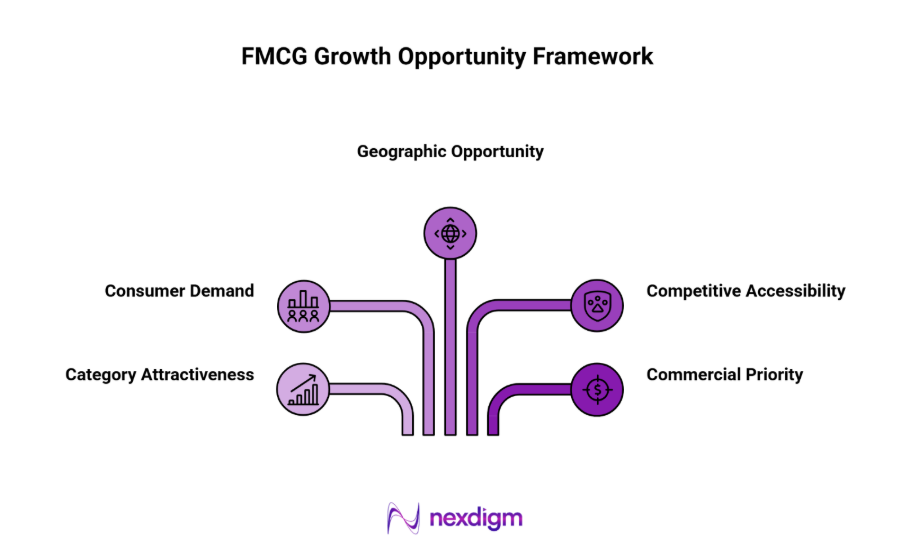
Nexdigm’s Five-Point FMCG Growth Opportunity Framework
- Category and Market Attractiveness
Assess category growth, market size, penetration, consumption trends, and the structural factors supporting future demand. - Consumer and Demand Potential
Identify consumer segments with rising expenditure, changing preferences, new consumption occasions, and greater willingness to trade up. - Geographic and Channel Opportunity
Compare regional demand patterns, retail availability, channel migration, and the role of modern trade, general trade, and digital channels in reaching target consumers. - Competitive Accessibility
Evaluate incumbent strength, competitor coverage, pricing, promotional intensity, and areas where fragmented competition or unmet needs create room for entry. - Commercial and Investment Priority
Translate market attractiveness into actionable priorities by assessing revenue potential, addressable demand, investment requirements, and the feasibility of capturing identified growth pockets.
From Market Mapping to Investment Priorities
Nexdigm can combine secondary research, primary consumer research, competitive intelligence, channel analysis, and market sizing to identify commercially relevant growth pockets.
The analysis can examine:
- Category momentum and penetration
- Consumer income and purchasing behavior
- Regional consumption differences
- Channel availability and migration
- Competitor presence and positioning
- Price and promotional dynamics
- Unmet consumer requirements
These findings can then be used to prioritize markets, categories, consumer segments, and channels for further investment.
The value lies in narrowing a large FMCG market into a smaller set of opportunities that can be investigated, tested, and acted upon.
Vietnam FMCG Assessment Informed an IPO Strategy
Nexdigm studied Vietnam alongside China and Thailand, analysing FMCG spending, modern trade, e-commerce, premiumization, wealth distribution, and consumer trends. Primary research and comparative analysis helped the client develop an informed IPO prospectus strategy.
To take the next step, simply visit our Request a Consultation page and share your requirements with us.
Harsh Mittal
+91-8422857704