

Launching an FMCG product is relatively easy. Getting consumers to buy it repeatedly is the expensive part.
A new offering must enter a market where consumers already have familiar brands, established price expectations and increasingly fragmented routes to purchase.
It may find demand and still fail because the price is wrong, distribution is expensive, the product lacks differentiation or competitors can replicate the proposition quickly.
A feasibility study should therefore test the commercial system around the product, not simply estimate category growth.
The First Test: Is There a Real Consumer Need?
A product concept should begin with a specific consumption problem.
Is it solving a convenience gap?
Improving nutritional value?
Offering a more accessible price?
Providing a better format?
Serving a previously overlooked consumer segment?
Voice of the Consumer 2025 found that 84% of Indian consumers considered food safety an important driver, while 63% were concerned about food costs.
It also found that 29% cited health benefits among the top three reasons they would switch food brands.
These findings illustrate why a broad proposition such as “healthier” or “premium” is insufficient. The product needs a reason to be chosen.
Then Test the Price, Not the Excitement
Consumer interest does not equal willingness to pay.
A feasibility assessment should construct a price ladder covering:
- Entry price
The lowest viable price point that enables trial and reaches price-sensitive consumers. - Core price
The price at which the product needs to generate sustainable margins and repeat purchases. - Premium price
The ceiling that can be supported by measurable product benefits, ingredients, format or brand positioning. - Promotional price
The level at which discounts, introductory offers and channel promotions remain commercially viable.
This becomes particularly important in a market where consumers are actively reassessing value.
Distribution Can Make or Break the Product
A product that works on a spreadsheet may become unviable once distribution costs are included. The route to market affects margins, reach and speed of adoption.
- General trade provides scale and habitual purchasing but requires distributor and retailer economics.
- Modern trade provides visibility and organized shelf presence but can involve listing, promotional and margin requirements.
- E-commerce expands assortment and enables targeted discovery.
- Quick commerce can support high-frequency, convenience-oriented purchases but changes expectations around availability and fulfilment.
NIQ reported that e-commerce represented 18% of FMCG sales across India’s top eight metros in OND 2025, while quick commerce contributed more than three-fourths of e-commerce FMCG sales.
A launch plan therefore needs to determine where the product should appear first rather than attempting nationwide distribution immediately.
Competitive Fit Is More Than Market Share
A new product can enter a large category and still have limited room to compete.
The assessment should identify:
- Number and strength of established brands
- Private-label penetration
- Price gaps between competing products
- Product differentiation
- Distribution reach
- Promotional intensity
- Innovation frequency
- Consumer switching behaviour
A useful test is whether the proposed offering creates a meaningful reason to switch without requiring consumers to learn an entirely new consumption behaviour.
Build the Feasibility Case Around Four Decisions
Rather than asking whether the market is attractive in isolation, the feasibility assessment should answer four commercial questions:
- Demand: Is the target consumer segment large enough and dissatisfied enough to support adoption?
- Economics: Can the product achieve acceptable margins at a realistic consumer price?
- Route to market: Can distribution reach the target consumer without destroying unit economics?
- Competitive response: Can incumbents easily replicate the proposition or defend their position through pricing and promotions?
A product that passes all four has a stronger basis for launch than one supported only by category-growth statistics.
Nexdigm’s FMCG Launch Feasibility Framework
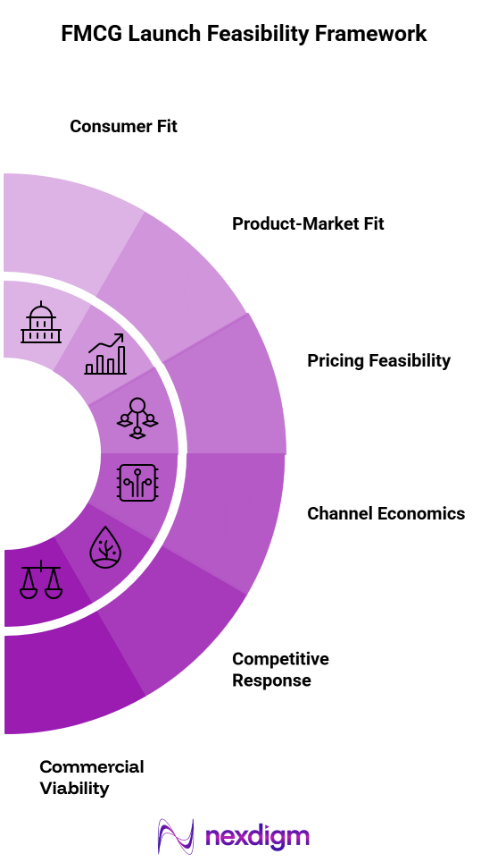
- Consumer Fit
Segment target consumers by need, consumption occasion, purchase behaviour and switching triggers. - Product-Market Fit
Assess product attributes, differentiation, format, benefits and competitive alternatives. - Pricing Feasibility
Benchmark prices, pack sizes, willingness to pay, margins and promotional requirements. - Channel Economics
Evaluate general trade, modern trade, e-commerce, quick commerce and other routes to market. - Competitive Response
Assess incumbent brands, private labels, innovation pipelines and likely pricing responses. - Commercial Viability
Model market size, penetration, revenue, margins, distribution costs and launch economics.
Nexdigm’s FMCG market feasibility study consulting helps companies assess whether a new offering is commercially viable through consumer research, market sizing, pricing analysis, competitor assessment, channel economics and go-to-market evaluation.
This creates a go-to-market assessment based on the economics of winning, rather than simply the size of the category.
Nexdigm Case Study: Testing an FMCG Product Launch
Nexdigm assessed a new FMCG proposition against consumer demand, price points, channel economics and competitive intensity. With 52% of Indian consumers switching to private labels and e-commerce reaching 18% of FMCG sales in top metros, the assessment helped refine positioning and launch priorities.
The analysis enabled the client to identify the most relevant consumer segment, establish a defensible price architecture and prioritize channels where initial distribution could be scaled efficiently.
To take the next step, simply visit our Request a Consultation page and share your requirements with us.
Harsh Mittal
+91-8422857704