
FMCG pricing feasibility becomes critical when small price changes can materially influence demand, trial, repeat purchases, and brand switching across competitive categories. FMCG pricing feasibility research consulting helps businesses evaluate price elasticity, consumer willingness to pay, competitor benchmarks, pack-price architecture, channel margins, and promotional response.
With strategic Pricing Analysis, companies can test alternative price points, forecast volume shifts, estimate break-even performance, and identify profitable market positions. These insights reduce launch risk, support margin optimization, and improve commercial decisions across product portfolios, retail channels, customer segments, and regional markets.
Global consumer packaged goods value sales grew 3.5% in 2025, while volumes increased 0.9%, according to NIQ. This expansion demonstrates that disciplined Pricing Analysis can help FMCG brands protect demand, improve price realization, and capture profitable growth despite consumer sensitivity.
FMCG Pricing Analysis for Consumer and Market Alignment
FMCG pricing analysis aligns consumer affordability, competitor positioning, pack architecture, and category economics, helping brands protect demand, improve margins, strengthen value perception, and achieve sustainable market growth. Some core advantages for the same are:
- Demand Protection: Identification of customer sensitivity to price changes, helping businesses select acceptable thresholds, reduce volume losses, maintain repeat purchases, and support stable category performance consistently.
- Innovation Pricing: Determination of suitable prices for new formulations, packaging, claims, or features, helping brands support trial while capturing value from meaningful product differentiation.
- Revenue Forecasting: Estimation of sales and margin outcomes across alternative price points, helping businesses select commercially balanced options and improve financial planning before implementation.
- Pricing Governance: Establishment of decision rules, approval limits, and review schedules, helping businesses improve pricing consistency, accountability, execution speed, and control across teams and markets.
Nexdigm’s Strategic Pricing Support for Competitive FMCG Markets
Nexdigm enables FMCG businesses to make confident pricing decisions through data-driven market intelligence and commercial analytics. Our expertise in FMCG pricing feasibility research consulting, pricing analysis, competitor price benchmarking, price elasticity analysis, FMCG pricing strategy consulting, retail pricing optimization, promotional pricing analysis, portfolio pricing, and pricing intelligence helps brands improve demand forecasting, protect margins, strengthen competitive positioning, and achieve sustainable business growth.
Nexdigm’s Market-Sensing Pricing Framework for Consumer Goods
Nexdigm’s market-sensing framework combines consumer signals, competitor movements, channel trends, and category economics to guide responsive pricing strategies that improve relevance, demand protection, margins, and execution across markets. Some important strategies used in the framework are:
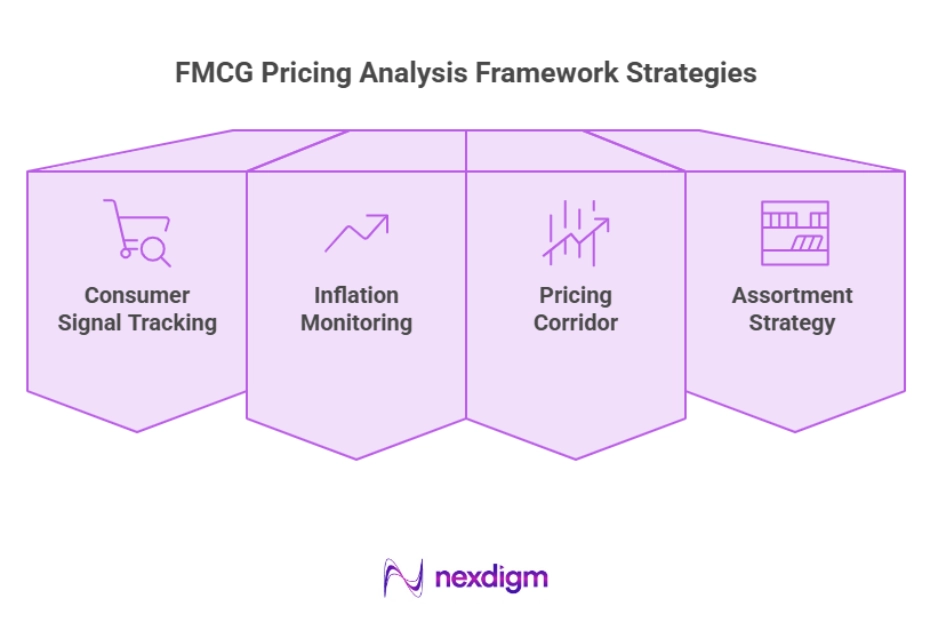
- Consumer Signal Tracking Strategy: Monitors spending behaviour, affordability concerns, preferences, and purchase frequency, helping businesses detect demand changes early and adjust prices before customer switching increases significantly.
- Inflation Monitoring Strategy: Evaluates commodity costs, supplier increases, logistics expenses, and market pass-through patterns, helping businesses implement selective price changes without weakening consumer confidence or affordability.
- Pricing Corridor Strategy: Defines minimum, target, and maximum price levels using demand, cost, and competitor signals, helping teams make faster decisions within commercially acceptable boundaries across markets.
- Assortment Strategy: Monitors product mix, competitor assortment changes, and shelf visibility, helping businesses identify pricing opportunities, strengthen differentiation, and respond to emerging category shifts early.
Nexdigm’s Case
Nexdigm supported an FMCG company in establishing market-sensing triggers across pricing, promotions, packs, and competitor activity. The initiative improved forecast accuracy by 13%, reduced response time to market changes by 31%, increased full-price sales contribution by 9%, and lowered consumer switching, strengthening demand resilience across priority categories.
To take the next step, simply visit our Request a Consultation page and share your requirements with us.
Harsh Mittal
+91-8422857704