

The biggest procurement category is not necessarily the best savings opportunity. A high-spend category may have limited supplier competition or strict technical requirements, while a smaller category may contain inconsistent pricing, missed rebates, or unnecessary product variation. FMCG procurement teams need to distinguish expenditure size from the portion that can realistically be reduced.
A category-ranking exercise should consider spend, price variation, supplier competition, and the practical cost of making a change.
Market Context: Cost Pressure Is Uneven
India’s food-processing sector recorded gross value added of ₹2.24 lakh crore in 2023-24, according to the Ministry of Food Processing Industries. Government data also show that processed food accounted for 20.4% of India’s agricultural exports in 2024-25, compared with 13.7% in 2014-15. This expanding ecosystem is relevant to FMCG sourcing because it supports processing, packaging, and value-added production.
However, a larger supplier base does not guarantee more competitive pricing in every category. Supplier capacity, brand or formulation requirements, quality approvals, distribution reach, and minimum production volumes all influence the number of viable alternatives.
Commodity movements are also mixed. In September 2026, the FAO Food Price Index was 5.8% above its year-earlier level. Cereals rose 17.2% year on year and vegetable oils 18.3%, while dairy fell 18.8% and sugar fell 8.5%. FMCG buyers should therefore monitor the inputs relevant to each category rather than assume that the whole portfolio faces the same cost trend.
Category Spend: Which Purchases Have the Greatest Impact?
Start by ranking annual expenditure across ingredients, packaging, contract manufacturing, logistics, cleaning supplies, and other operating categories. For each, calculate spend concentration and identify the products responsible for most of the total.
The analysis should separate direct purchase prices from freight, duties where relevant, rebates, and other charges. It should also distinguish changes in price from changes in volume or product mix.
Savings Potential: Where Is the Cost Gap Addressable?
The best candidates for early review often share several characteristics:
- Multiple suppliers can meet the same specification.
- Comparable products show unexplained price variation.
- Purchasing is fragmented across sites or business units.
- Contract terms, rebates, or delivery charges are inconsistent.
- Product or packaging variation creates avoidable complexity.
By contrast, specialised ingredients or tightly regulated products may require testing and lengthy qualification before a supplier can be changed. A high theoretical price gap does not equal an immediately achievable saving.
For FMCG procurement category benchmarking consulting, each category should be assessed against both the size of the opportunity and the cost of implementing it.
Supplier Competition and Commercial Levers
Benchmarking should examine whether buyers are using their full purchasing leverage. Relevant factors include the number of qualified vendors, supplier capacity, minimum order quantities, credit periods, volume rebates, freight, and price-adjustment clauses.
A bulk discount may be less attractive after storage, expiry, and working-capital costs are included. Similarly, consolidating suppliers may simplify purchasing but increase dependence on a single producer. Category decisions need to balance commercial leverage with continuity.
FMCG Procurement Savings Framework
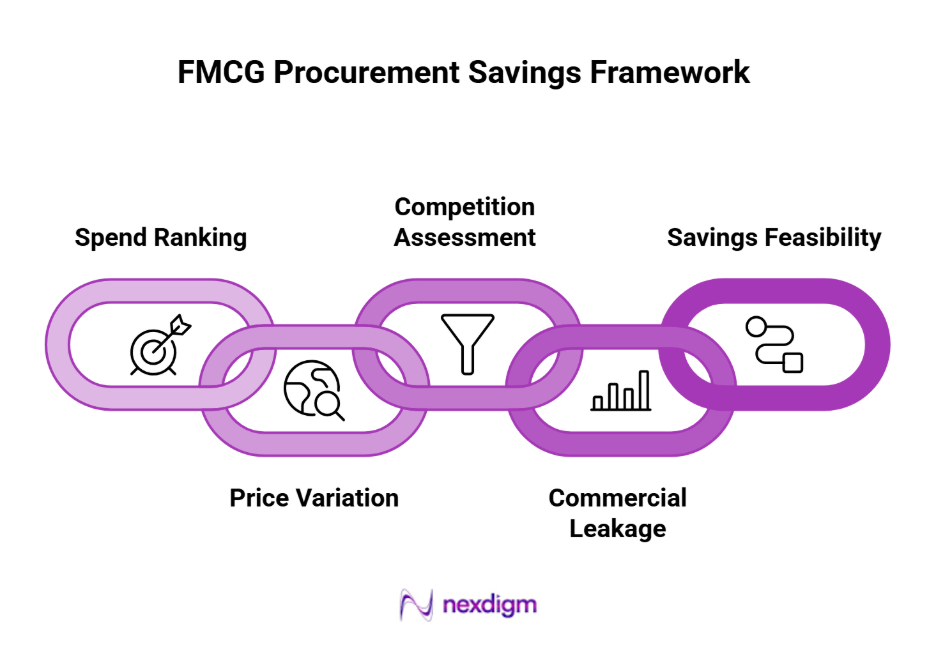
- Spend Ranking: Prioritise categories by annual expenditure, product-level concentration, and financial materiality.
- Price Variation: Compare equivalent products across suppliers, sites, and contract periods to identify unexplained cost gaps.
- Competition Assessment: Evaluate qualified alternatives, market concentration, switching costs, and the time needed for technical approval.
- Commercial Leakage: Review rebates, freight, credit terms, minimum orders, and purchasing outside negotiated contracts.
- Savings Feasibility: Rank opportunities by achievable reduction, implementation effort, inventory impact, quality risk, and supply continuity.
Where FMCG Buyers Should Look First
Standard packaging, routine consumables, and comparable non-specialised inputs may offer relatively accessible opportunities when specifications are consistent. Logistics and contract compliance can also yield savings without changing the product itself.
Ingredient substitutions and formulation changes need more scrutiny. Testing, label changes, regulatory requirements, and consumer acceptance can outweigh the apparent purchase price advantage.
Nexdigm’s Case Study
An FMCG business reviewed ₹52 crore in annual procurement across ingredients, packaging, logistics, and operating supplies. Category-level benchmarking highlighted inconsistent net prices and missed commercial benefits. The resulting sourcing plan prioritised categories with qualified alternatives and measurable contract gaps, with savings assessed against actual purchases and implementation costs.
To take the next step, simply visit our Request a Consultation page and share your requirements with us.
Harsh Mittal
+91-8422857704