
FMCG procurement is facing a more uneven cost and demand environment, making category-level benchmarking increasingly important. NIQ’s 2026 data puts global CPG inflation at 2.7%, while global FMCG volume growth is only 0.2%, indicating that value growth cannot be understood without examining category-level price and volume movements.
NIQ also reports that 68% of consumers view private label as a good alternative to national brands, increasing competitive pressure across categories. In India, CRISIL Ratings expects organized FMCG players to maintain 8–10% revenue growth, but notes that crude-linked input costs are affecting categories unevenly and could reduce gross margins by 300–350 basis points.
These dynamics make FMCG procurement category benchmarking retail increasingly relevant for comparing supplier costs, commercial terms, demand patterns, and category performance.
Why FMCG Categories Cannot Be Benchmarked the Same Way
FMCG categories respond differently to input costs, consumer demand, promotions, pack sizes, supplier concentration, and competitive intensity. A category facing commodity-driven inflation may require a different procurement response from one experiencing declining volumes or stronger private-label competition. Category-level benchmarking helps procurement teams understand these differences rather than applying a single cost or supplier benchmark across the entire portfolio.
The Dimensions Behind Category Performance
A useful FMCG benchmark needs to connect procurement economics with demand and market behavior.
- Cost and Supplier Position: Compare supplier pricing, input costs, volumes, terms, and supplier concentration to identify meaningful commercial differences.
- Demand and Category Position: Examine volume trends, price movements, product mix, and category growth to understand whether procurement performance aligns with market conditions.
Together, these comparisons provide a clearer picture of which categories are performing competitively and where procurement strategy may need adjustment.
Nexdigm’s Expert-led View of FMCG Category Competitiveness
Nexdigm looks at FMCG categories as interconnected commercial ecosystems, where supplier economics, demand behavior, pricing, and market conditions influence one another. Our experts bring these signals together to understand what is shaping category performance by:
- Reading the Cost Story: Examine whether cost movements are driven by supplier pricing, input costs, volumes, specifications, or broader market conditions.
- Interpreting Demand Signals: Assess volume changes, product mix, pricing movements, and category growth to understand how demand is influencing procurement requirements.
- Connecting Market and Supplier Dynamics: Consider supplier concentration, competitive intensity, sourcing markets, and category developments to identify where procurement positioning may be strengthened.
This integrated view helps FMCG businesses move beyond isolated benchmarks and develop a clearer understanding of what is driving category performance and where intervention could create value.
Nexdigm’s FMCG Category Benchmarking Framework
Nexdigm can structure category benchmarking through a FMCG procurement category benchmarking service that connects procurement economics with market and demand signals, helping businesses evaluate each category on a consistent basis by conducting:
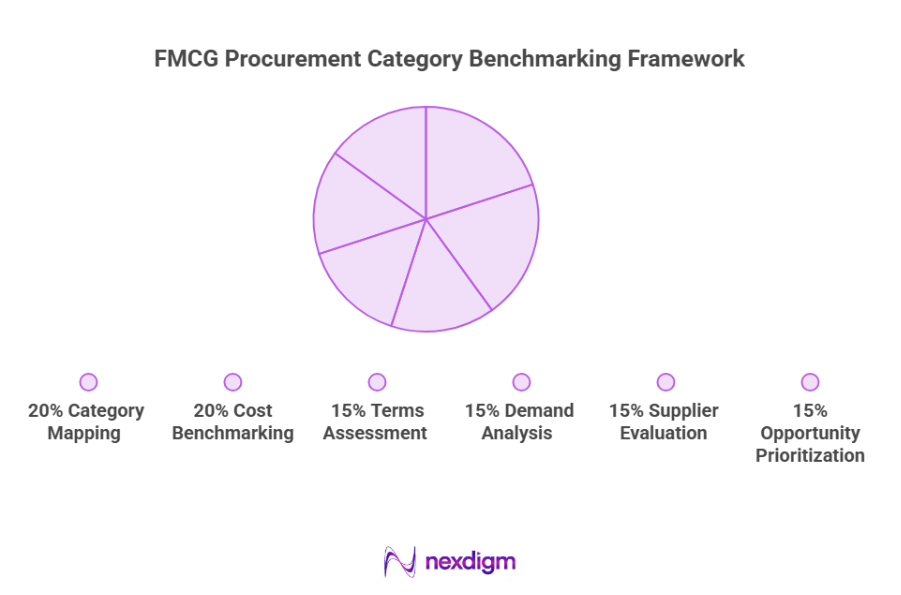
- Category Mapping: Defining categories, suppliers, products, specifications, volumes, and purchasing patterns to establish a reliable comparison baseline.
- Cost Benchmarking: Comparing supplier prices, input costs, volumes, and relevant market references to identify meaningful cost differences.
- Terms Assessment: Evaluating discounts, rebates, payment conditions, minimum orders, logistics costs, and contractual terms to understand total supplier economics.
- Demand Analysis: Examining volume trends, product mix, pricing movements, and category growth to determine how demand influences procurement performance.
- Supplier Evaluation: Assessing supplier concentration, capabilities, competitive alternatives, and sourcing markets to identify structural strengths or dependencies.
- Opportunity Prioritization: Rank identified gaps according to spend, savings potential, market conditions, strategic importance, and feasibility of intervention.
This framework enables FMCG businesses to move from category-level comparison to a structured view of performance gaps and actionable procurement opportunities.
How Nexdigm’s Framework Identifies Actionable Procurement Opportunities
Nexdigm’s framework helps FMCG businesses move from category-level observations to specific procurement opportunities by connecting:
- Expose Cost Opportunities: Identify categories where pricing, input costs, volumes, or supplier terms indicate potential for negotiation, sourcing changes, or cost improvement.
- Revealing Supplier Opportunities: Use supplier concentration, capabilities, and competitive alternatives to identify opportunities for consolidation, diversification, or stronger commercial leverage.
- Connecting Demand With Action: Assess volume trends, product mix, and category growth to determine whether changing demand requires adjustments to purchasing strategies or supplier arrangements.
- Prioritizing Commercial Impact: Rank opportunities according to spend, potential savings, strategic relevance, market conditions, and implementation feasibility to focus resources on the strongest opportunities.
This enables procurement teams to move from benchmarking what is happening to understanding what can be done, where action should begin, and why it matters.
Nexdigm’s Case
Nexdigm benchmarked 12 FMCG categories across suppliers and five sourcing markets, identifying four categories with significant cost and commercial gaps. The assessment highlighted a 19% potential cost-improvement opportunity and identified 4 categories requiring supplier diversification, enabling the client to prioritize negotiations, sourcing alternatives, and category-level interventions based on commercial impact.
To take the next step, simply visit our Request a Consultation page and share your requirements with us.
Harsh Mittal
+91-8422857704