
Fast-moving consumer goods procurement is shaped by a combination of commodity markets, packaging inputs, manufacturing capacity, distribution economics, and supplier bargaining power. A retailer may face different cost pressures across packaged foods, beverages, personal care, and household products even when purchasing volumes remain stable.
A meaningful benchmark must therefore compare equivalent products and commercial terms while distinguishing market-wide price movements from supplier-specific differences.
Track Product-Level Costs
FMCG categories should be analysed at a sufficiently detailed level to account for brand, pack size, formulation, quality, and promotional requirements. Comparing a larger pack with a smaller one using unit price alone can distort the result, while changes in product mix can make aggregate spending appear to rise even when comparable prices remain stable.
For food-related categories, the Food and Agriculture Organization’s Food Price Index provides an official indicator of international price movements across major food commodity groups. It can help explain upstream pressures on cereals, vegetable oils, sugar, dairy, and meat, but it does not directly measure the price paid by a retailer for a finished branded product.
Compare Supplier Economics
Supplier quotations may differ because of order quantities, rebates, credit periods, promotional funding, delivery frequency, minimum order values, and return conditions. Some suppliers offer lower invoice prices but require larger purchases, increasing working capital and inventory exposure.
For FMCG procurement cost benchmarking services, these terms need to be compared alongside product specifications and supply reliability. Retailers should also distinguish manufacturers from distributors because intermediary margins, warehousing, and service responsibilities can affect the final landed cost.
Investigate Market Differences
A price difference between suppliers does not automatically indicate overpayment. Regional freight, tax treatment, manufacturing location, product freshness, and delivery frequency may explain legitimate cost variation.
The more useful question is whether comparable retailers or suppliers operate under similar conditions. Internal comparisons across stores and regions can reveal inconsistent contract terms, while supplier quotations and official commodity indicators can provide additional context for negotiations.
FMCG Procurement Cost Benchmarking Framework
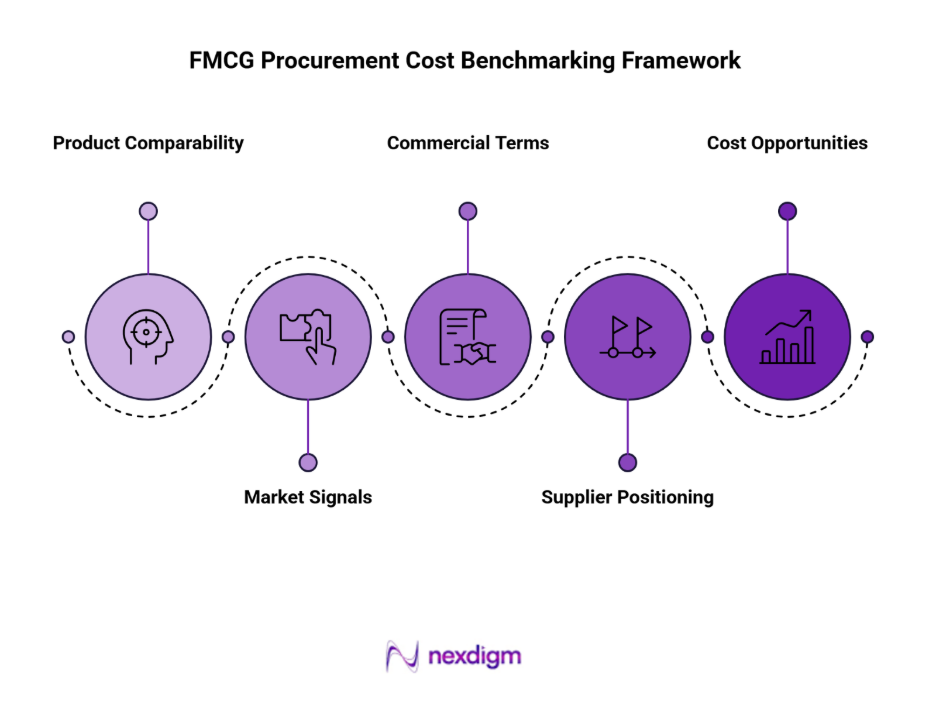
- Product Comparability: Standardise product identity, brand, pack size, specification, quality, and delivery conditions before comparing unit prices across suppliers.
- Market Signals: Track relevant commodity and input-price indicators to understand upstream pressures, while separating those movements from finished-product pricing and supplier margins.
- Commercial Terms: Compare rebates, promotional contributions, credit periods, minimum orders, delivery charges, returns, and other conditions that change the effective purchase price.
- Supplier Positioning: Assess manufacturer and distributor roles, geographic coverage, order capacity, supply reliability, and alternative sourcing options to understand competitive pressure.
- Cost Opportunities: Prioritise categories with unexplained price variance, fragmented volumes, inconsistent terms, or viable alternative suppliers, then validate savings against actual purchasing data.
Build a Defensible Benchmark
Procurement teams should maintain a record of comparable products, supplier offers, contract terms, and the evidence supporting each benchmark. This helps distinguish a genuine pricing opportunity from a difference caused by specifications or service obligations.
Nexdigm’s Case Study
A retailer analysed ₹30 crore in annual FMCG purchases across four categories. Normalising pack sizes, rebates, and freight revealed inconsistent effective prices between suppliers. Consolidated negotiations identified a potential 2.5% reduction in addressable spend, equivalent to ₹75 lakh annually, subject to supplier agreement and volume validation.
To take the next step, simply visit our Request a Consultation page and share your requirements with us.
Harsh Mittal
+91-8422857704