

FMCG procurement decisions sit between volatile input markets and the commercial realities of retail. Manufacturers and retailers must manage product availability, promotional commitments, pack-size requirements, supplier margins, and inventory turnover while protecting margins. A low purchase price is useful only if the product meets specifications and arrives in the required quantity and timeframe.
Spend benchmarking should establish whether procurement costs are competitive after accounting for the full set of commercial and operational conditions.
Understand the Market Context
India’s food-processing sector has been growing, with government estimates recording average annual growth of 6.55% over the nine years ending in 2023-24. Processed food also accounted for 20.4% of India’s agricultural exports in 2024-25, compared with 13.7% in 2014-15.
For FMCG buyers, this growth points to an evolving supplier base and increasing importance of processing, packaging, and distribution capability. Yet market expansion does not guarantee lower procurement prices. Demand growth can tighten capacity in specific categories, while supplier concentration or specialised production requirements may limit alternatives.
The relevant question is not whether the FMCG market is growing, but whether the buyer’s terms are competitive within the product category and sourcing geography.
Benchmark the Effective Purchase Price
FMCG spend can be distorted by differences in pack size, formulation, grade, promotional support, and delivery terms. A larger pack may have a lower price per unit but require more working capital or sell more slowly. A supplier offering rebates may appear expensive on the invoice but deliver a lower net cost after agreed commercial support.
For FMCG procurement spend benchmarking services, every comparison should normalise product specifications and commercial conditions. Analysis should include freight, rebates, payment terms, minimum order quantities, returns, promotional funding, and any service charges.
External indicators are useful when they match the purchased input. Commodity data may help explain movements in sugar, vegetable oils, or cereals, but they should not be treated as direct benchmarks for finished branded goods.
Look for Hidden Spend Drivers
Three areas commonly deserve closer investigation. Fragmented ordering can prevent buyers from reaching better volume tiers. Supplier substitutions can introduce differences in product cost or quality. Inconsistent contract terms across locations can create price variation for otherwise comparable purchases.
Inventory also matters. Buying more to secure a discount can increase storage costs, expiry exposure, and cash tied up in stock. Procurement benchmarking should therefore consider the economic cost of the purchasing decision, not just the negotiated rate.
FMCG Procurement Spend Benchmarking Framework
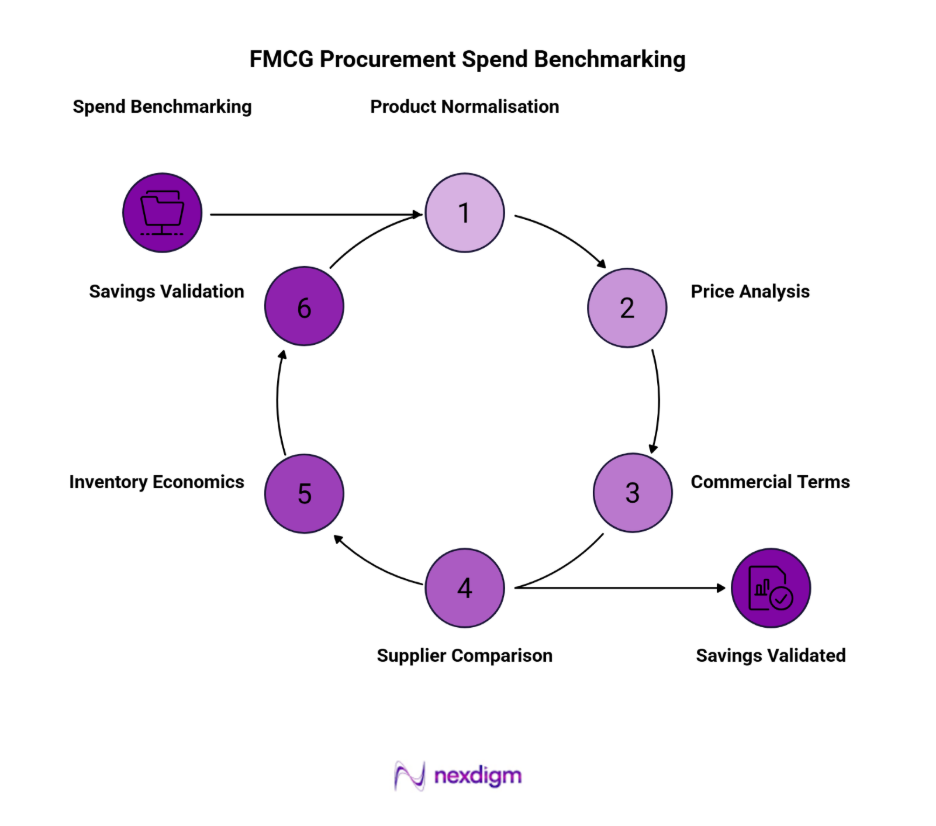
- Product Normalisation: Standardise brand, grade, pack size, formulation, delivery conditions, and quality requirements before comparing purchase prices.
- Price Analysis: Track historical prices and relevant input indicators to distinguish market movements from supplier-specific changes and differences in product mix.
- Commercial Terms: Compare rebates, credit periods, promotional funding, minimum orders, returns, freight, and additional charges to calculate effective purchase costs.
- Supplier Comparison: Assess equivalent quotations, manufacturing or distribution capability, delivery performance, and available alternatives within each category.
- Inventory Economics: Examine order frequency, stock cover, shelf life, wastage, and working-capital requirements to identify when bulk discounts create hidden costs.
- Savings Validation: Prioritise categories with meaningful spend and credible alternatives, then measure realised savings against a volume- and mix-adjusted baseline.
Turn Benchmarks Into Negotiation Leverage
Benchmarking is most valuable when it changes the next sourcing decision. Buyers can consolidate orders, revise contract structures, negotiate more transparent rebates, or move selected volumes to qualified alternatives. Categories with limited competition may require longer-term supplier development rather than immediate switching.
Nexdigm’s Case Study
A regional FMCG retailer analysed ₹36 crore in annual procurement across packaged foods, personal care, and household products. Normalising pack sizes, rebates, and freight revealed inconsistent net pricing across comparable products. Consolidated negotiations and revised order allocation reduced addressable spend by 3.2% over two quarters while retaining approved product specifications.
To take the next step, simply visit our Request a Consultation page and share your requirements with us.
Harsh Mittal
+91-8422857704