

FMCG supply chains depend on a large network of manufacturers, contract packers, ingredient suppliers, packaging companies and logistics partners. Each participant contributes to the quality and consistency of the final product. A weakness at any stage can lead to rejected batches, delayed launches, regulatory exposure or reputational damage.
For companies operating across multiple product categories, supplier compliance can become difficult to monitor consistently. A vendor may satisfy documentation requirements during onboarding but fail to maintain the same standards across facilities, production batches or subsequent regulatory changes.
Compliance Is a Continuing Supplier Requirement
The scale of India’s food-processing industry makes supplier oversight particularly important. The sector recorded gross value added of ₹2.24 lakh crore in FY2023–24 and accounted for 12.83% of employment in registered and organised manufacturing. Its processed food exports reached approximately US$10.1 billion in FY2024–25.
As FMCG manufacturers expand their production and distribution networks, they increasingly depend on suppliers operating under different regulatory, technical and quality-management conditions. Compliance assessment must therefore consider both formal documentation and the supplier’s ability to maintain operational standards.
Five Areas That Require Supplier Evaluation
- Licensing and Regulatory Documentation
The first stage is establishing whether a supplier holds the approvals required for its activities. For food-related vendors, this may include FSSAI licences, relevant product approvals, manufacturing permissions and other applicable statutory registrations.
Documentation should be checked for validity, business address, authorised activities and consistency with the products being supplied. A certificate belonging to one facility should not automatically be treated as evidence of compliance at another. - Product Standards and Quality Testing
Product testing provides evidence of whether supplied materials meet the required specifications. Businesses should examine testing frequency, laboratory credentials, sampling procedures, test parameters and records of non-conforming batches.
FSSAI analysed 170,535 food samples during FY2024–25, with 34,388 classified as non-conforming. The finding reinforces the need to examine actual quality records rather than relying entirely on supplier declarations. - Manufacturing and Process Controls
A supplier’s operating discipline can be assessed through its production procedures, hygiene practices, equipment maintenance, employee training and handling arrangements. For manufacturers, the assessment should also consider batch identification, segregation of materials and procedures for managing deviations. - Traceability and Corrective Action
A supplier should be able to trace raw materials, production batches and dispatch records. This becomes especially important when a product defect or contamination concern requires investigation or withdrawal.
Under Section 28 of the Food Safety and Standards Act, food business operators must initiate withdrawal procedures when they believe a product does not comply with applicable requirements and inform the competent authorities. Suppliers therefore need systems capable of identifying affected batches and supporting timely corrective action. - Consistency Across Facilities
Large FMCG companies may source similar products from multiple factories or contract manufacturers. Differences in equipment, workforce training, quality systems and documentation can create uneven compliance standards. Assessments should compare facilities individually instead of treating a supplier group as one uniform operating entity.
What the Regulatory Environment Indicates
FSSAI’s risk-based inspection programme recorded 26,267 inspections in FY2024–25, compared with 18,098 in FY2023–24 and 11,904 in FY2022–23. The increase reflects a more structured approach to prioritising businesses according to food safety risk.
General food manufacturers holding Central Licences are also required to undergo annual third-party audits by FSSAI-empanelled agencies. This makes audit readiness, record maintenance and corrective-action management important considerations for suppliers serving regulated food businesses.
For FMCG companies, the practical implication is that compliance checks should extend beyond onboarding. Suppliers need to demonstrate that standards are maintained through routine production, facility changes and changes in the regulatory environment.
Building a Supplier Compliance Evaluation Model
A focused FMCG supplier compliance evaluation consulting engagement can help businesses understand how suppliers compare across regulatory and operational criteria.
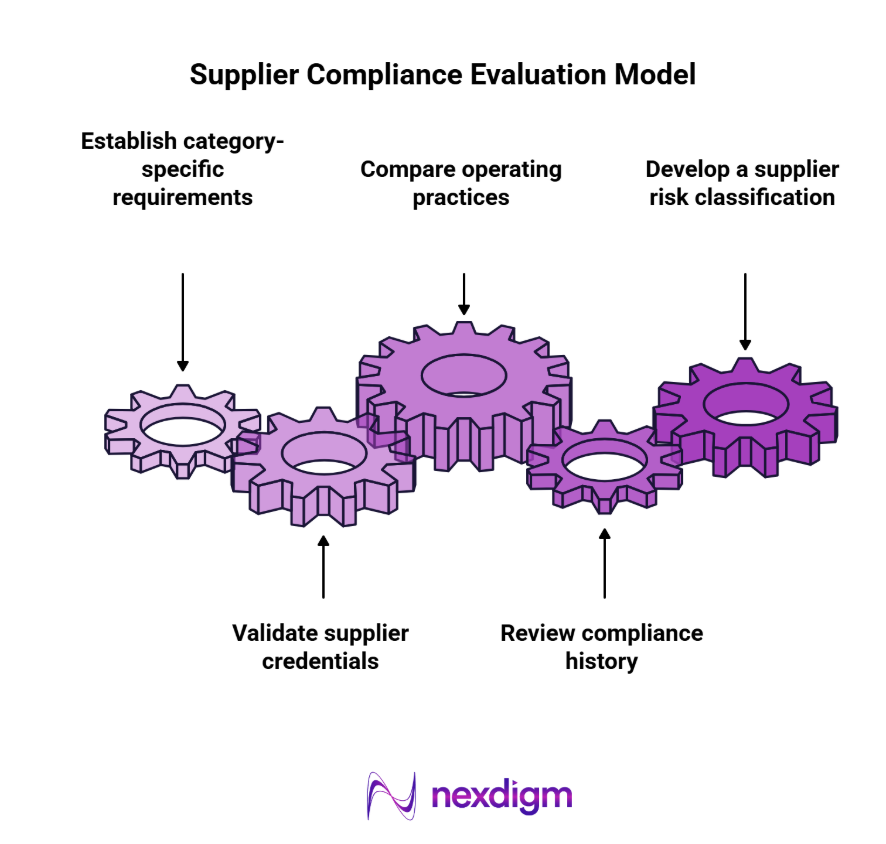
- Establish category-specific requirements: Define the relevant statutory, product and technical standards for each supplier category.
- Validate supplier credentials: Examine licences, registrations, certifications and facility-specific documentation.
- Compare operating practices: Assess production controls, quality testing, hygiene procedures and maintenance systems.
- Review compliance history: Examine audit findings, product rejections, corrective actions and traceability arrangements.
- Develop a supplier risk classification: Categorise suppliers according to the severity of identified gaps and the importance of their products to business operations.
Nexdigm’s market intelligence and industry assessment capabilities can help businesses understand supplier landscapes, compare operating environments and evaluate the market conditions affecting vendor reliability. This supports more informed supplier selection and business planning.
Nexdigm’s Case Study
An FMCG company with 3 product divisions and 28 manufacturing and contract-packing partners undertook a supplier compliance review. The assessment identified documentation and traceability gaps across 9 partners. Following a prioritised remediation programme, 25 of the 28 partners met the revised compliance requirements within 6 months.
To take the next step, simply visit our Request a Consultation page and share your requirements with us.
Harsh Mittal
+91-8422857704