
India’s food market is large enough to create opportunities across almost every price point, yet scale alone does not make a category attractive. Consumers are simultaneously managing food costs, seeking greater nutritional value, experimenting with convenience and moving between traditional and digital channels.
For food and beverage companies, the more useful assessment is therefore narrower: where is demand expanding, what are consumers willing to pay for it, and where is competition leaving room for a differentiated proposition?
The Market Is Expanding, but Growth Is Becoming More Selective
India’s food processing market reached approximately US382.2billioninFY25andisprojectedtoreachUS689.0 billion by FY34, according to IBEF. Processed food already accounts for around 20.4% of India’s agricultural exports, up from 13.7% in FY2014-15.
The size of the processing market matters, but the composition of growth matters more. Demand is being influenced by urbanisation, changing consumption patterns, food safety concerns, convenience and increasing value addition.
IBEF reports that food consumption is expected to reach approximately US$1.2 trillion in CY26.This creates multiple growth pools rather than one homogeneous food market.
Follow the Consumer Before Following the Category
A 2025 India consumer survey found that taste, price and nutritional value were among the primary factors influencing food purchases. Health benefits were also a leading reason consumers considered switching food brands. The survey covered 1,031 Indian consumers.
Three demand tensions stand out.
- Affordability versus value
Consumers remain price-conscious, but lower price does not necessarily mean stronger value. Pack size, nutrition, quality and perceived benefits influence whether a product justifies its price. - Convenience versus familiarity
Ready-to-eat and ready-to-cook formats can solve time constraints, but established consumption habits remain powerful. New products need to fit existing occasions rather than assuming consumers will completely change them. - Health versus taste
Health positioning creates an opportunity, but it still has to survive the sensory and price test. PwC found health benefits among the top three reasons for switching food brands for 29% of Indian respondents.
Pricing Has to Be Read with Pack Architecture
Pricing analysis should not stop at MRP.
A food company can reach different consumer segments through smaller entry packs, larger value packs, premium formats or differentiated product variants.
The same category can therefore support very different price points.
This is particularly relevant as FMCG demand becomes more channel specific.
NIQ reported that India’s FMCG sector recorded 7.8% value growth in OND 2025, while rural volume growth reached 2.9% and urban volume growth 2.3%.
E-commerce accounted for 18% of FMCG sales across the top eight metros, with quick commerce contributing more than three-fourths of e-commerce FMCG sales.
Distribution is consequently part of the pricing equation.
A product designed for modern trade may require a different pack, margin structure and price architecture from one designed for traditional retail or quick commerce.
Where White Spaces Can Emerge
The strongest opportunity is rarely an entirely empty category. It is more often an underserved combination of consumer need, price point, format and channel.
Potential white spaces can emerge around:
- Health-led products at accessible price points
- Convenient formats for specific consumption occasions
- Regional products with scalable packaging and distribution
- Premium products with measurable functional benefits
- Smaller packs designed for trial and affordability
- Products positioned between mass-market and premium offerings
- Categories where digital discovery is growing faster than physical distribution
The opportunity needs to be tested against existing competitors rather than assumed from consumer trends alone.
Competition Determines Whether Demand Becomes Opportunity
A growing category can still be unattractive when incumbents have strong distribution, high brand loyalty and extensive promotional capacity.
Competitive assessment should therefore examine more than market share. Product architecture, price ladders, pack sizes, distribution reach, promotional intensity, innovation frequency and channel presence can reveal where competitive pressure is concentrated.
This is particularly important in categories where established manufacturers can respond rapidly through extensions or price adjustments.
Nexdigm’s Food and Beverage White-Space Framework
Nexdigm’s food and beverage market assessment services help companies evaluate market attractiveness through market sizing, consumer research, pricing analysis, competitive benchmarking, channel assessment and identification of commercially viable growth opportunities.
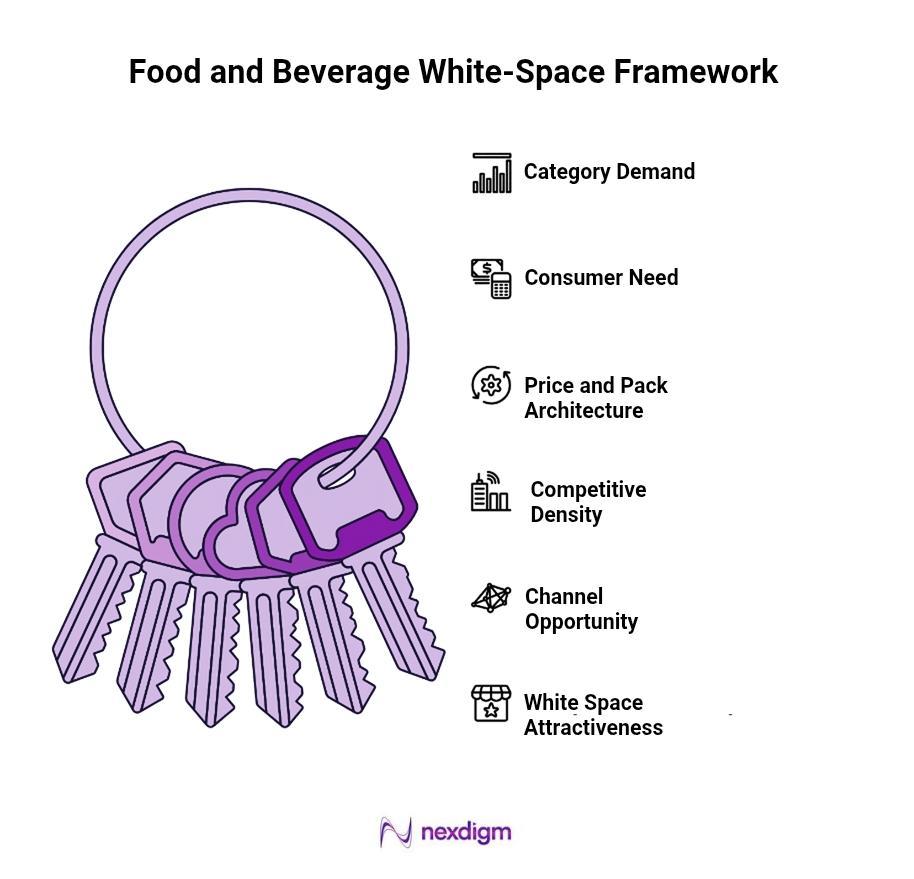
- Category Demand
Measure category size, historical growth, consumption frequency, household penetration and emerging consumption occasions. - Consumer Need
Identify unmet requirements around taste, nutrition, convenience, safety, affordability and product functionality. - Price and Pack Architecture
Map MRP, pack sizes, price ladders, promotional discounts and consumer willingness to pay. - Competitive Density
Benchmark brands, private labels, product variants, distribution strength, innovation activity and promotional intensity. - Channel Opportunity
Assess traditional retail, modern trade, e-commerce, quick commerce, food service and institutional channels. - White-Space Attractiveness
Evaluate the size, accessibility, competitive intensity and economics of potential product-market gaps.
The resulting assessment connects consumer demand with the commercial conditions required to capture it.
Nexdigm Case Study: Identifying a Food Category White Space
Nexdigm supported a food company evaluating category expansion by analysing consumer preferences, price points, competitor offerings and channel growth. The assessment used FMCG’s 7.8% OND 2025 value growth and 18% e-commerce share in top metros to prioritize high-potential opportunities.
The analysis helped the client refine its target consumer, price architecture and channel strategy before committing resources to product expansion.
To take the next step, simply visit our Request a Consultation page and share your requirements with us.
Harsh Mittal
+91-8422857704