

Food and beverage procurement risks can emerge well before a supplier misses a delivery. Dependence on one ingredient origin, a specialised processor, a limited packaging source, or a temperature-controlled logistics provider can leave production exposed to disruptions that are difficult to replace quickly.
A useful risk assessment examines the supply network behind each critical input, not just the direct vendor listed in a purchase order.
Map Critical Dependencies
Start by identifying the ingredients, packaging materials, processing services, and logistics activities required to maintain production. Record the direct supplier, manufacturing or processing location, upstream dependencies where known, lead time, inventory coverage, and available substitutes.
A supplier with several sales offices may still depend on one production facility. Similarly, two vendors may source the same ingredient from the same origin. Counting supplier names without tracing these dependencies can overstate the level of diversification.
Assess Food-Specific Risks
F&B supply chains face risks linked to agricultural seasonality, weather, commodity prices, product perishability, contamination, shelf life, and transport conditions. Imported ingredients may also be exposed to border delays, documentation requirements, currency movements, or changes in trade policy.
Traceability is another important consideration. In the United States, the FDA’s Food Traceability Rule covers additional recordkeeping for specified foods, with the compliance date set at July 20, 2028, under current federal direction. Businesses supplying covered products should assess their applicable obligations and their suppliers’ ability to maintain and share required records.
Prioritise Vulnerabilities
For food and beverage procurement risk mitigation, risks should be ranked by their potential impact on production, food safety, customer supply, and financial performance. A low-cost ingredient with no qualified substitute may deserve greater attention than a more expensive input available from several independent sources.
Mitigation should match the risk. Options include qualifying alternative origins, setting appropriate inventory buffers, improving traceability, revising contract terms, or validating backup logistics arrangements. Each option should be assessed for cost, lead time, and practical feasibility.
F&B Procurement Risk Mapping Framework
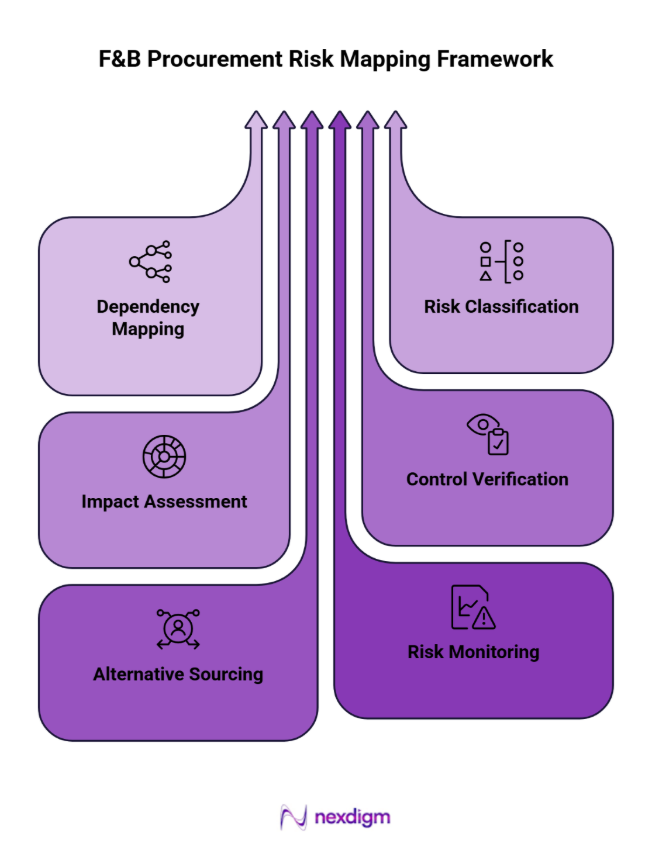
- Dependency Mapping: Trace critical ingredients, packaging, processors, and logistics providers to identify shared origins, single facilities, and other hidden supply dependencies.
- Risk Classification: Assess supplier concentration, seasonality, perishability, regulatory exposure, quality history, lead times, and substitution difficulty for each critical input.
- Impact Assessment: Estimate the consequences of disruption for production continuity, lost sales, product safety, inventory, and customer commitments.
- Control Verification: Review traceability records, quality systems, contingency plans, transport controls, and contractual obligations to establish whether existing safeguards are effective.
- Alternative Sourcing: Identify and qualify backup suppliers, alternative origins, substitute specifications, or logistics routes, accounting for approval and testing timelines.
- Risk Monitoring: Define review triggers such as price movements, supplier performance deterioration, crop conditions, regulatory changes, or capacity constraints, and assign responsibility for action.
Build Resilience Around Critical Inputs
Risk mapping should lead to practical decisions about which inputs require diversification, which suppliers need closer monitoring, and where additional inventory is justified. The objective is not to maintain multiple suppliers for every purchase, but to protect production and product safety where disruption would have the greatest consequences.
Nexdigm’s Case Study
A food manufacturer mapped 30 critical inputs and found that four depended on single qualified sources. It assessed alternative origins and supplier lead times, then prioritised two inputs for backup qualification. The plan targeted reducing single-source exposure across those inputs while maintaining food safety and product specifications.
To take the next step, simply visit our Request a Consultation page and share your requirements with us.
Harsh Mittal
+91-8422857704