

Food and beverage sourcing decisions increasingly require a product-level view of supplier markets. The most competitive source for dairy ingredients may differ from the best origin for edible oils, grains, flavourings, or packaging. Price alone does not reveal whether a supplier has the processing capability, certifications, export experience, or capacity needed to support commercial growth.
A sourcing assessment should identify where suitable suppliers operate, what they can deliver, and whether the economics remain attractive after logistics, quality assurance, and import requirements are considered.
Map Supply by Product
Start by defining the product precisely, including grade, origin requirements, processing method, shelf life, packaging, and intended application. Broad categories such as oils, sweeteners, or dairy ingredients can conceal important differences in technical specifications and supplier capability.
Trade data can help identify exporting countries, import dependence, and changes in product flows. However, export value alone is not enough: a high-value trade flow may reflect premium products or processing differences rather than greater physical availability. Compare quantities, unit values, seasonality, and product classifications wherever the data allow.
Compare Supplier Markets
Supplier markets differ in their production cycles, export infrastructure, processing capacity, and exposure to weather or transport disruptions. The FAO Food Price Index provides a useful macro-level indicator of international food commodity prices, but it should not be treated as a direct benchmark for finished ingredients or individual supplier quotations.
For food and beverage supplier identification consulting, the objective is to move from broad market signals to a qualified supplier longlist. Companies should assess production locations, export capability, product specifications, quality systems, minimum order quantities, and evidence of consistent delivery.
Test the Landed Economics
A supplier offering a lower ex-works price may become more expensive after freight. Insurance, duties, testing, storage, financing, and expected wastage are included. Perishable products also require assessment of transit time, temperature control, shelf life on arrival, and contingency arrangements.
Currency exposure and payment terms can further affect sourcing economics. Companies should compare alternatives using the same delivery basis and order assumptions, then test how margins change under different freight, exchange-rate, and input-price conditions.
F&B Supplier Market Assessment Framework
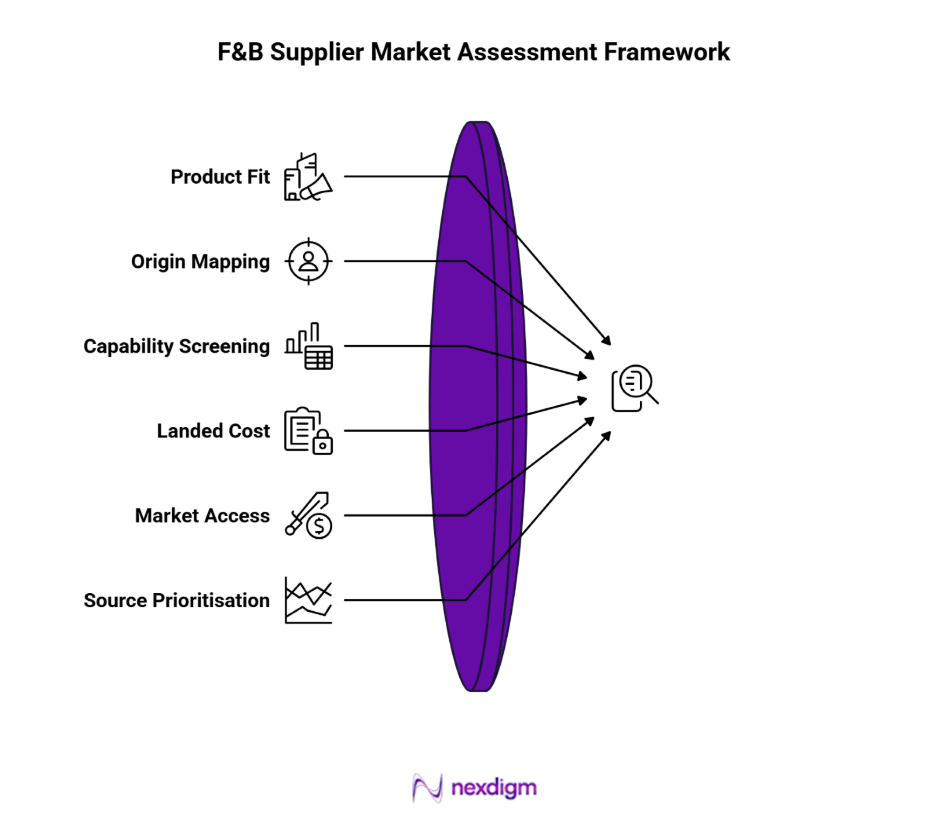
- Product Fit: Define the required grade, composition, processing method, packaging, shelf life, and application before comparing suppliers across countries or regions.
- Origin Mapping: Examine production locations, export volumes, supplier concentration, seasonality, and trade patterns to identify established sources and potential alternatives.
- Capability Screening: Verify manufacturing or processing capacity, quality controls, certifications, export experience, and the ability to meet required order volumes consistently.
- Landed Cost: Compare purchase prices, freight, duties, insurance, testing, storage, financing, and expected losses using consistent delivery and payment assumptions.
- Market Access: Check import rules, documentation, product standards, food safety requirements, and destination-specific approvals before treating a supplier as commercially accessible.
- Source Prioritisation: Rank options by cost, quality, reliability, capacity, market access, and disruption exposure, then validate leading candidates through samples and commercial discussions.
Turn Sourcing Research Into Action
The best sourcing decision balances price with continuity and suitability. Companies can use the assessment to diversify origins, negotiate with existing suppliers, qualify alternatives, or target new markets where their required specifications and volumes are commercially viable.
Nexdigm’s Case Study
A beverage manufacturer assessed suppliers across three origins for a key ingredient. After comparing quality requirements, freight, lead times, and minimum order quantities, it identified a second source with an estimated 6% lower landed cost for part of its demand. Qualification and sample testing were required before any volume transfer.
To take the next step, simply visit our Request a Consultation page and share your requirements with us.
Harsh Mittal
+91-8422857704