
Global food and beverage trade is being reshaped by changing consumption patterns, supply conditions, climate pressures, and shifting sourcing relationships. UN Trade and Development reports that food products account for nearly 87% of global agricultural export value, highlighting the importance of food trade within international commerce. Meanwhile, global merchandise exports reached approximately $26.3 trillion in 2025.
For food and beverage companies, however, global growth does not automatically identify the right market. A category may be expanding in one country while remaining stagnant elsewhere. Similarly, high import values may reflect a mature market rather than an emerging opportunity.
Businesses therefore need to examine where demand is growing, which products are being imported, which countries are gaining export share, who the active buyers and suppliers are, and how pricing is changing.
This makes food and beverage trade analysis an important tool for identifying markets and trade flows with stronger commercial potential.
Where Is Food and Beverage Demand Growing?
Import data can provide a useful indicator of actual purchasing activity. Rising imports of a particular food or beverage category may signal stronger consumption, limited domestic production, or changing sourcing preferences.
However, the growth rate matters as much as market size. A smaller market experiencing sustained import growth may present a stronger expansion opportunity than a large but stagnant market. Product-level analysis helps businesses distinguish between these scenarios.
Which Markets Are Becoming More Import-Dependent?
Import dependence can reveal opportunities for international suppliers. Markets that rely heavily on overseas products may offer greater potential for exporters, particularly when demand is increasing and supplier structures remain fragmented.
Businesses can examine import values, volumes, supplier shares, country origins, and shipment frequency to understand how dependent a market is on external supply and whether new suppliers could realistically compete.
Nexdigm in Converting Food Trade Signals into Market Intelligence
Nexdigm combines trade data, market research, competitive intelligence, pricing analysis, and primary research to assess international food and beverage markets. Our Food and Beverage Trade Analysis can be structured across products, SKUs, brands, companies, countries, regions, ports, and trade corridors.
For food and beverage businesses, this can include analyzing product demand, importing companies, supplier networks, trade flows, market shares, pricing, sourcing concentration, and market-entry conditions.
Nexdigm also supplements quantitative analysis with distributor and warehouse audits, trade-channel checks, vendor procurement, disguised interviews, mystery shopping, and on-ground research to validate market-level findings.
Nexdigm’s Food Trade Analysis Assessment Framework
While trade data can reveal where products are moving and where demand exists, businesses need a structured framework to convert these signals into actionable market intelligence. Nexdigm uses the framework to assess food and beverage opportunities from multiple perspectives in the following ways:
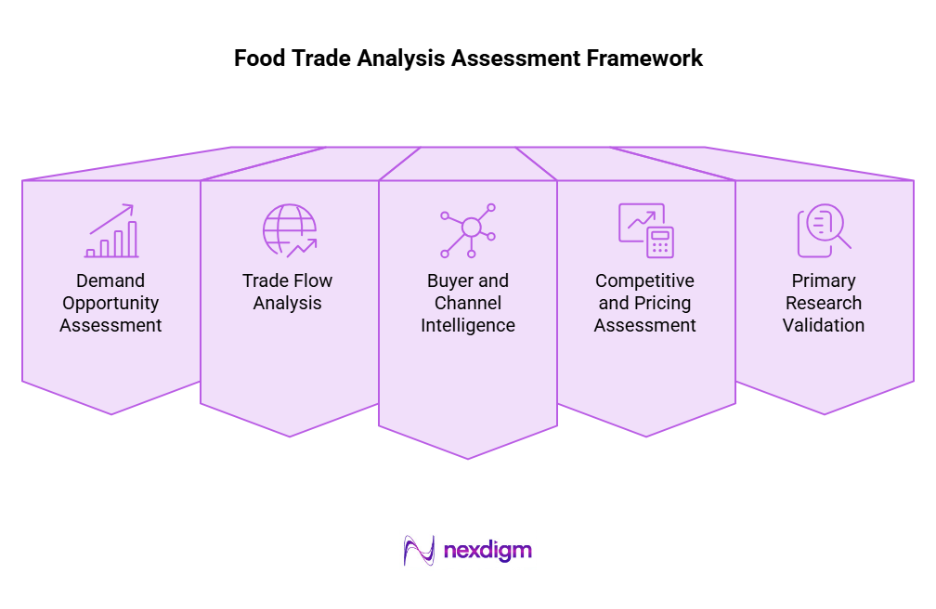
- Demand Opportunity Assessment: Analysis of import activity, consumption trends, and historical trade patterns to identify markets demonstrating sustained demand and attractive growth potential for food products.
- Trade Flow and Supply Network Analysis: Nexdigm evaluates sourcing relationships, supplier activity, and international trade movements to understand how products flow across markets and supply chains.
- Buyer and Channel Intelligence: Identification of active importers, distributors, and channel participants to understand purchasing behavior, route-to-market structures, and customer accessibility.
- Competitive and Pricing Assessment: Nexdigm examines competitor presence, market participation, and pricing dynamics to determine market attractiveness and potential positioning opportunities.
- Primary Research Validation: Validation of trade-data findings through interviews, channel checks, market visits, mystery shopping, and other on-ground research activities.
By using the framework analysis, Nexdigm helps food and beverage businesses identify, validate, and prioritize opportunities, enabling more confident market-entry and growth decisions.
How Nexdigm’s Framework Helps Food Businesses Stay Ahead of Market Shifts
The food and beverage industry is influenced by evolving consumer demand, changing sourcing patterns, seasonal consumption cycles, and emerging trade opportunities. Nexdigm’s framework helps businesses identify and respond to these shifts through:
- Emerging Consumption Trends: Nexdigm tracks changing import patterns and product demand to identify food categories, ingredients, and beverage segments gaining traction across markets.
- Seasonality and Demand Cycle Monitoring: Analysis of seasonal purchasing patterns to help businesses align production, inventory, and export strategies with market demand fluctuations.
- Sourcing and Supply Network Intelligence: Evaluation of supplier activity and trade flows to identify sourcing shifts, emerging supplier markets, and potential supply-chain vulnerabilities.
- Export Opportunity Tracking: Nexdigm monitors demand growth and import activity across countries to identify new export destinations and emerging international growth opportunities.
The insights gathered from Nexdigm’s assessment helps food and beverage businesses anticipate market changes, identify emerging opportunities, and make proactive growth decisions.
Nexdigm’s Case
Nexdigm supported a food-sector client by analyzing product-level import volumes, supplier concentration, destination markets, shipment patterns, and indicative pricing across priority markets. The analysis identified three high-potential markets, 22 relevant buyer accounts, and 14 alternative suppliers, helping the client prioritize expansion and sourcing opportunities using evidence from actual trade activity.
To take the next step, simply visit our Request a Consultation page and share your requirements with us.
Harsh Mittal
+91-8422857704