

Global food and beverage trade is creating opportunities across markets with very different consumption profiles, import dependencies, and pricing conditions. For exporters, food manufacturers and distributors, the commercial challenge is identifying where demand can support profitable market entry, which products are gaining traction, and whether existing supply chains can serve those markets competitively.
The scale of international trade makes this assessment increasingly important. The Food and Agriculture Organization of the United Nations (FAO) estimated that the global food import bill would reach US$2.22 trillion in 2025, an increase of nearly 8% from 2024. Much of this increase reflected higher prices for products such as coffee and cocoa, rather than uniform growth in imported volumes. This distinction matters because a rising import bill can indicate stronger demand, higher commodity prices, or a combination of both.
Where Import Demand Is Creating Commercial Openings
Consumption patterns vary considerably across product categories and regions. Population growth, urbanisation, income levels, dietary changes and the development of modern retail influence what consumers buy and how food reaches them. These factors create different opportunities for staple commodities, processed foods, premium beverages, and specialised ingredients.
Rice illustrates how volume growth can create opportunities beyond traditional export markets. In June 2025, FAO forecast that international rice trade would reach a record 60.5 million tonnes that year, supported by demand from Africa and rising exports from India and South America. For exporters, this points towards markets where domestic production cannot fully satisfy consumption. However, export competitiveness still depends on landed prices, freight costs, import policies, and the ability to meet local quality requirements.
FAO attributed much of the projected increase in the 2025 global food import bill to a 34.5% average price increase for higher-value products, particularly coffee and cocoa. Businesses operating in these categories must distinguish between temporary price-led revenue growth and sustained increases in consumption. Price volatility can inflate market value while simultaneously weakening affordability and reducing purchase volumes.
These differences make product-level analysis essential. A country importing large quantities of cereals may offer substantial volume opportunities but limited margins. Another market with rising demand for speciality ingredients, packaged foods or premium beverages may offer better returns for exporters with the right distribution relationships and product positioning.
Consumption Growth Does Not Automatically Translate into Accessible Demand
Import dependence is a useful starting point for identifying markets, but it is an incomplete measure of commercial attractiveness. A country may rely heavily on imported food because domestic agricultural production is constrained, yet import restrictions, currency depreciation or weak purchasing power can limit the addressable market.
Supply conditions also influence opportunity. FAO’s November 2025 Food Outlook reported expectations of record global wheat and coarse grain production, alongside improving inventories for several major commodities. Greater availability can ease procurement pressures for buyers, but it can also intensify competition among exporters and place pressure on prices. Businesses need to assess how changing supply conditions affect individual trade routes and product categories.
Market access introduces another layer of complexity. Tariffs, sanitary and phytosanitary requirements, labelling rules, product registration and shelf-life standards can influence the cost and feasibility of entering a market. Perishable foods require additional consideration of cold-chain capacity, transit times, and spoilage risks. Processed products may face different regulatory and distribution requirements from raw agricultural commodities.
This is where food and beverage trade intelligence becomes commercially valuable. By combining import volumes, unit values, consumption indicators, domestic production, trade policies and competitor performance, businesses can identify markets where demand is growing and where their products have a credible route to market.
Reading the Trade Data Behind the Opportunity
A robust market assessment should examine three connected dimensions.
- Demand quality: Import growth should be separated into volume and price effects. Rising volumes, expanding consumption, and a growing addressable customer base provide stronger evidence of demand durability than an increase in import value alone. Product-level analysis can also reveal whether growth is concentrated in premium segments, mass-market staples, or industrial food ingredients.
- Competitive supply: Import data should be compared with domestic production, exports from competing origins, and changes in supplier market shares. A growing market may already be served by exporters with cost, freight or trade-agreement advantages. Identifying gaps in supplier coverage, product specifications or delivery reliability can reveal more defensible entry opportunities.
- Commercial accessibility: The final assessment should account for tariffs, compliance costs, distributor margins, freight, currency exposure and payment conditions. These variables determine whether an apparently attractive market can generate acceptable returns. For temperature-sensitive products, storage and transport infrastructure can be equally important to market size.
Evaluating Import-Led Market Opportunity and Export Competitiveness
Nexdigm’s market-assessment approach can help companies translate fragmented trade and consumption data into practical expansion decisions. Rather than ranking countries on import value alone, the assessment can connect product demand with supply gaps, competitive positioning, and the economics of serving each destination.
A decision framework should progress through four stages:
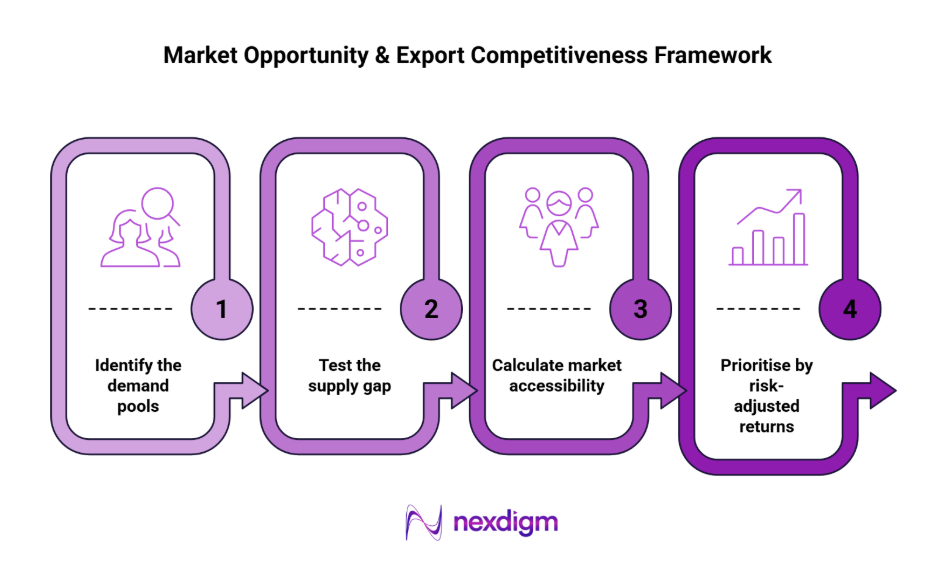
- Identify the demand pools. Segment products by category, end use and consumption pattern, then shortlist markets showing sustained import-volume growth or emerging demand.
- Test the supply gap. Compare domestic production, import dependence, supplier concentration and competitor origins to establish where additional supply could be commercially relevant.
- Calculate market accessibility. Evaluate tariffs, product standards, logistics, distribution structures, and landed costs to determine whether the exporter can compete on price, quality, or reliability.
- Prioritise by risk-adjusted returns. Compare expected margins, demand stability, regulatory exposure and investment requirements. Markets with slightly lower growth may be more attractive when entry costs and operating risks are manageable.
The resulting assessment gives businesses a defensible basis for selecting target countries, prioritising product portfolios, identifying distribution partners, and deciding where further investment is justified.
Nexdigm Case: Prioritising Export Markets
A packaged-food exporter screens 12 destination markets using import volumes, three-year growth, competitor shares, tariffs and estimated landed costs. Four markets advance to commercial validation. Further analysis identifies two with stronger projected contribution margins, allowing the company to focus distributor outreach and pilot shipments on a narrower, commercially viable shortlist.
To take the next step, simply visit our Request a Consultation page and share your requirements with us.
Harsh Mittal
+91-8422857704