

Food and beverage companies can measure awareness, preference and purchase intent. None of those metrics necessarily prove that consumers will buy a product repeatedly at a profitable price.
The difference matters because food purchases are frequent, price-sensitive and highly substitutable. A consumer may say a new product is appealing and still choose a familiar alternative at the shelf because it is cheaper, easier to find or simply tastes better.
A useful demand assessment therefore needs to connect what consumers say with what they actually buy, pay and repeat.
Taste Still Has to Survive the Price Tag
PwC’s Voice of the Consumer 2025 India survey of 1,031 consumers found that taste, price and nutritional value were the primary factors influencing food purchases. Health benefits were among the top three reasons cited for switching food brands by 29% of respondents, while 21% identified health benefits as the key switching driver.
This creates a three-part value equation:
- Sensory value: Does the product taste good enough to encourage trial and repeat?
- Economic value: Does the consumer believe the price is justified?
- Functional value: Does the product provide a meaningful nutritional or practical benefit?
A product usually needs to perform adequately across all three to build repeat demand.
Willingness to Pay Is More Useful Than Stated Interest
Consumers routinely express interest in premium products. The commercial question is what happens when a real price is attached.
NIQ’s 2025 health and wellness research found that 53% of Indian consumers actively take steps to improve their health and wellness. Yet 51% said healthier alternatives are too expensive, and another 51% said they struggle to find healthier alternatives in the market.
This creates a clear gap between intention and purchase feasibility.
For F&B companies, that gap can be tested through price ladders:
- Entry price
- Mainstream competitive price
- Premium price
- Promotional price
- Multipack or larger-pack economics
The objective is to identify where demand begins to fall sharply rather than assuming that a stated preference translates into unlimited pricing power.
Repeat Purchase Reveals the Real Market
Trial can be driven by curiosity, advertising, sampling or promotions.
Repeat purchase is different.
A consumer returning to a product indicates that it has successfully delivered enough value to replace or compete with an existing habit.
Repeat behaviour should therefore be assessed by:
- Purchase frequency: How often can the product realistically be consumed?
- Replenishment cycle: How quickly does the consumer need to buy again?
- Switching behaviour: What existing product is being displaced?
- Repurchase trigger: Taste, convenience, health, price, availability or habit?
- Drop-off point: At what price or after how many purchases does retention weaken?
This is particularly important for categories with low switching costs.
Convenience Can Create Frequency
Digital channels are changing how frequently consumers interact with food brands.
NIQ reported that e-commerce continued to gain share across India’s metros in Q3 2025, while food consumption remained broadly stable at 5.4% during the quarter.
Quick commerce adds another dimension by reducing the time between consumer need and product availability.
Mordor Intelligence estimates that sub-10-minute delivery accounted for 62.24% of India’s quick-commerce market in 2025, with grocery and staples representing 61.33% of the category mix.
For F&B brands, this can affect repeat behaviour because products become easier to replenish. It can also increase competitive pressure because consumers can compare alternatives almost immediately.
Health Claims Need Credibility
Health-oriented products have an expanding consumer base, but the proposition must be understandable.
NIQ found that 64% of Indian consumers want detailed product information, while 61% want more transparent and easier-to-understand labels. It also found that 47% did not fully trust the effectiveness of products or services claiming to improve health.
This means consumer demand assessment should test the claim itself.
“High protein,” “probiotic,” “natural,” “low sugar” or “fortified” may generate different levels of interest depending on how consumers interpret the benefit and whether they consider the claim credible.
Nexdigm’s Consumer Demand Diagnostic Framework
Nexdigm’s F&B consumer demand assessment consulting helps companies quantify consumer needs, willingness to pay, purchase triggers, repeat behaviour, switching dynamics and channel preferences to determine whether demand is commercially addressable.
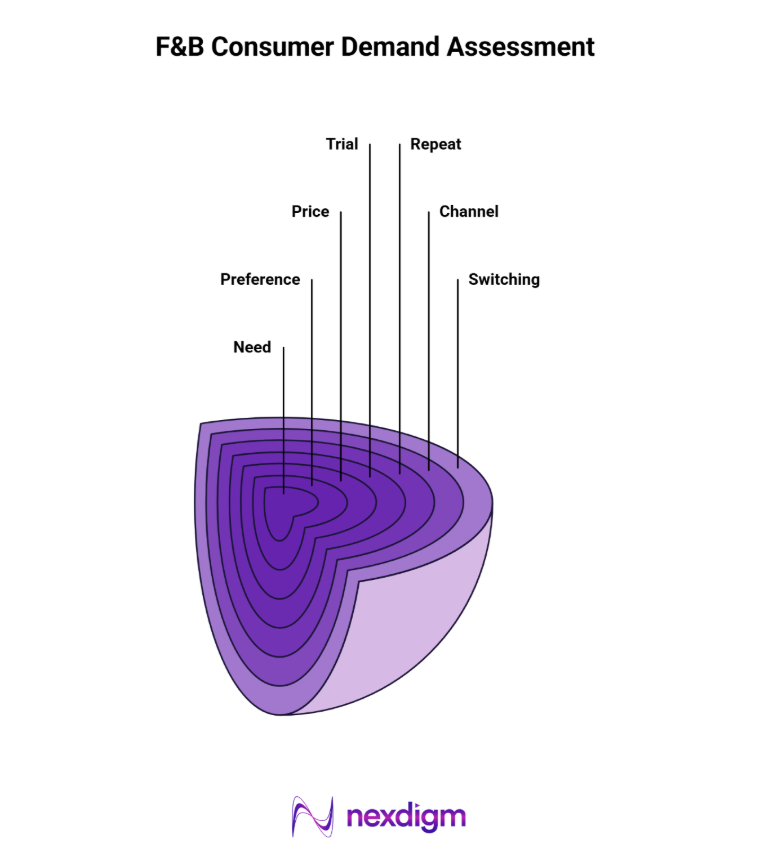
- Need: Identify the consumer problem, occasion or unmet requirement.
- Preference: Determine which product attributes generate genuine interest.
- Price: Establish willingness-to-pay thresholds and price elasticity.
- Trial: Measure purchase intent under realistic competitive and price conditions.
- Repeat: Test the likelihood and frequency of repurchase.
- Channel: Identify where consumers discover, purchase and replenish the product.
- Switching: Determine which incumbent product or behaviour the new offering would replace.
The framework allows companies to separate stated enthusiasm from addressable, monetizable demand.
Nexdigm Case: Measuring Consumer Demand for New F&B Concepts
A beverage company tested 4 product concepts with 2,200 consumers across 5 cities. Nexdigm identified one concept with 31% purchase intent, compared with 18% for the existing proposition, while optimal pricing increased expected conversion by 11%.
To take the next step, simply visit our Request a Consultation page and share your requirements with us.
Harsh Mittal
+91-8422857704