

A new F&B market can look attractive from a distance and become considerably more complicated once the commercial variables are examined together.
Consumer demand determines whether the proposition has an audience. Product-market fit determines whether that audience sees a reason to buy. Pricing determines whether consumers accept the proposition and whether margins remain viable. Channels determine whether the product can reach the intended consumer at an acceptable cost.
These variables need to be assessed as one commercial system.
The Consumer Comes Before the Channel
The first question is who the product is being built for.
Consumer research can identify consumption occasions, purchase frequency, unmet needs, brand preferences, switching behavior, and willingness to pay. It can also reveal whether demand is concentrated among a narrow premium audience or distributed across a broader mass market.
This distinction matters because a product designed around premium health credentials, for example, may require a very different route to market from an affordable everyday staple.
India’s FMCG market provides a useful example of channel fragmentation. NIQ reported 7.8% FMCG value growth in Q4 2025, while rural markets recorded 2.9% volume growth compared with 2.3% in urban markets. E-commerce reached 18% of FMCG sales across the top eight metros.
The same product can therefore encounter very different demand conditions depending on geography and route to market.
Product and Price Have to Move Together
A new product cannot be evaluated only by whether consumers say they like it.
Concept testing should examine perceived value, differentiation, purchase intent, acceptable price ranges, competitive substitutes, pack sizes, and the attributes consumers are willing to pay for.
Price elasticity analysis adds another layer by testing how changes in price could affect demand and how competitors might respond.
For F&B brands, this can expose important commercial choices: whether to enter at a premium, build an accessible entry pack, use multiple price points, or differentiate through formulation and pack architecture.
Then Comes the Route to Market
Once the target consumer and proposition are established, the channel strategy can be developed around actual purchasing behavior.
Nexdigm’s F&B go-to-market assessment consulting combines market opportunity assessment, consumer segmentation, channel prioritization, pricing strategy, competitive analysis, and route-to-market design.
The objective is to determine which combination of product, consumer, price, and channel can generate sustainable demand.
For some categories, that could mean modern trade supported by digital discovery. For others, general trade may provide the required distribution depth. Convenience-oriented products may benefit disproportionately from e-commerce or quick commerce.
The right answer depends on the category and the consumer rather than a predetermined channel hierarchy.
Turning Four Variables Into One Commercial Decision
Nexdigm’s approach can connect four layers of analysis:
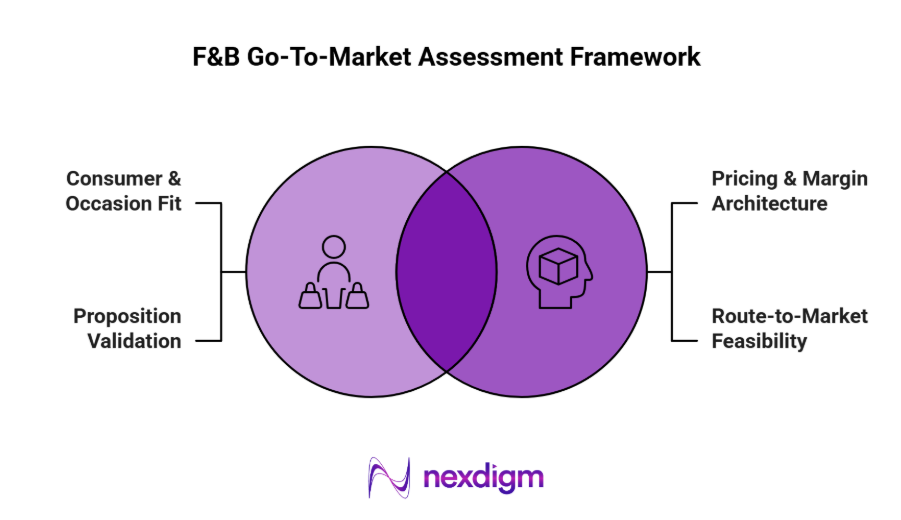
- Consumer & Occasion Fit: Identify the target segment and map the specific usage occasions that trigger purchase intent.
- Proposition Validation: Verify whether the product solves a high-priority, recurring consumer pain point better than existing options.
- Pricing & Margin Architecture: Test customer willingness-to-pay against competitor benchmarks while protecting channel partner margins and unit economics.
- Route-to-Market Feasibility: Screen distribution channels based on physical reach, handling requirements, operational scalability, and net contribution margins.
This creates a clearer basis for decisions around launch geography, product configuration, pricing, channel allocation, and investment priorities.
A Go-to-Market Engagement with Measurable Outcomes
Nexdigm supported an F&B client across channels, customer segments, and price points. The engagement improved channel prioritization by 29%, customer-targeting accuracy by 28%, and pricing optimization by 24%.
To take the next step, simply visit our Request a Consultation page and share your requirements with us.
Harsh Mittal
+91-8422857704