
India’s food market is being reshaped by a shift in what households buy, how often they buy it, and where they buy it. Rising incomes are creating room for differentiated products, while urban lifestyles are increasing demand for convenience, packaged foods, and ready-to-consume formats.
The opportunity is therefore moving beyond aggregate food consumption toward specific categories, consumer segments, and channels.
The household food budget is being reallocated
Food remains a significant component of household spending, but the composition of that spending is changing.
According to the 2023–24 Household Consumption Expenditure Survey, food accounts for around 46.38% of rural consumption expenditure and 39.17% of urban expenditure. At the same time, cereals represent less than 5% of total urban consumption expenditure, reflecting the broader diversification of the urban food basket.
This creates space for categories built around convenience, nutrition, differentiation, and processing.
Income is changing what gets bought
Higher disposable income does not simply increase food consumption. It changes the mix.
Urban consumers are increasingly exposed to products such as:
- Clean-label packaged foods
- Packaged curd and dairy
- Vacuum-packed paneer
- Processed meats
- Functional dairy products
- Ready-to-cook and ready-to-eat meals
- Premium grains and multi-millet products
The commercial opportunity depends on identifying which of these shifts are durable enough to support scalable demand.
Three changes are reshaping the food basket
- Convenience: Time-constrained households are increasing their reliance on packaged and ready-to-consume formats.
- Health positioning: Protein, functional nutrition, cleaner labels, and alternative grains are creating differentiated subcategories.
- Format innovation: Smaller packs, portion-controlled products, improved shelf life, and easier preparation can expand consumption beyond traditional formats.
The significance of these trends varies substantially by income group and geography.
Quick commerce is changing the route to market
Food demand is increasingly connected to distribution speed. Quick-commerce platforms offering 10–15 minute delivery have created a new route for products that benefit from immediate availability.
This changes the commercial equation for food companies. Packaging, pack size, inventory placement, margins, promotional economics, and replenishment frequency become part of demand strategy.
A product may therefore have strong consumer demand but weak economics if its distribution model requires excessive discounts or inefficient fulfilment.
Affordability keeps the market bifurcated
Premiumization is occurring alongside intense price sensitivity.
Tier-2, Tier-3, and rural markets continue to respond strongly to accessible price points such as ₹5, ₹10, and ₹20 packs. Urban consumers may simultaneously support premium products with higher nutritional or convenience value.
Food companies consequently need to assess demand by consumer segment, price point, geography, format, and channel, rather than relying on a single national growth estimate.
Cold chain and packaging now sit inside demand strategy
For dairy, meat, seafood, and other perishables, demand growth is constrained by the ability to maintain product quality through distribution.
Packaging technology, shelf life, temperature control, warehousing, and last-mile availability can determine whether an attractive consumer segment is commercially reachable.
Nexdigm’s Food Consumption Demand Analysis: Finding Where the Basket Is Moving
Nexdigm’s Food consumption demand analysis can evaluate demand across:
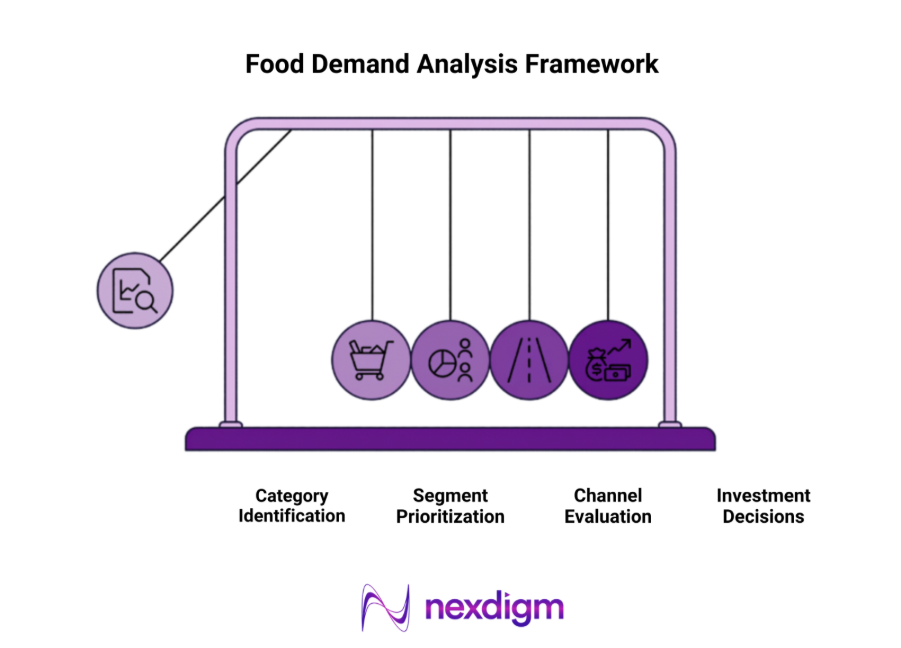
- Consumer segments: income, geography, household characteristics, and consumption patterns.
- Category shifts: staples, processed foods, dairy, protein, functional foods, and convenience formats.
- Price architecture: pack sizes, price points, premiumization, and affordability thresholds.
- Channel dynamics: general trade, modern retail, e-commerce, quick commerce, and food service.
- Supply requirements: processing, packaging, cold chain, warehousing, and distribution infrastructure.
This enables companies to identify attractive categories, prioritize target consumer segments, evaluate channel economics, and determine where capacity or distribution investment should follow demand.
Nexdigm Case: Moving from Bulk Staples to Higher-Margin Formats
A packaged-staples assessment by Nexdigm found that a 25 kg flour business was delivering only single-digit volume growth. A portfolio shift toward high-protein multi-millet flour, vacuum-packed paneer, and ambient retort curry bases was evaluated across Mumbai, NCR, and Bengaluru. Selected products achieved 38% gross margins versus 8% for bulk flour, with quick commerce contributing 62% of sales within nine months.
To take the next step, simply visit our Request a Consultation page and share your requirements with us.
Harsh Mittal
+91-8422857704