
Changing food consumption patterns are significantly impacting agricultural production and supply chains, driven by evolving consumer preferences for healthier, sustainable, and diverse food options. Food consumption trend analysis, powered by competitive intelligence, allows businesses to track and understand these shifts in real-time.
By analyzing market data, consumer behaviors, and industry trends, competitive intelligence provides valuable insights that help agricultural producers and suppliers adapt quickly to new demands, optimize resources, and stay competitive in a rapidly evolving food market.
The global organic food market, driven by changing consumption patterns, reached $120 billion and is projected to grow at a CAGR of 14% through 2027. Additionally, demand for plant-based foods has surged, with the market estimated to hit $74.2 billion by 2027. As a result, agricultural producers are increasingly diversifying their crops to meet the rising preference for plant-based and sustainable food products, influencing supply chains and production practices.
Using Competitive Intelligence to Track Food Consumption Trends
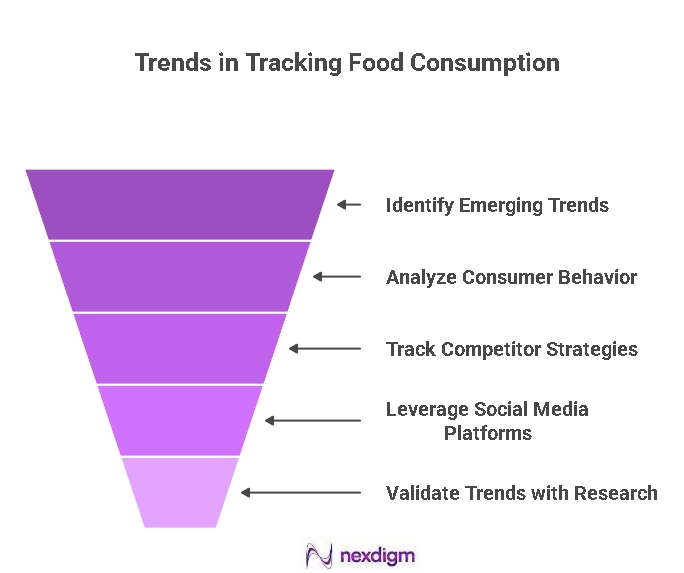
Using competitive intelligence to track food consumption trends involves analyzing market data, consumer behavior, and industry shifts. This helps businesses anticipate demand, adjust production, and optimize supply chains to align with evolving preferences:
-
Identifying Emerging Food Consumption Trends
Competitive intelligence helps detect early shifts in consumer preferences, enabling businesses to adapt their products and services accordingly.
-
Analyzing Consumer Behavior for Market Insights
By studying consumer purchasing patterns, competitive intelligence offers valuable insights into the factors driving food consumption choices.
-
Tracking Competitor Strategies in Food Trends
Competitive intelligence monitors competitors’ responses to food consumption trends, helping businesses identify gaps and opportunities for innovation.
-
Leveraging Social Media for Consumer Sentiment
Competitive intelligence uses social media data to understand consumer opinions and sentiment around food trends, guiding market strategies.
-
Utilizing Market Research for Trend Validation
Market research tools in competitive intelligence validate food consumption trends, ensuring businesses align their production with proven consumer preferences.
Nexdigm’s Competitive Intelligence Solutions for Food Trend Tracking
Nexdigm’s competitive intelligence solutions help businesses track and analyze food consumption trends by gathering and interpreting market data, consumer behavior, and competitor strategies. Through advanced analytics, Nexdigm provides actionable insights that enable businesses to anticipate shifts in demand, optimize production, and align their offerings with evolving consumer preferences. This helps improve decision-making, enhance competitiveness, and drive growth in the food industry.
Enhancing Supply Chain Efficiency with Nexdigm’s Food Trend Insights
Nexdigm enhances supply chain efficiency by using food trend insights to align production, optimize inventory, and streamline distribution. This ensures timely delivery, reduces waste, and helps businesses meet shifting consumer demands.
-
Aligning Production with Emerging Food Trends
Nexdigm’s insights help businesses adjust production schedules, ensuring supply meets consumer demand for new and trending food products.
-
Optimizing Inventory Management with Trend Analysis
Using food trend insights, Nexdigm helps optimize inventory levels, reducing overstocking and stockouts while minimizing waste and costs.
-
Improving Supplier Coordination with Trend Insights
Nexdigm helps businesses align with suppliers by sharing food trend data, improving collaboration and ensuring a consistent supply of in-demand ingredients.
-
Forecasting Consumer Preferences for Better Resource Allocation
By predicting shifts in food consumption trends, Nexdigm helps businesses allocate resources efficiently, reducing unnecessary production and maximizing profitability. .
-
Reducing Food Waste through Predictive Supply Chain Strategies
By aligning production and supply with food trends, Nexdigm helps minimize food waste, contributing to more sustainable and cost-efficient operations.
Nexdigm’s case:
Nexdigm assisted a regional food producer in aligning its supply chain with evolving consumer food trends. By applying Nexdigm’s food trend insights and forecasting models, the client reduced inventory holding costs by 18% and improved on‑time deliveries by 22% within nine months. Trend‑aligned production planning also cut food waste by 12%, enhancing both operational efficiency and customer satisfaction in target markets.
To take the next step, simply visit our Request a Consultation page and share your requirements with us.
Harsh Mittal
+91-8422857704