

Global food markets are becoming increasingly interconnected, but that connectivity also creates varying levels of import dependence. Recent study reports that food and agricultural trade increased fivefold between 2000 and 2024, with low- and middle-income countries becoming more integrated into international markets. FAO also identifies Asia as an increasingly import-dependent region, with its trade deficit widening as food and feed demand grows.
Import dependence, however, is not necessarily a weakness. For food companies, it can indicate a significant commercial market for international suppliers. The opportunity becomes more compelling when imports are growing, supplier bases are fragmented, prices support viable economics, and buyers are actively diversifying sourcing.
At the same time, concentrated sourcing can create exposure. FAO reports that the top two soybean and palm-oil exporters accounted for about 85% of global exports in 2024, illustrating how dependence on a limited number of origins can create supply vulnerabilities.
For food producers, exporters, importers, distributors, and investors, a food import analysis can provide a more granular basis for evaluating market opportunities and supply exposure.
Import Dependence Is More Than a Volume Metric
A country can have high food imports because of population size, limited agricultural resources, consumer preferences, processing requirements, or structural production constraints.
Understanding the reason behind imports is important. A market dependent on imported wheat for structural reasons presents a different opportunity from one experiencing a temporary shortage. Businesses therefore need to examine product-specific import trends, domestic supply, supplier concentration, and historical patterns before interpreting import dependence.
Supplier Concentration Can Change the Risk Profile
Two markets with similar import values can have very different supply risks. One may source from ten major countries, while another may rely heavily on one or two origins.
Supplier concentration analysis helps businesses identify single-origin dependencies, limited supplier diversity, and potential substitution opportunities. It can also reveal where an exporter may have a realistic opportunity to become an additional source.
Nexdigm’s Food Market and Supply-Chain Expertise
Nexdigm brings together food-industry knowledge, trade intelligence, market research, and supply-chain assessment to understand how import-dependent markets function. Its approach connects demand and sourcing patterns with production capabilities, supplier structures, pricing, logistics, regulatory conditions, and buyer ecosystems.
This enables businesses to evaluate food markets from both sides of the equation: where import dependence creates commercial opportunities and where concentrated supply creates strategic risks.
Why Businesses Partner with Nexdigm
Nexdigm combines food and agriculture expertise with trade intelligence and market research to translate complex import patterns into commercially relevant insights for businesses.
- Integrated Market Intelligence: Nexdigm combines supplier, buyer, pricing, demand, regulatory, logistics, and competitive information to provide a connected view of import opportunities and risks.
- Decision-Focused Analysis: Nexdigm translates product- and market-level findings into practical priorities for sourcing diversification, market entry, buyer targeting, competitive positioning, and supply-chain planning.
Together, these capabilities help businesses make more informed decisions about where to source, where to expand, and how to manage import-related exposure.
Nexdigm’s Food Import Assessment Approach
Nexdigm’s food import analysis examines import-dependent markets through a combination of trade data, competitive intelligence, pricing analysis, and industry research. The assessment helps businesses determine why imports are growing through:
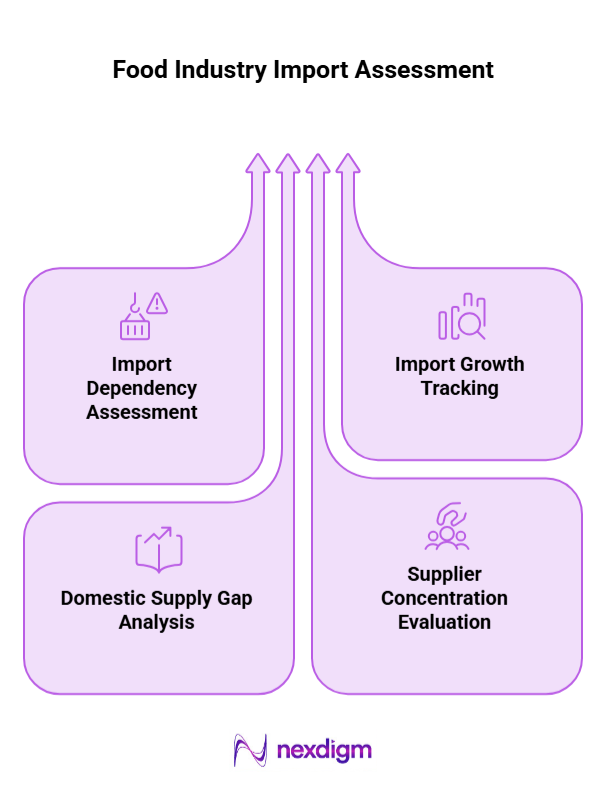
- Import Dependency: Nexdigm measures product-level import reliance to identify markets where international suppliers play a structurally important role.
- Import Growth Tracking: Assessing historical import values, volumes, and shipment activity to distinguish sustained demand expansion from temporary increases.
- Domestic Supply Gap Analysis: Nexdigm compares import requirements with domestic production and supply conditions to identify products where local availability may be insufficient.
- Supplier Concentration Evaluation: Nexdigm evaluates country and company shares to identify markets dependent on limited suppliers and assess opportunities for supplier diversification.
The assessment helps businesses interpret import dependence from both an opportunity and risk perspective. For exporters, it can reveal markets where international supply requirements create room for new suppliers. For importers, it can identify alternative origins and concentration risks.
Benefits of Nexdigm’s Food Import Analysis
Nexdigm’s analysis can help businesses convert detailed import and market data into clear commercial and supply-chain decisions. Key benefits include:
- Identify High-Potential Import Markets: Pinpoint countries and food categories where import dependence, demand growth, and supplier gaps indicate stronger commercial potential.
- Strengthen Sourcing Resilience: Identify alternative suppliers and origins to reduce dependence on concentrated sourcing networks and improve procurement flexibility.
- Prioritize Market Entry: Compare demand, pricing, competition, regulation, and accessibility to focus expansion efforts on markets with stronger fundamentals.
- Discover New Buyers: Identify active importers, distributors, and trading companies to create more targeted business-development opportunities.
- Understand Competitive Shifts: Track changing supplier shares and trade activity to identify emerging competitors, declining suppliers, and potential market-entry gaps.
Nexdigm’s Case
Nexdigm supported an agribusiness exporter in benchmarking 15 international markets, analyzing production, pricing, and trade performance. The engagement contributed to a 16% improvement in export profitability and 21% growth in market penetration across key regions, demonstrating how detailed market and competitive assessment can support more targeted international expansion.
To take the next step, simply visit our Request a Consultation page and share your requirements with us.
Harsh Mittal
+91-8422857704