

A country importing billions of dollars’ worth of food may look like an attractive export destination, but the headline figure says little about which products are in demand, who already supplies them or whether a new exporter can compete. A market importing large volumes of wheat, for example, offers a very different opportunity from one importing premium dairy products or processed fruit.
This distinction matters because global food trade is unevenly distributed across commodities and suppliers. FAO’s 2025 analysis of trade through 2024 found that the two largest exporters accounted for around 85% of global exports of both soybeans and palm oil. Such concentration reflects established production capacity, infrastructure and commercial relationships, but it can also make individual markets vulnerable to disruptions affecting major suppliers.
Start With The Product, Not The Country
National import totals can conceal substantial differences between product categories. A country may import more food overall because of increased purchases of grains or edible oils, while demand for a particular company’s products remains flat. Analysing trade at a more detailed product classification helps separate these trends.
Three questions are particularly useful at the start of a market assessment:
- Which food products have recorded sustained growth in import quantities, rather than value alone?
- Are purchases spread across several suppliers, or concentrated among a small group of exporting countries?
- Does the product require specific grades, processing standards, packaging formats or certifications that limit the pool of eligible suppliers?
The answers help distinguish a broad increase in food imports from a commercially relevant opening for a particular product. They also prevent businesses from treating an entire national food market as one undifferentiated opportunity.
For businesses assessing international expansion, food import export analysis helps move beyond country rankings to examine the specific products being traded, the suppliers meeting demand and the conditions that might allow another exporter to enter.
What Supplier Leadership Reveals
The leading exporters in the product category provide a useful starting point for understanding competition. Their position may reflect cost advantages, seasonal production, established shipping routes, trade agreements, or the ability to meet demanding quality specifications.
Yet market leadership is not the same as an unbeatable position. A country dependent on a small number of suppliers may be interested in diversification, especially where buyers need continuity of supply. Other openings can emerge when the dominant supplier cannot meet a particular grade, delivery window, packaging requirement, or customer specification.
Trade data alone cannot confirm that buyers are actively seeking alternatives. It can, however, identify where further investigation is justified. Exporters can then examine buyer requirements, competing offers, freight costs and market-access conditions before committing sales resources.
A practical review should consider more than the largest suppliers:
- Supplier Concentration: Measure the share held by leading exporting countries and track whether their combined position is increasing.
- Import Growth: Check whether rising purchases are sustained across several years and supported by increasing quantities.
- Price Positioning: Compare unit values while accounting for differences in quality, processing and product mix.
- Market Access: Review tariffs, sanitary and phytosanitary rules, labelling requirements and any product-specific restrictions.
These factors explain why a smaller market can be more attractive than a larger one. A modest but growing import category with manageable entry requirements may offer a more realistic route to sales than a large market dominated by established suppliers.
Reading Demand Gaps Without Overstating Them
An import gap is not automatically unmet demand. Imports may already cover the market efficiently, while apparent growth may reflect higher prices, inventory rebuilding, or a temporary shortfall in domestic production. A genuine opportunity needs stronger evidence.
The analysis should compare import quantities and values over time, review domestic production where reliable data are available, and identify whether purchases are becoming more concentrated in origins. It should also consider how much of the product is used directly as food, as an ingredient, or for animal feed. FAO’s food balance sheets track these different uses, helping analysts avoid interpreting all agricultural imports as direct consumer demand.
For an exporter, the next step is to test the data against commercial reality. Importers, distributors, and potential customers can clarify specifications, purchasing cycles, acceptable price ranges, and supplier qualification requirements. Without that validation, a statistical gap remains a hypothesis rather than a sales opportunity.
A Framework for Assessing Market Potential
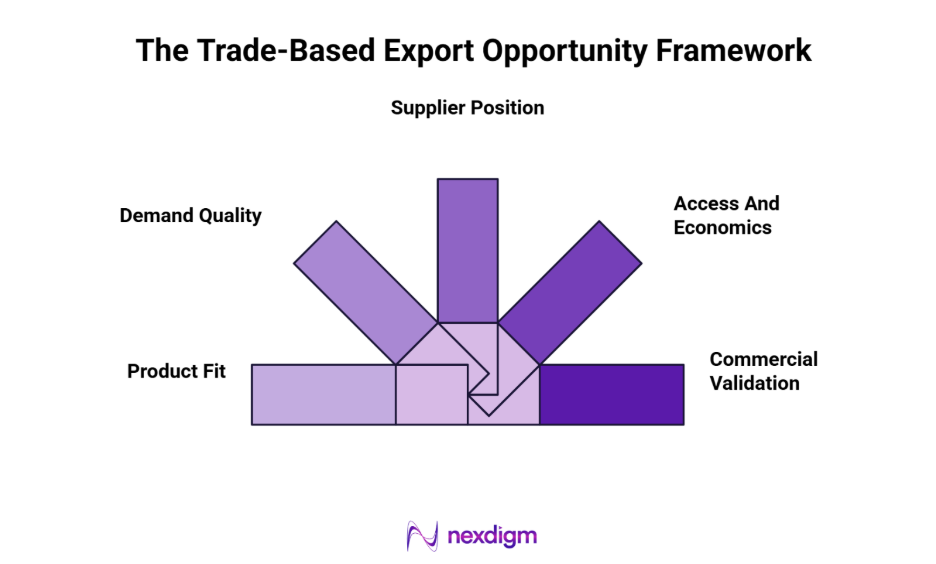
- Product Fit: Define the exact commodity, grade and processing level the business can supply, then match it to the relevant trade classifications.
- Demand Quality: Compare import value with physical quantities across several years to distinguish genuine volume growth from price movements.
- Supplier Position: Identify the main exporting countries, their market shares and any changes in concentration.
- Access And Economics: Assess tariffs, food safety rules, freight, distribution margins and the delivered price required to compete.
- Commercial Validation: Confirm buyer interest, product specifications and likely order volumes before committing to market entry.
Nexdigm’s Case Study
A packaged-food exporter reviewed 8 potential destination markets after its initial screening identified rising imports across several product categories. A closer examination of product-level trade data showed that 3 markets had import growth concentrated in formats outside the company’s current portfolio. In 2 other markets, import quantities for a closer product match had increased over the review period, and supplier concentration was comparatively lower.
Rather than spreading its sales effort across all 8 countries, the company prioritised the 2 better-fit markets for distributor discussions and a review of labelling, shelf-life and food safety requirements. The next stage was designed to establish whether the apparent demand gap could support commercially viable orders before a wider export commitment.
To take the next step, simply visit our Request a Consultation page and share your requirements with us.
Harsh Mittal
+91-8422857704