

A food producer can find dozens of countries importing its product yet still struggle to decide where to expand. One market may buy large quantities but leave little room for a new supplier. Another may have smaller imports, fewer established competitors and a better fit with the producer’s quality standards or price range. The challenge is not simply finding demand; it is working out which demand the business can realistically serve.
FAOSTAT’s detailed trade matrix provides annual import and export values and quantities for food and agricultural products, with coverage through 2024 in its December 2025 revision. The dataset supports comparisons across countries and commodities, although coverage and reporting quality still need to be checked for the markets under review
Food import export data analysis brings together import and export records, product classifications, trade quantities, unit values and supplier shares to make that decision more evidence based. Used carefully, it helps companies narrow a long list of destinations into a manageable set for commercial investigation.
Build A Reliable Picture Of Demand
The first step is to define the product accurately. Broad categories such as dairy, cereals or processed foods are rarely specific enough for a market-entry decision. Different product grades, forms and levels of processing can face different buyers, competitors, and import requirements.
Once the relevant product codes are established, import values and quantities should be reviewed together. If a country’s import bill rises while quantities remain broadly flat, higher prices or a shift towards more expensive products may explain much of the increase. If quantities rise consistently over several years, the case for stronger underlying demand becomes more credible, though it still needs to be tested against domestic production, inventory changes, and end-use patterns.
The review should also account for seasonality. Some food categories experience predictable import peaks around harvest cycles, festivals, or periods of low domestic availability. Comparing a single year with the previous year can therefore produce a misleading signal. A multi-year view, supported by monthly or quarterly data where available, gives a more useful picture of the market.
Where Supply Gaps May Be Hiding
A supply gap can take several forms. Domestic production may be insufficient to meet demand; local output may not meet the required quality or processing standard, or buyers may rely heavily on a small number of foreign suppliers. These situations create different opportunities and should not be treated as interchangeable.
For example, a market importing substantial quantities of frozen fruit may not be attractive to an exporter that only supplies fresh produce. A country buying a particular grade of edible oil may have limited relevance to a supplier whose product falls outside the buyer’s specification. Trade classification and product-level detail are essential to avoid confusing market size with product fit.
The following checks help identify which gaps warrant further work:
- Domestic Supply: Compare imports with local production and available food balance data to understand how much demand is met internally.
- Origin Concentration: Examine the leading source countries and whether buyers rely heavily on one or two origins.
- Product Mix: Identify which grades, formats or processing categories account for import growth.
- Entry Conditions: Review food safety approvals, sanitary and phytosanitary measures, labelling rules, tariffs and documentation requirements.
- Delivered Economics: Estimate freight, insurance, duties, storage and distribution costs alongside the likely selling price.
FAO food balance sheets are useful for understanding how commodities move between domestic production, imports, exports, food use, feed and other purposes. This helps analysts avoid assuming that every imported agricultural commodity is intended for direct human consumption.
From Shortlisting to Market Entry
A country ranking is a starting point, not a final recommendation. Once the data identifies promising markets, businesses need to understand how purchasing decisions are made and what it would take to become an approved supplier.
That often means speaking with importers and distributors, checking competitor prices, reviewing shipment sizes, and testing whether the product meets local requirements. For perishable products, shelf life, cold-chain access and delivery reliability may matter as much as the headline tariff. For processed foods, labelling, ingredients, packaging, and certification can determine whether a product can be sold at all.
It is also worth checking whether reported trade values are comparable. Unit values are calculated from reported trade value and quantity, but they are not necessarily market prices. Differences in quality, packaging, shipment size, currency, freight terms or product composition can make one country’s unit value look higher than another’s without indicating a straightforward price premium.
A sound market assessment therefore combines trade statistics with regulatory checks and direct commercial validation. The data narrows the search; it cannot replace buyer conversations or a realistic assessment of the cost to serve each market.
A Framework for Prioritising Export Opportunities
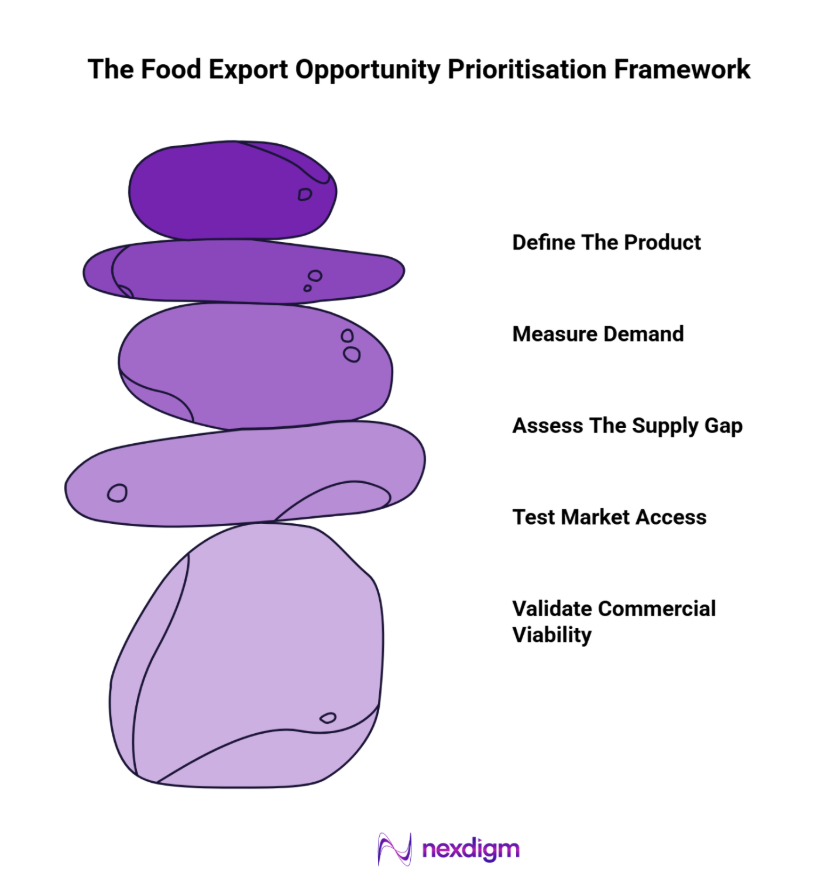
- Define The Product: Match the company’s actual specifications to the relevant customs codes and product categories.
- Measure Demand: Review import values and quantities across multiple years, accounting for seasonality and price movements.
- Assess The Supply Gap: Compare imports with domestic production, identify supplier concentration and establish whether the product is genuinely underserved.
- Test Market Access: Check tariffs, food safety rules, certification, labelling and distribution requirements.
- Validate Commercial Viability: Confirm buyer interest, competitor positioning, landed costs and achievable order volumes before committing investment.
Nexdigm Case Study
A processed-food manufacturer assessed 10 potential export markets for two product lines. Its initial review identified 5 countries with sustained import demand, but a closer assessment found that two of them had high import values largely because of product formats the company did not manufacture. The remaining shortlist was evaluated against tariffs, freight costs, distributor access, and local labelling requirements.
The company then selected 2 markets for importer discussions and sample testing, delaying a broader launch until it had clearer evidence of buyer acceptance and landed-cost competitiveness. This staged approach helped connect trade-data findings to the operational requirements of entering a new market, rather than relying on import rankings alone.
To take the next step, simply visit our Request a Consultation page and share your requirements with us.
Harsh Mittal
+91-8422857704