

Global food trade is becoming more interconnected, but import and export patterns are not changing uniformly across countries or products. FAO reports that the value of food and agricultural trade increased fivefold between 2000 and 2024, reaching around US$2 trillion. At the same time, changing production conditions, consumption requirements, climate events, and geopolitical developments continue to reshape international sourcing and destination markets.
Asia has become increasingly important in these shifts. FAO notes that the region’s agricultural trade deficit has widened as demand for food and feed has grown, while several developing regions have strengthened their export participation. Trade concentration also remains significant: the top two exporters of soybeans and palm oil accounted for around 85% of global exports in 2024.
These developments make food import export trends important for businesses seeking to understand where demand is strengthening, which origins are gaining share, where supply dependencies are emerging, and how international trade relationships are evolving.
Import Growth Is Becoming More Product-Specific
Rising food imports do not necessarily indicate broad-based market expansion. Growth may be concentrated in particular products because of changing consumer preferences, domestic production shortages, processing requirements, population growth, or sourcing diversification.
Businesses therefore need to examine product-level import values, volumes, shipment activity, and supplier participation to determine which categories are genuinely driving changes in international demand.
Export Growth Is Creating New Competitive Centres
Export capacity is also shifting as producing countries invest in agriculture, processing, logistics, and market access. New origins can become increasingly relevant when they offer competitive costs, reliable supply, quality consistency, or access to new destinations.
Tracking changes in export shares, destination coverage, product mix, and supplier participation can reveal which countries are strengthening their position within global food value chains.
Nexdigm’s Expertise in Assessing Food Trade Ecosystem
Export competitiveness in food is shaped by more than trade volumes. Nexdigm evaluates these interconnected factors to understand how changes in the food value chain influence international trade patterns by assessing the following areas:
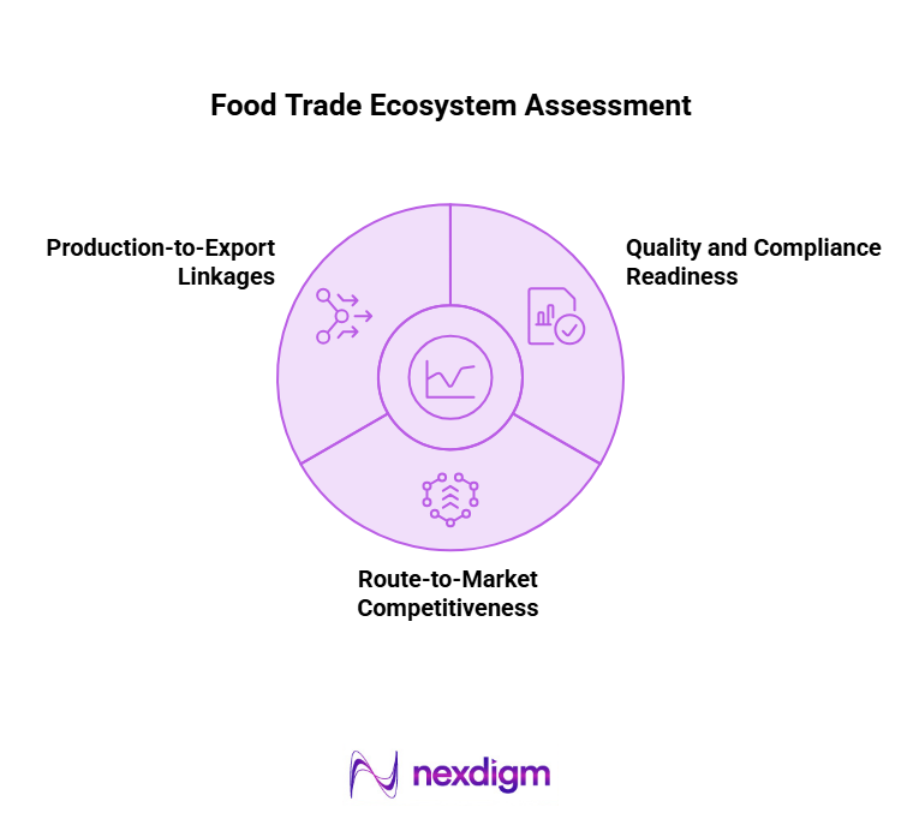
- Production-to-Export Linkages: Assessment of production clusters, procurement availability, processing capacity, and export volumes to identify whether growing trade is supported by a sustainable domestic supply base.
- Quality and Compliance Readiness: Evaluation of quality systems, traceability, certifications, food-safety requirements, and destination regulations to understand an origin’s ability to serve demanding international food markets.
- Route-to-Market Competitiveness: Examination of logistics, ports, distributors, buyers, pricing, and destination access to determine how efficiently food products can move from production centres to international customers.
By connecting upstream agricultural capabilities with downstream trade performance, Nexdigm can help businesses understand not only which countries are gaining export share, but the industry fundamentals supporting that growth.
How Nexdigm Interprets the Signals Behind Changing Food Trade Ecosystem
Changes in product mix, destination markets, supplier shares, shipment frequency, and trade values can reveal whether an exporting country is building a durable position or responding to temporary market conditions. Nexdigm can interpret food import export trends across the food value chain to identify:
- Changing Product Mix: Track which food categories are gaining export momentum and whether higher-value or processed products are becoming more important.
- Destination Expansion: Identify new countries and regions receiving greater export volumes, indicating potential shifts in market access and international demand.
- Supplier Share Movement: Monitor changes in country and company-level shares to identify emerging exporters, competitive displacement, and sourcing diversification.
- Trade Value and Volume: Compare values with physical volumes to determine whether export growth is driven by stronger demand, higher prices, or changing product composition.
- Shipment Activity: Examine shipment frequency and trade continuity to distinguish sustained commercial relationships from isolated or temporary export increases.
These signals provide a stronger basis for understanding how global food trade is changing and which shifts may have lasting implications for exporters, importers, and investors.
Nexdigm’s Approach to Identifying Opportunities from Food Trade Shifts
Identifying a changing trade pattern is only the starting point. Businesses need to determine whether that movement creates a market opportunity, sourcing advantage, or competitive risk. Nexdigm’s industry led expertise connects trade movements with commercial indicators to assess:
- Market Attractiveness: Compare demand growth, import dependence, pricing, competition, and accessibility to identify destinations with stronger commercial potential.
- Supplier Opportunity: Identify markets where buyers are diversifying sourcing or where supplier concentration creates room for alternative origins.
- Product-Market Fit: Match specific food products with destination demand, price realization, regulatory requirements, and competitive conditions.
- Commercial Feasibility: Assess logistics, distribution, market access, supply readiness, and route-to-market economics before prioritizing an opportunity.
This helps businesses move from simply observing food import-export trends to identifying the specific products, markets, and trade relationships that could support future growth.
Nexdigm’s Case
Nexdigm supported an agribusiness client in evaluating product categories across 12 export markets, combining trade flows, supplier movements, pricing, and demand indicators. The analysis identified 7 high-growth product-market combinations and 11 emerging supplier opportunities, helping the client redirect its export strategy. Within targeted markets, qualified leads increased 24%, while market-development costs declined 15%.
To take the next step, simply visit our Request a Consultation page and share your requirements with us.
Harsh Mittal
+91-8422857704