
Global food and agricultural trade has expanded rapidly, but the growing volume of transactions also makes market interpretation more complex. Recent study reports that food and agricultural trade increased fivefold between 2000 and 2024, reaching around US$2 trillion. The organization also highlights growing exposure to extreme weather, conflicts, macroeconomic pressures, and other disruptions.
Recent WTO data also shows that world trade in food increased by approximately 7% in value terms during January–November 2025, following 3% growth in 2024.
For businesses, however, trade growth alone does not answer the most important questions. This is where food trade intelligence becomes valuable, connecting trade movements with market conditions, competitive dynamics, supply capabilities, pricing, and commercial feasibility.
Assessing Trade Data to Gather Valuable Insights
Import and export records provide evidence of what moved between markets, but they do not automatically explain why those movements occurred.
A rise in imports could reflect stronger consumption, domestic supply shortages, inventory rebuilding, processing demand, or temporary supply disruption. Similarly, export growth may result from additional capacity, competitive pricing, new market access, or changes in global sourcing.
Businesses therefore need to interpret trade data alongside industry, company, market, and supply-chain intelligence.
Understanding Demand Shifts that Create New Market Windows
Evolving consumption patterns, import requirements, and buyer activity can create new opportunities across food products and markets. Identifying these shifts early helps businesses target:
- Emerging Demand Identification: Analyzes import growth, shipment activity, and buyer participation to uncover markets experiencing rising demand for specific products.
- Market Opportunity Evaluation: Compares supplier presence, pricing dynamics, and market accessibility to identify commercially attractive opportunities with sustainable growth potential.
By evaluating demand shifts alongside market fundamentals, businesses can identify new market windows and prioritize opportunities with greater confidence.
How Nexdigm Helps Assess Demand Shifts Across Food Value Chain
Recognizing demand shifts is only the first step. Businesses must assess whether emerging market signals translate into sustainable and commercially viable opportunities. Nexdigm combines trade intelligence and competitive insights to help organizations identify, validate, and prioritize high-potential opportunities through:
- Demand Signal Analysis: Evaluation of import growth, buyer activity, shipment trendsand consumption patterns to identify emerging opportunities before they become mainstream.
- Opportunity Validation: Assessment of supplier participation, pricing dynamics, competitive intensity, and market accessibility to determine the commercial attractiveness of identified opportunities.
By combining insights from Food Trade Intelligence, Nexdigm helps businesses transform demand shifts into actionable growth opportunities and informed market decisions.
The Growing Demand for Food Trade Intelligence
As global food markets become increasingly interconnected, businesses require deeper visibility into evolving demand patterns, supplier dynamics, pricing movements, and trade flows. Food trade intelligence helps organizations move beyond historical trade data by identifying emerging opportunities, assessing competitive developments, and understanding market risks. These insights support informed decisions across market expansion, sourcing, investment, and supply chain planning, enabling businesses to respond proactively to changing market conditions and pursue sustainable growth opportunities with greater confidence.
Nexdigm’s Food Trade Intelligence Assessment
Identifying opportunities in global food markets requires a structured understanding of demand, supply dynamics, competition, and market accessibility. Nexdigm combines trade intelligence with commercial and market analysis to help businesses uncover growth opportunities through:
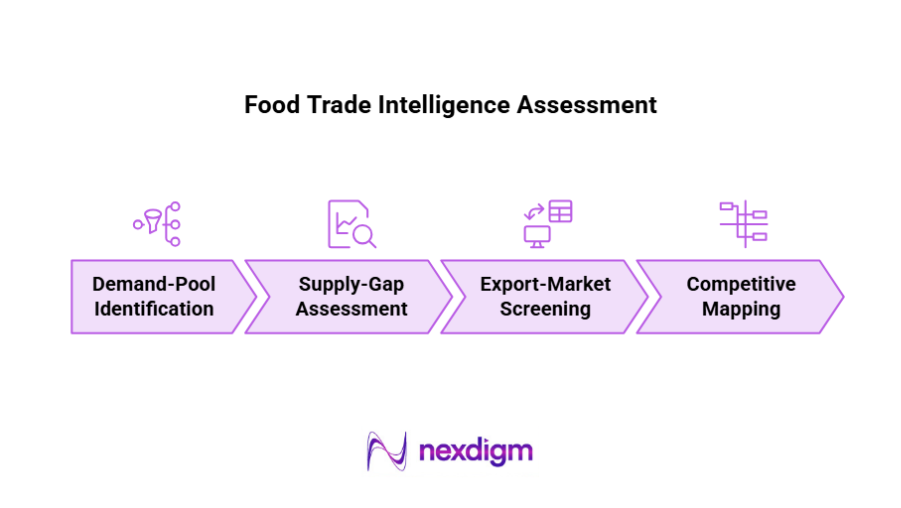
- Demand-Pool Identification: Nexdigm analyses product-level imports, volumes, values, and growth to identify markets where demand is expanding and warrants deeper commercial investigation.
- Supply-Gap Assessment: Comparing import dependence, supplier participation, sourcing concentration, and domestic supply indicators to identify potential gaps between demand and available supply.
- Export-Market Screening: Nexdigm evaluates destination markets based on import growth, pricing, supplier competition, market access, and buyer participation.
- Competitive Mapping: Tracking country and company-level supplier shares to identify established competitors, emerging exporters, and changing competitive positions.
By evaluating markets through multiple interconnected dimensions, Nexdigm’s intelligence services help businesses move beyond trade data interpretation and identify commercially viable opportunities supported by market realities and competitive insights.
How Nexdigm’s Food Trade Assessment Offers Competitive Advantage
In increasingly competitive food markets, success depends on identifying opportunities faster, evaluating risks more effectively, and making decisions with greater confidence. Nexdigm’s Food Trade Intelligence Assessment helps businesses with:
- Earlier Opportunity Identification: Detect emerging demand pools, supply gaps, and attractive export markets before they become widely recognized.
- Stronger Market Positioning: Understand competitive intensity, supplier shares, and buyer dynamics to identify areas for differentiation.
- Improved Decision Confidence: Support expansion, sourcing, and investment decisions through a structured evaluation of market fundamentals.
- Enhanced Strategic Agility: Monitor changing trade patterns, competitive movements, and market developments to respond proactively to emerging opportunities and risks.
With these advantages, businesses can strengthen their competitive positioning, identify high-potential opportunities, and make strategic decisions that support sustainable growth in evolving global food markets.
Nexdigm’s Case
Nexdigm supported an Indian food exporter evaluating expansion into European markets. The assessment helped develop a structured farm-to-export traceability approach covering 4,500 contracted hectares. Following implementation, product rejections fell to zero over two seasons, realized prices increased by 14%, and average clearance time declined from 21 days to four days.
To take the next step, simply visit our Request a Consultation page and share your requirements with us.
Harsh Mittal
+91-8422857704