

Food demand is becoming increasingly complex for logistics networks. Growing consumption, urbanization, organized retail, food processing, e-commerce grocery, and changing consumer preferences are increasing requirements across storage, transportation, fulfillment, and distribution.
The scale of the challenge is significant. FAO estimates that 13.3% of food was lost globally after harvest and before retail in 2023. Fruits and vegetables recorded an even higher loss rate of 25.4%, reflecting their greater perishability and handling requirements.
Cold-chain infrastructure represents another major opportunity. FAO reports that 526 million tonnes of food are lost or wasted because of insufficient refrigeration, while cold-chain technologies could potentially prevent 144 million tonnes of food waste annually in developing countries.
These figures demonstrate that food logistics is not simply about moving more products. It is about matching product characteristics, demand patterns, storage conditions, transportation requirements, and infrastructure capacity.
For food producers, processors, retailers, wholesalers, distributors, 3PL providers, warehouse operators, investors, developers, and logistics technology companies, a Food logistics market demand assessment can reveal where capacity is growing, where shortages may emerge, and what type of logistics infrastructure is required.
Food Logistics Is Becoming More Segmented
Food products do not place identical demands on logistics networks. Ambient products such as grains, packaged foods, canned goods, and dry ingredients generally require conventional warehousing and transportation.
Chilled products such as dairy, fresh produce, meat, seafood, and selected prepared foods require tighter temperature control and faster movement.
Frozen products require continuous low-temperature conditions, specialized storage equipment, and dependable refrigerated transportation.
As food markets become more diversified, logistics networks need to manage these requirements separately rather than treating food capacity as one category.
Nexdigm in Reading the Demand Behind the Volume
Food demand alone does not determine infrastructure requirements. A growing market may need more ambient warehouses, additional chilled capacity, frozen storage, refrigerated vehicles, regional distribution centers, or last-mile facilities depending on its product mix.
Nexdigm connects consumption patterns, production locations, product categories, temperature requirements, trade flows, infrastructure availability, and geographic demand to understand what capacity is actually needed.
This helps decision-makers distinguish between simple volume growth and genuine infrastructure opportunity.
Where Food Logistics Pressure Is Building
Several changes are influencing food logistics requirements. Nexdigm analyzes major factors affecting the requirements, such as:
- Urbanization: Larger urban populations concentrate food consumption and increase demand for strategically positioned distribution facilities.
- Fresh-food consumption: Greater demand for fresh products increases requirements for chilled storage, rapid transportation, and reliable temperature management.
- Frozen-food adoption: Expanding frozen categories create demand for freezer capacity, refrigerated transportation, and specialized distribution networks.
- Online grocery: Digital food purchasing increases the need for localized fulfillment, inventory visibility, and temperature-controlled last-mile delivery.
Nexdigm’s Approach to Food Logistics Demand Assessment
Understanding food logistics demand requires more than analyzing consumption growth. Nexdigm evaluates how product characteristics, infrastructure availability, and distribution requirements interact to determine the logistics capacity needed to support evolving food supply chains by focusing on the following dimensions:
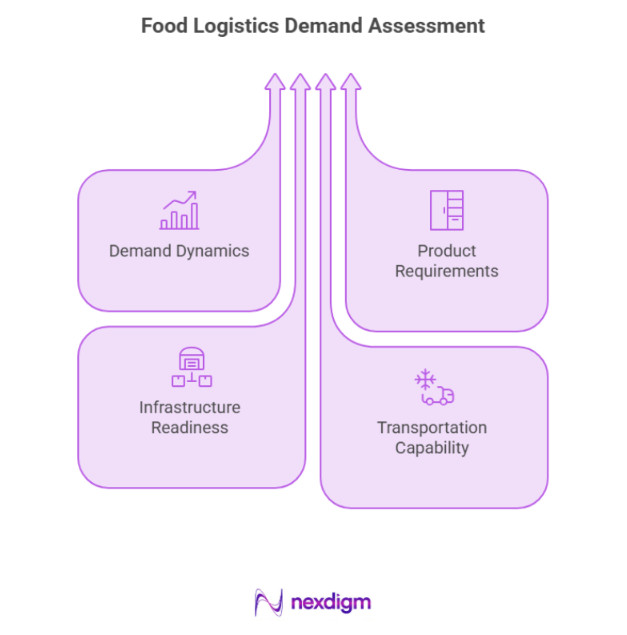
- Demand Dynamics: Assesses consumption trends, population growth, retail expansion, and seasonal variations to understand where food logistics demand is increasing and how markets re evolving.
- Product Requirements: Evaluates the logistics needs of ambient, chilled, and frozen food categories to determine the storage, handling, and transportation capabilities required.
- Infrastructure Readiness: Reviews warehousing capacity, temperature-controlled facilities, and distribution networks to identify infrastructure strengths, limitations, and potential capacity gaps.
- Transportation Capability: Assesses the availability and efficiency of transportation assets, connectivity, and refrigerated logistics solutions required to ensure reliable product movement.
By combining these dimensions into a structured assessment approach, Nexdigm helps organizations identify logistics requirements, prioritize infrastructure investments, and align supply chain capabilities with changing food market demand.
Nexdigm’s Food Logistics Demand Framework
Nexdigm conducts Food logistics market demand assessment through its framework model. This focuses on several major areas which help organizations understand where food logistics demand is developing. This is done through:
- Demand Assessment: Assessment of food consumption trends, population growth, retail expansion, and seasonal demand fluctuations to identify markets where food logistics requirements are expected to increase.
- Product Type Assessment: Evaluation of the logistics requirements of different food categories, including ambient, chilled, and frozen products. The assessment helps determine the storage, transportation, and handling capabilities needed to support diverse product portfolios.
- Storage Infrastructure Assessment: Reviewing warehouse capacity, temperature-controlled requirements, facility location, and storage specialization to evaluate whether existing infrastructure can support current and future food logistics demand.
- Transportation Assessment: Assessment of refrigerated transportation availability, route complexity, connectivity, and distribution efficiency. The evaluation helps determine the effectiveness of food movement across the supply chain.
- Market Capacity Assessment: Analysis of infrastructure availability against projected demand to identify capacity gaps, emerging growth corridors, and future logistics requirements across key markets.
Nexdigm’s Case
A food distributor took Nexdigm’s assistance to optimize ambient, chilled, and frozen capacity. Within 12 months, warehouse utilization increased 23%, spoilage declined 18%, delivery efficiency improved 21%, and logistics costs fell 15%, strengthening supply reliability and supporting profitable regional expansion.
To take the next step, simply visit our Request a Consultation page and share your requirements with us.
Harsh Mittal
+91-8422857704