

Food safety vendors perform different jobs. Laboratories test ingredients and finished products; audit providers assess systems and facilities; pest-management companies control infestation risks; and specialist firms support hygiene monitoring, traceability, or training. Selecting a provider based on a general service list or the lowest fee can leave technical gaps that only become visible during an audit, product complaint, or regulatory incident.
Vendor identification should begin with the risk and operating requirement, then evaluate capability, accreditation, cost, and geographic coverage separately.
Why Vendor Selection Has Commercial Consequences
The World Health Organization estimates that 600 million people fall ill after eating contaminated food each year, with 420,000 deaths annually. Children under five account for 40% of the foodborne disease burden, including approximately 125,000 deaths each year.
These figures demonstrate the scale of the public-health problem. For food businesses, the operational implications include product recalls, rejected consignments, interrupted production, regulatory action, reputational damage, and potential loss of market access. Vendor selection is therefore a risk-control decision, not simply a service-procurement exercise.
Capability: Does the Vendor Perform the Required Work?
The vendor’s technical scope must match the food category and operating environment. A dairy plant, frozen-food processor, bakery, restaurant chain, and ambient warehouse have different testing, hygiene, and audit requirements.
Assess:
- Relevant product and facility experience.
- Availability of required tests, methods, audits, or specialist services.
- Staff qualifications and equipment capability.
- Sample collection, transport, and chain-of-custody procedures.
- Reporting quality, corrective action support, and response during incidents.
A broad service catalogue is not evidence that every required test or service is available at the necessary location.
Accreditation: Verify the Actual Scope
In India, the Food Safety and Standards Authority of India recognises and notifies laboratories for food analysis under Section 43 of the Food Safety and Standards Act, 2006. FSSAI’s published laboratory lists distinguish primary food laboratories, referral laboratories, and other designated facilities.
Buyers should verify a laboratory’s current status and the specific tests covered by its accreditation or notification. Accreditation for one method does not establish that every method the laboratory offers falls within its accredited scope. The required regulatory acceptance should also be checked for the intended use of the test result.
Cost: Compare the Complete Service
A low testing fee can be offset by sample transport, repeat testing, expedited reporting, travel, or the need to send specialised samples elsewhere. For audit and pest-management services, the comparison should account for site count, visit frequency, reporting requirements, corrective-action follow-up, and emergency coverage.
For food safety vendor identification, commercial benchmarking should use a common service specification so that bids are comparable. Cost should be evaluated alongside turnaround time, accuracy controls, geographic coverage, and incident response.
Coverage: Can the Vendor Support the Operating Network?
A provider may be suitable for one manufacturing site but unable to support a multi-state restaurant or distribution network. Assess laboratory locations, field-team availability, sample pickup, service windows, regional response times, and backup capacity.
Digital reporting can improve visibility across sites, but buyers should also check data access, record retention, traceability, and the ability to retrieve reports during inspections or investigations.
Food Safety Vendor Evaluation Framework
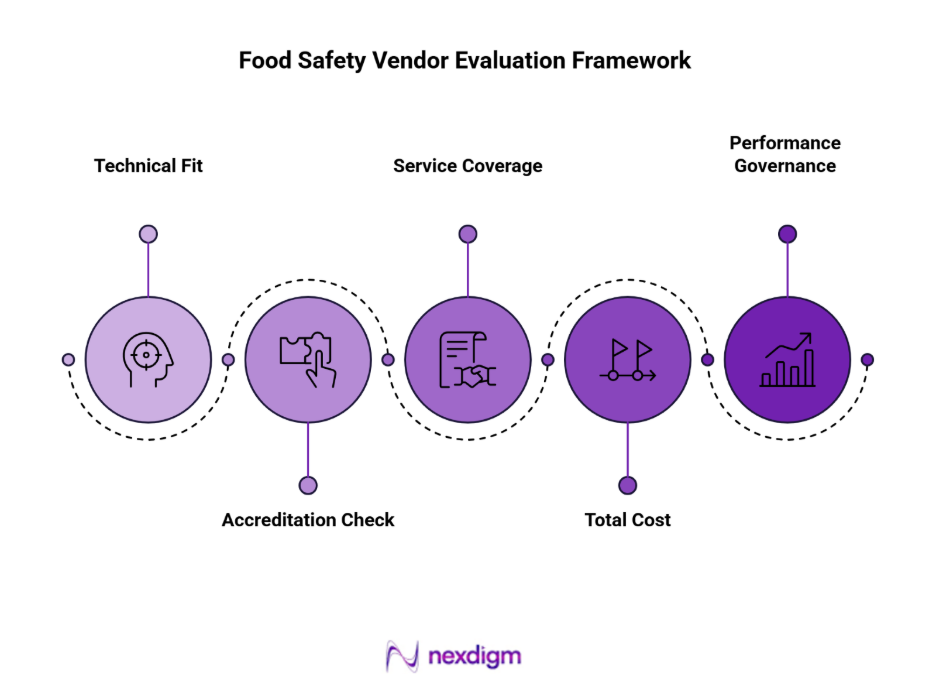
- Technical Fit: Match services, methods, personnel, and experience to the product category and facility risks.
- Accreditation Check: Verify current recognition, accredited scope, test methods, and regulatory acceptance for the intended use.
- Service Coverage: Map locations, collection networks, site capacity, turnaround commitments, and emergency response.
- Total Cost: Compare fees, travel, logistics, repeat testing, reporting, contract minimums, and additional charges.
- Performance Governance: Set service levels, report formats, escalation rules, corrective action timelines, and periodic reviews.
Outlook: Traceability Is Becoming Essential
Longer supply chains and multi-site operations increase the need for consistent records from sampling through final reporting. Buyers should favour vendors that can produce traceable results, support investigations, and maintain consistent service across locations. Technology helps, but it cannot replace valid methods, competent personnel, or verified accreditation.
Nexdigm’s Case Study
In a representative food safety vendor review, services across 14 facilities were mapped against testing requirements, accreditation scope, turnaround commitments, and total fees. The assessment identified overlapping contracts and inconsistent coverage. Consolidation of compatible services and clearer service-level requirements created a basis for cost control and more consistent reporting.
To take the next step, simply visit our Request a Consultation page and share your requirements with us.
Harsh Mittal
+91-8422857704