

The food industry faces significant volatility, with supply chain fluctuations due to seasonal demand shifts, transportation disruptions, and price variability. To navigate these challenges, companies are increasingly relying on food supply chain intelligence, which leverages real-time data, predictive analytics, and performance benchmarking.
Applying competitive intelligence allows businesses to monitor rivals’ sourcing strategies, optimize inventory management, anticipate market changes, and implement proactive distribution solutions, ultimately enhancing operational efficiency, reducing waste, and maintaining a reliable supply of products in an unpredictable market environment.
In recent years, research shows that price deviations of more than 10 – 15 % in agricultural and food products are widely perceived as significant volatility within food supply chains, affecting farmers, wholesalers, and processors. This highlights the scale of instability companies must manage. Meanwhile, the global food supply chain market is projected to grow by approximately USD 59.5 billion from 2025 to 2028, at around 7.9 % CAGR, as firms adopt blockchain, AI, and other technologies to improve resilience and intelligence.
Competitive Intelligence Identification in Technology Adoption and Digital Transformation in Food Supply Chains
Competitive Intelligence, Technology Adoption, and Digital Transformation in Food Supply Chains involves leveraging advanced analytics, IoT, and AI to monitor rivals, optimize operations, reduce volatility, and enhance efficiency and decision-making:
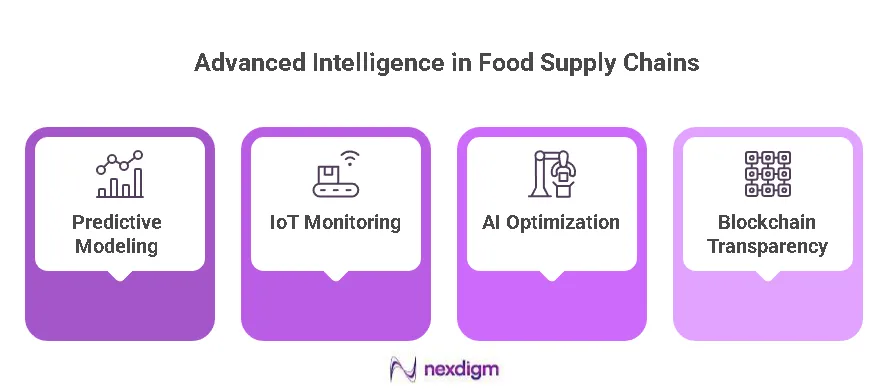
- Advanced Analytics and Predictive Modeling – Use data-driven insights to forecast demand, identify disruptions, and optimize inventory and supply chain performance.
- IoT and Real-Time Monitoring – Deploy sensors and tracking devices to monitor food quality, storage conditions, and logistics operations continuously.
- AI-Powered Route and Inventory Optimization – Apply artificial intelligence to enhance delivery efficiency, reduce waste, and manage fluctuating demand effectively.
- Blockchain for Transparency and Traceability – Implement blockchain solutions to improve product traceability, ensure compliance, and strengthen supplier and partner accountability.
Nexdigm Continuous Improvement and Data-Driven Insights for Food Supply Chains
Nexdigm Continuous Improvement and Data-Driven Insights for Food Supply Chains helps companies enhance resilience and efficiency by leveraging real-time analytics, performance metrics, and benchmarking. Through monitoring inventory, delivery routes, and supplier performance, Nexdigm identifies bottlenecks, reduces waste, and anticipates disruptions. These insights enable proactive decision-making, operational optimization, and sustained competitive advantage in volatile food supply chain environments.
Nexdigm’s Strategies for Food Supply Chain Strategy and Risk Mitigation
Nexdigm Advisory for Food Supply Chain Strategy and Risk Mitigation guides businesses in managing volatility, optimizing logistics operations, anticipating disruptions, and implementing proactive strategies to ensure resilient, efficient, and cost-effective food supply chains.
- Volatility Assessment and Risk Analysis – Identify supply chain vulnerabilities, demand fluctuations, and potential disruptions to implement proactive mitigation strategies.
- Strategic Network Design – Optimize warehouse locations, transport routes, and inventory distribution to enhance efficiency and resilience in volatile food supply chains.
- Supplier and Partner Evaluation – Assess third-party vendors and collaborators for reliability, compliance, and risk exposure in supply chain operations.
- Contingency and Crisis Planning – Develop response plans, backup strategies, and emergency protocols to minimize impact of supply chain disruptions.
- Performance Benchmarking and Monitoring – Establish KPIs and track operational metrics to identify gaps, inefficiencies, and opportunities for continuous improvement.
Nexdigm’s case:
Nexdigm worked with a U.S. consumer healthcare company facing high import costs, sea freight delays, and supply disruptions. By transitioning to local distributors and redesigning inventory strategy, the client avoided approximately USD 0.56 million in air freight costs, protected USD 192 million in net trade sales (NTS), and created 30 days of safety stock to improve operational resilience and responsiveness under volatile supply conditions.
To take the next step, simply visit our Request a Consultation page and share your requirements with us.
Harsh Mittal
+91-8422857704