

Food logistics networks are expanding as demand rises for fresh and processed products across urban, regional, and cross-border markets. As part of a market entry strategy, strong food logistics capabilities help businesses manage storage, transportation, inventory flow, quality control, and timely distribution from the start.
A well-planned Food supply chain logistics expansion strategy supports reliable movement of perishable and packaged goods while reducing spoilage, delays, and service gaps. By strengthening cold storage, route planning, warehouse networks, and last-mile delivery, businesses can improve product availability, meet consumer expectations, and scale food distribution efficiently across new and growing markets.
The need for a Food supply chain logistics expansion strategy is supported by steady market growth. The global food logistics market reached USD 130.0 billion in 2025 and is projected to reach USD 227.0 billion by 2034, growing at a CAGR of 6.39%. The food cold chain logistics market is also projected to grow from USD 326.69 billion in 2025 to USD 677.27 billion by 2031, highlighting rising demand for reliable food distribution.
Building Reliable Food Distribution Networks for Market Entry
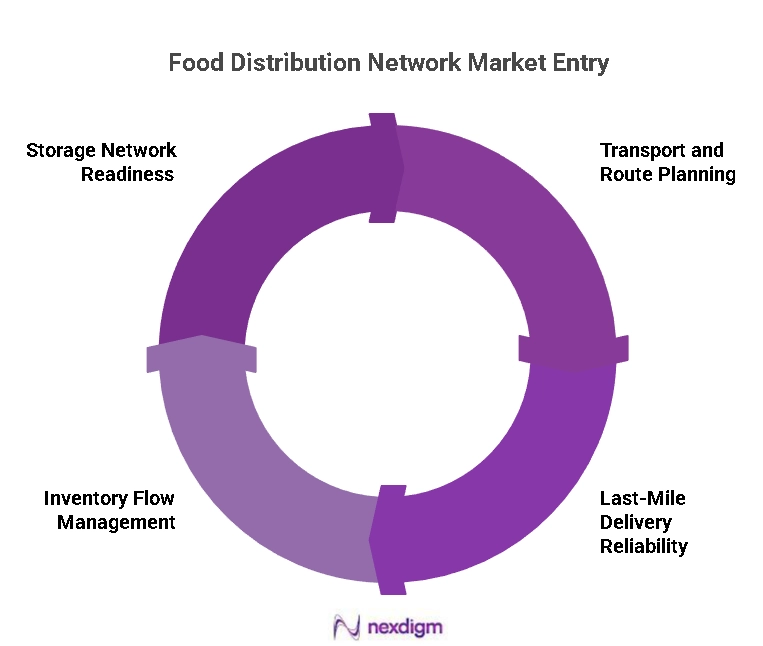
Building reliable food distribution networks supports market entry by ensuring timely storage, transport, cold chain handling, inventory flow, and last-mile delivery for fresh and processed products:
-
Storage Network Readiness
Assesses warehouse capacity, cold storage availability, hygiene standards, and inventory systems needed for food distribution.
-
Transport and Route Planning
Reviews delivery routes, vehicle capability, transit times, and cost efficiency for fresh and processed food movement.
-
Inventory Flow Management
Tracks stock movement, replenishment cycles, expiry dates, and demand patterns to reduce wastage and shortages.
-
Last-Mile Delivery Reliability
Evaluates delivery timelines, service coverage, packaging quality, and partner capability to improve customer reach.
Nexdigm Food Logistics Advisory for Market Entry Strategy
Nexdigm can advise businesses on food logistics market entry by assessing demand patterns, storage needs, cold chain readiness, transport networks, compliance requirements, partner capabilities, and cost structures. This helps build reliable food distribution models for fresh and processed products while reducing spoilage, delays, and operational risks.
Nexdigm Quality and Hygiene Framework for Food Supply Chain Performance
Nexdigm can define hygiene standards, quality checks, handling controls, storage protocols, compliance records, and performance monitoring to protect food safety and improve supply chain reliability.
-
Hygiene Standard Definition
Defines cleanliness, sanitation, pest control, and handling standards required across food storage, transport, and distribution operations.
-
Quality Inspection Controls
Establishes inspection checks for packaging, expiry dates, temperature conditions, product damage, and storage compliance.
-
Food Handling Protocols
Sets procedures for loading, unloading, segregation, labelling, and movement of fresh and processed food products.
-
Compliance Documentation
Maintains hygiene records, quality reports, audit trails, and regulatory documents to support food logistics compliance.
Nexdigm’s case:
Nexdigm helped a food products company design a quality and hygiene framework for supply chain performance across five distribution locations. By defining hygiene standards, inspection controls, handling protocols, compliance documentation, and performance monitoring, Nexdigm helped the company reduce spoilage incidents by 28%, improve quality compliance scores by 35%, cut customer complaints by 22%, and strengthen food logistics reliability during market expansion.
To take the next step, simply visit our Request a Consultation page and share your requirements with us.
Harsh Mittal
+91-8422857704