

A food supply chain can look efficient under normal conditions and still be highly vulnerable to disruption. A production region suffers a weather event, a highway closes, a cold-chain vehicle is delayed, or an urban distribution hub runs short of inventory, and the weakness becomes visible almost immediately.
India’s food system faces this challenge because production is geographically concentrated while consumption is increasingly urban, fast-moving, and dependent on compressed replenishment cycles. Resilience therefore requires more than securing agricultural output. It requires understanding how much disruption each stage of the network can absorb before supply becomes commercially unavailable.
Resilience Starts Where Production Is Concentrated
Several major food categories depend heavily on particular production belts. More than 40% of commercial onion production is concentrated in the Nashik-Ahmednagar-Pune belt, while more than 70% of commercial apple production comes from Jammu & Kashmir and Himachal Pradesh.
Wheat and rice production are similarly concentrated across the Indo-Gangetic Plain. These concentrations create efficiency through specialised production and established procurement infrastructure, but they also create exposure to localised climate events, road disruption, and seasonal supply shocks.
Post-harvest losses amplify that exposure. The supplied research places structural losses at 4.6% to 6% for food grains, 5.3% to 10% for oilseeds, and 12% to 18% for fruits and vegetables.
A resilient system therefore needs to protect not only production, but the volume that survives between harvest and consumption.
A Supply Shock Does Not Need to Be National to Become Commercially Serious
The downstream network can magnify relatively local disruptions.
Quick-commerce distribution provides a clear example. Fresh-food dark stores can operate with less than 24 hours of inventory, relying on replenishment cycles of three to six hours. A transport bottleneck lasting only 12 hours can therefore create stock-outs across urban fulfilment networks.
Cold-chain availability creates another constraint. Less than 3% of India’s fruit and vegetable output is estimated to move through active cold-chain transit, leaving substantial fresh produce exposed to ambient temperatures during transportation.
The result is a mismatch between how quickly consumers expect food to arrive and how much redundancy exists behind the scenes.
What Happens When One Part of the Network Fails?
Resilience can be tested through several disruption scenarios:
- A production region experiences excessive rainfall or heat.
- A highway or rail corridor becomes unavailable.
- A major supplier cannot fulfil contracted volumes.
- Cold-chain capacity becomes unavailable during a harvest peak.
- Fuel costs increase sharply.
- An urban fulfilment centre loses access to its primary procurement route.
The important measure is not whether the network experiences disruption. Disruptions are inevitable. The relevant question is how long the network can continue operating, how much additional cost it incurs, and how quickly alternative supply can be activated.
From Efficient Networks to Resilient Networks
A food supply chain market assessment can help companies move from identifying individual risks to understanding the resilience of the entire network. Nexdigm can assess sourcing concentration, production geography, storage buffers, logistics alternatives, processing dependencies, cold-chain capacity, and urban distribution requirements.
The analysis can identify where a second supplier, alternative route, regional storage facility, or secondary procurement hub creates enough resilience to justify its cost.
This is particularly relevant for food processors, FMCG companies, modern retailers, and businesses operating time-sensitive fresh-food networks.
Nexdigm’s Resilience Stress-Test Framework
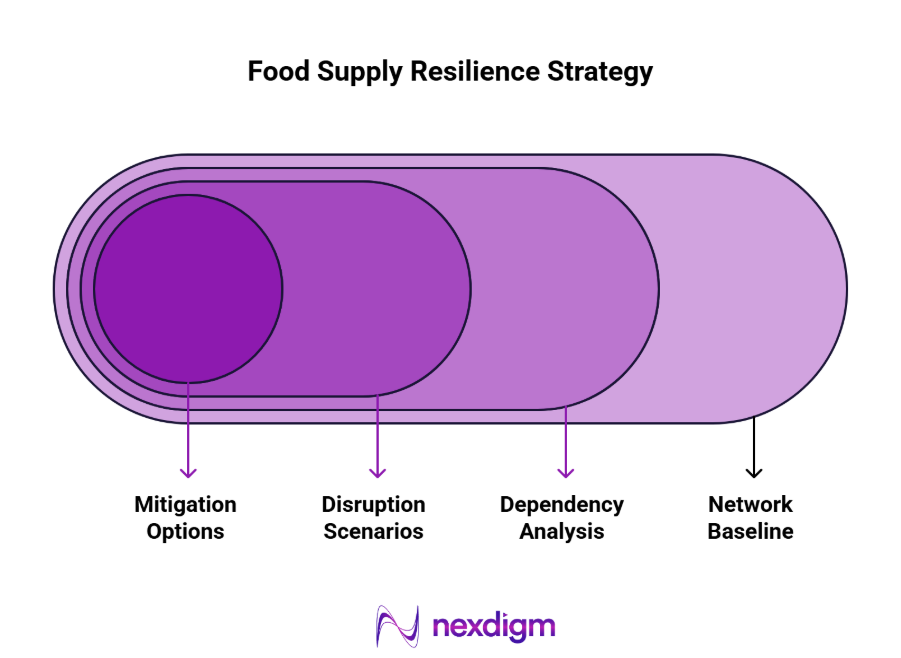
- Network Baseline Map production regions, suppliers, processing facilities, storage, transport corridors, distribution centres, and consumption markets. Evaluate each node’s supply contribution and failure impact.
- Dependency Analysis Identify supplier/geographic concentration, single transport routes, limited cold storage, and specialised assets to locate single points of failure.
- Disruption Scenarios Model weather events, route closures, fuel‑price hikes, supplier failures, and infrastructure shutdowns. Estimate lost volume, added logistics costs, inventory depletion, and service‑level deterioration.
- Mitigation Options Compare alternative sourcing, safety stocks, decentralised procurement, secondary routes, contract structures, and storage buffers against implementation costs.
Final output will be a resilience architecture that separates risks absorbable operationally from those requiring structural network changes.
Nexdigm Case Study: Strengthening Perishable Supply Networks
Nexdigm’s Cold Chain Distribution & Supply Resilience Benchmarking Practice has evaluated logistics networks, temperature-control performance, and multi-node routing. The resulting network redesign generated a reported 17% reduction in perishable spoilage and a 22% improvement in on-time delivery reliability across regional fulfilment lanes.
The case illustrates the commercial value of resilience planning. The objective is not to build unlimited inventory or duplicate every asset. It is to identify the few dependencies where additional flexibility materially reduces the consequences of disruption.
To take the next step, simply visit our Request a Consultation page and share your requirements with us.
Harsh Mittal
+91-8422857704